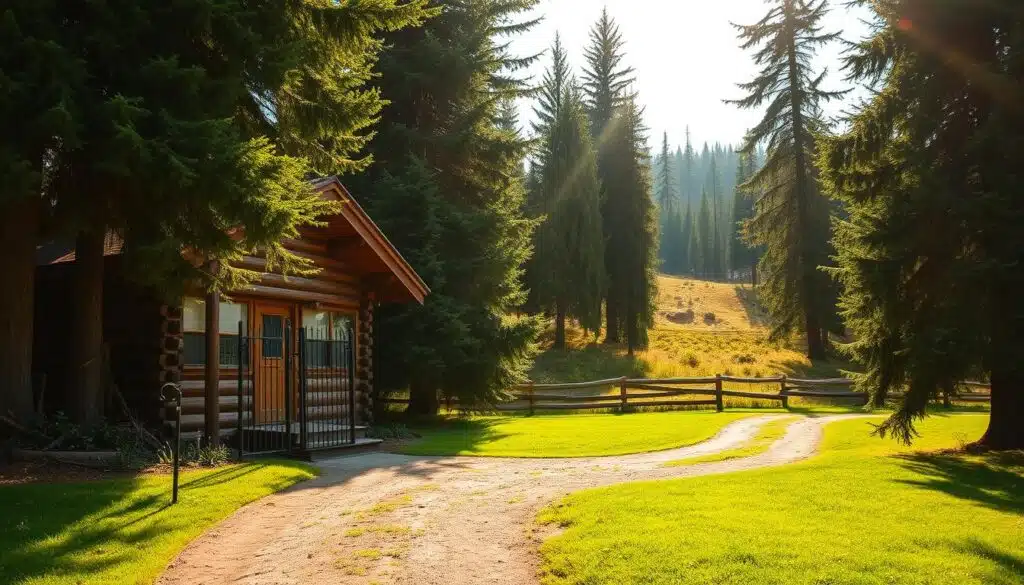
Home insurance for log cabins in rural areas is available, but it costs more and is written by fewer companies than insurance on an ordinary suburban house. Two things drive that: the specialized log construction, which is expensive and slow to rebuild, and the rural location, where your distance from a fire department sets much of the price. Big national carriers like State Farm, USAA, Allstate, and American Family do insure log homes, though not in every state, alongside specialty log-home insurers. The key moves are to insure the cabin for full replacement cost rather than actual cash value, and to reduce your fire risk, since wildfire is making remote cabins harder to cover.
Log Cabin Insurance in Rural Areas: Key Facts at a Glance
| Factor | What it means for you |
|---|---|
| Insurable? | Yes, but by fewer carriers |
| Cost vs a frame home | Generally higher |
| Biggest price driver | Distance to a fire department |
| Fire protection class | ISO Class 1 to 10, higher is worse |
| Coverage to insist on | Replacement cost, not ACV |
| Two standard exclusions | Flood and earthquake |
| Rising rural threat | Wildfire non-renewals |
| If it’s a second home | You must disclose occupancy |
A log cabin in the woods is a dream that comes with an insurance headache. The same features that make it special, custom timber and a remote setting, are exactly what make insurers cautious. The good news is that these homes are insurable. Understanding the two forces at work, construction and location, lets you find coverage and keep the price sane. This guide walks through both, names the companies that write log homes, and covers the coverage traps unique to rural cabins.

Are Log Cabins Hard to Insure? Why Carriers Hesitate
Yes, harder than a standard house. Not impossible, though, and the gap is smaller than most owners fear.
Fewer carriers write log homes, and the ones that do underwrite them carefully. That leaves you a smaller pool of options and often a higher price. Two things drive the caution. Log and timber homes use expensive, specialized materials that cost more to rebuild than standard framing, and an all-wood structure carries a higher fire risk. On top of that, cabins tend to sit in remote, wooded places that are hard for fire crews to reach.
Neither factor makes a cabin uninsurable. As one log-home agency puts it, unless the cabin is in disrepair, a knowledgeable carrier will almost always insure it.
The real obstacle is usually expertise, not risk. Find an agent who knows log homes and the problem often shrinks.
Fire Protection Class: Why Distance to the Fire Department Sets Your Price
If one thing decides your premium, it’s this.
Insurers assign every property an ISO Public Protection Class from 1 to 10, based largely on how well the fire department and water supply can protect it. A class of 6 or lower usually means a town or suburb with staffed fire service and hydrants. A 7 or higher signals a rural setting. A 10 typically means the home sits more than five to seven miles from a responding fire department.
The higher the class, the higher the premium. Beyond about seven miles from a fire station, coverage gets genuinely hard to place at any price. Distance to a hydrant or reliable water source counts too, since a tanker shuttle is slower than a hydrant.
This is why two identical cabins can carry very different premiums. The one closer to a staffed fire department and a water source wins.

Log Home Insurance Companies: Who Actually Writes These Policies
Plenty of well-known insurers write log and timber homes. Not in every state, though, so it pays to shop.
Among the national carriers: State Farm, USAA for military families, Allstate, American Family, Farmers, Nationwide, and Chubb. GEICO can place them through partners. Beyond the nationals sit specialty log-home insurers like Foremost and American Modern, plus dedicated log-home programs, and they often understand the niche best. Some write only kit homes, others only custom builds, and a few do both.
There’s no single best company here. Availability depends on your state, your cabin, and its exact location.
If a mainstream insurer declines you, don’t assume you’re uninsurable. That’s your cue to call an independent agent who represents log-home carriers. Compare quotes on coverage and price, not brand name.
Log Home Insurance Cost: What Rural Cabin Owners Really Pay
Expect to pay more than for a comparable frame house. There’s no honest single average, though, because location and construction swing the number so much.
The real drivers are your fire protection class, the cabin’s rebuild cost, the roof and log type, and wildfire exposure.
Two real examples show the spread. One agency reported insuring a $580,000 log home with a $1,000 deductible in a Protection Class 9 area for about $1,580 a year, which is a reasonably protected rural cabin. In high-wildfire country the picture turns grim, and a rural homeowner in Idaho said the only quote available was Travelers at roughly $6,000 a year, after other insurers pulled out of the area.
Your number lands somewhere on that spectrum, driven mostly by fire risk and distance to help. Location, not the log walls alone, usually decides whether the premium is reasonable or painful.
Replacement Cost vs Actual Cash Value on Custom Timber
This is the coverage decision that matters most, and getting it wrong is expensive.
Always insure a log home on a replacement-cost basis, ideally guaranteed or extended replacement cost. Never actual cash value.
Here’s the trap. Actual cash value pays the depreciated worth of your home, so an older cabin’s logs might be valued at a fraction of what new timber costs. That leaves a gap between the payout and the real rebuild bill, and because log construction is custom and pricey to reconstruct, the gap can be devastating after a total loss. Replacement cost instead pays what it actually costs to rebuild with like materials, which is what irreplaceable timber work demands.
Get it in writing. Confirm the policy is replacement cost, and that the coverage amount reflects a true log-home rebuild estimate rather than a generic per-square-foot figure. For the full breakdown, see our guide on replacement cost versus actual cash value.
The 80% Rule, Coinsurance, and Your Dwelling Coverage Amount
The 80% rule catches a lot of cabin owners off guard.
Most homeowners policies include a coinsurance provision requiring you to insure the home to at least 80% of its full replacement cost. Fall below that and your claim payouts get cut proportionally. So if you trim coverage to shave the premium, a partial-loss claim can be reduced by the same percentage you’re short.
A cheap policy quietly becomes a bad one at claim time. Insure to the real rebuild cost, which for log homes runs higher than for frame homes, then revisit that number as construction costs climb. Better to carry the right amount now than to find the shortfall after a fire.
Flood, Earthquake, and the Gaps in Rural Cabin Coverage
Two events sit outside every standard homeowners policy, and both hit rural cabins hard. Flood and earth movement, meaning earthquakes and landslides, are excluded from ordinary home insurance everywhere in the country.
That gap matters more for cabins than for city homes, because rural properties often sit near rivers, on mountainsides, or in remote terrain where those risks are real. Near water, you’ll need separate flood insurance through the NFIP or a private insurer, since your homeowners policy won’t touch flood damage. In earthquake or landslide country, you’ll need a separate earthquake policy or endorsement. Ordinary exclusions for neglect and normal wear apply too, which is one reason log maintenance feeds straight into your coverage.
Don’t assume a broad policy handles these perils. Confirm each one, and add the separate coverage your terrain calls for.
Wildfire Risk, Defensible Space, and Firewise Discounts
Wildfire has become the defining challenge for rural cabin insurance. In heavily forested and wildland-urban-interface areas, insurers keep raising prices and, increasingly, declining to renew. Some large carriers have pulled back from high-risk states like California entirely.
You can’t move your cabin. You can lower its risk profile, though, and that helps both price and availability.
The steps insurers reward are practical ones: defensible space cleared of brush and trees around the home, an impact-resistant or fire-rated roof instead of flammable wood shake, ember-resistant vents, and membership in a wildfire-preparedness program like Firewise USA. Sitting closer to a water source or hydrant improves your fire protection class as well. In the hardest-hit areas, if no standard insurer will write you, your state’s FAIR Plan may be the last resort.
Mitigation isn’t a guarantee. It is the strongest lever a rural cabin owner actually controls.
Seasonal Cabins, Vacant Homes, and Occupancy Disclosure
Many rural log cabins are vacation or seasonal homes. That changes both the policy you need and what you owe your insurer in candor.
If the cabin isn’t your primary residence, you’ll generally need a seasonal or vacation-home policy, or a dwelling-fire policy, rather than a standard homeowners form. Vacant cabins carry extra requirements too, like winterization and periodic checks.
The critical rule is disclosure. Tell your insurer exactly how the cabin is used, whether it sits empty for months, gets rented out, or serves as a true second home. Failing to disclose occupancy hands the insurer grounds to cancel coverage or deny a claim. This is also the honest answer to “what not to say to your home insurer”: it isn’t about hiding anything, it’s about never misrepresenting how the property is used.
Misstating occupancy is the fastest way to void a cabin policy. For how to structure coverage on a home you don’t live in full-time, see our guide on second-home insurance.
Log Home Upkeep, Chinking, and Long-Term Insurability
A few ownership facts feed straight into insurability.
Log homes need real upkeep: staining and sealing every few years, maintaining the chinking between logs, and staying ahead of moisture and pests. A well-kept log home can last a century or more. A neglected one invites rot, and rot gets policies declined or non-renewed.
Building a log cabin also costs more than a frame home of the same size, which is exactly why rebuild costs and premiums run higher. Log homes hold their value well when maintained, though they sell to a narrower market than ordinary houses.
The disadvantages owners usually cite are maintenance, financing hurdles, and insurance cost and availability. Those are the same forces shaping your policy. Keep the cabin in good condition, keep records and photos of the upkeep, and you protect its value and its insurability at once.
The Honest Read
The honest read on insuring a rural log cabin is that the log walls are only half the story, and usually the smaller half. Yes, custom timber costs more to rebuild, which is why replacement-cost coverage and an accurate rebuild figure are non-negotiable. But your premium and even your ability to get covered ride mostly on location, specifically how far you are from a fire department and how exposed you are to wildfire. That’s where your effort pays off: mitigation, a fire-rated roof, defensible space, and proximity to water do more for your rate than shopping alone. Work with an agent who actually knows log homes, insure to full rebuild cost, add the separate flood or earthquake coverage your terrain needs, and be upfront about how you use the cabin. Do that, and the dream in the woods stays protected.
Conclusion
Home insurance for log cabins in rural areas is a two-part challenge: the specialized log construction that drives up rebuild cost, and the rural location that sets your fire protection class and wildfire exposure. Coverage is available from national carriers like State Farm, USAA, Allstate, and American Family and from specialty log-home insurers, but you should insure to full replacement cost, respect the 80% rule, and add separate flood or earthquake coverage since both are excluded. Reduce wildfire risk to protect your price and renewability, disclose the cabin’s occupancy honestly, and use an agent who knows log homes. Handle those, and even a remote cabin can be sensibly and affordably insured.
FAQs
Are log cabins difficult to insure?
Harder than a standard house, but rarely impossible. Fewer carriers write log homes because of the specialized, costly construction and the remote locations, so you get fewer options and usually a higher premium, though a knowledgeable log-home agent can almost always place a well-maintained cabin.
Which companies insure log homes?
Several national carriers do, including State Farm, USAA, Allstate, American Family, Farmers, Nationwide, and Chubb, though not in every state, and GEICO can place them through partners. Specialty log-home insurers like Foremost and American Modern focus on this niche. There’s no single best company, so compare quotes for your specific cabin and location.
Does State Farm, USAA, or Allstate insure log homes?
Yes, all three write log and timber homes, though availability varies by state and by the cabin’s location and condition. State Farm and Allstate are commonly used for log homes, and USAA serves military families. Because each may decline certain areas, especially high-wildfire regions, get quotes from several and consider a specialty log-home insurer too.
How much does home insurance for a log cabin in a rural area cost?
It’s generally higher than for a comparable frame home, but there’s no single average, since location drives it. One real example was a $580,000 log home in a moderately protected rural area insured for about $1,580 a year, while cabins in severe wildfire zones have seen quotes around $6,000. Your fire protection class and wildfire risk matter most.
Why does a rural location raise my cabin insurance?
Because insurers rate how well your home can be protected from fire. They assign an ISO Public Protection Class from 1 to 10. A 6 or lower usually means a town with staffed fire service and hydrants, while a 10 typically means you’re more than five to seven miles from a responding fire department. Past roughly seven miles, coverage becomes hard to place at any price, and the premium climbs with every class.
What is the 80% rule for homeowners insurance?
The 80% rule is a coinsurance provision requiring you to insure your home to at least 80% of its full replacement cost. If you carry less, your claim payouts can be reduced by the same proportion you’re underinsured. For log homes, whose rebuild cost runs high, insuring to the full, accurate replacement cost is especially important.
What two events are not covered under homeowners insurance?
Flood and earth movement, meaning earthquakes and landslides, are excluded from every standard homeowners policy. That gap bites rural cabins near rivers, on slopes, or in seismic country, so you’ll need separate flood coverage through the NFIP or a private insurer and a separate earthquake policy or endorsement.
Should I insure my log cabin for replacement cost or ACV?
Replacement cost, always. Actual cash value pays the depreciated worth, so an older cabin’s logs could be valued far below what new timber costs, leaving a large gap after a loss. Replacement cost, ideally guaranteed or extended, pays to rebuild with like materials, which is what custom log construction requires. Confirm the coverage type and amount in writing.
What should I not say to my home insurance company?
Don’t speculate about a claim’s cause, admit fault, or exaggerate. The bigger trap for cabin owners is failing to disclose how the property is used. If it’s seasonal, rented, or often vacant, say so, because misrepresenting occupancy gives the insurer grounds to cancel or deny. Being fully honest about the cabin protects your coverage.
Is it harder to insure a log cabin in California?
Yes, especially in wildfire-prone areas. Several major insurers, including State Farm, have pulled back from high-risk California home insurance. That makes coverage harder to find and pricier for rural cabins in the wildland-urban interface. Mitigation helps here more than anywhere: defensible space, a fire-rated roof, and Firewise participation all improve your odds. If no standard insurer will write you, California’s FAIR Plan serves as the last resort.
How can I lower my log cabin insurance premium?
Reduce your fire risk, which insurers reward. Create defensible space by clearing brush around the cabin, install an impact-resistant or fire-rated roof instead of wood shake, add ember-resistant vents, and join a program like Firewise USA. Being nearer a water source or hydrant improves your protection class. Good maintenance records and a higher deductible can also help.
Do I need special insurance if my cabin is a second or seasonal home?
Usually yes. If the cabin isn’t your primary residence, you’ll typically need a seasonal, vacation-home, or dwelling-fire policy rather than a standard homeowners form. These reflect the higher risk of a home that sits empty. You must disclose the second-home or rental use, and vacant cabins may require winterization and periodic checks.
Is there a lot of upkeep on a log cabin?
Yes, and it isn’t just cosmetic. Log homes need regular staining and sealing, chinking maintenance between the logs, and active control of moisture and pests, because a neglected cabin develops rot and can be declined or non-renewed by insurers.
What is the typical lifespan of a log cabin?
A well-built, well-maintained log home can last 100 years or more, which is why so many historic cabins still stand. Consistent maintenance against moisture, insects, and log decay is what separates a cabin that stays insurable from one that ages fast and becomes hard to cover.
What are the disadvantages of owning a log cabin?
The main drawbacks are ongoing maintenance, tougher financing, and insurance that costs more or takes work to find. Remote and wildfire-prone locations sharpen all three. Rebuild costs also run higher than for frame homes, which feeds directly into your premium. Resale appeals to a narrower market than an ordinary house. None of these are dealbreakers, but they’re the same factors that shape your policy, so price them in before you buy.
About the Author
Md Shahinuzzaman is an insurance and out-of-pocket healthcare cost specialist with 16 years of experience in banking and insurance. He writes for InsuranceGuidances.com to help US homeowners understand niche coverage in plain language. Reviewed July 2026. Next review: October 2026.
Sources
FEMA / National Flood Insurance Program, flood coverage basics (floodsmart.gov)
Policygenius, “Homeowners Insurance for Log Homes,” higher cost and second-home disclosure (policygenius.com)
American Family Insurance, “Does homeowners insurance cover log homes,” distance and roof factors (amfam.com)
Hitchings Insurance, “Are Log Homes More Expensive to Insure,” protection class and the $580,000 example (hitchingsinsurance.com)
National Association of Home Builders, “Insuring Your Dream Log Home,” carriers that write log homes (nahb.org)
Cabin Life, “Insuring a Log Home,” GEICO and carrier guidance (cabinlife.com)
The Nest, “Problems With Insuring Log Homes,” location and rebuild cost (budgeting.thenest.com)
Idaho County Free Press, “Wildfire insurance becoming harder to find for rural homeowners” (idahocountyfreepress.com)
AP via Yahoo News, “State Farm stops insuring California homes, citing wildfire risk” (news.yahoo.com)
Insurance Information Institute, standard homeowners exclusions and coinsurance (iii.org)