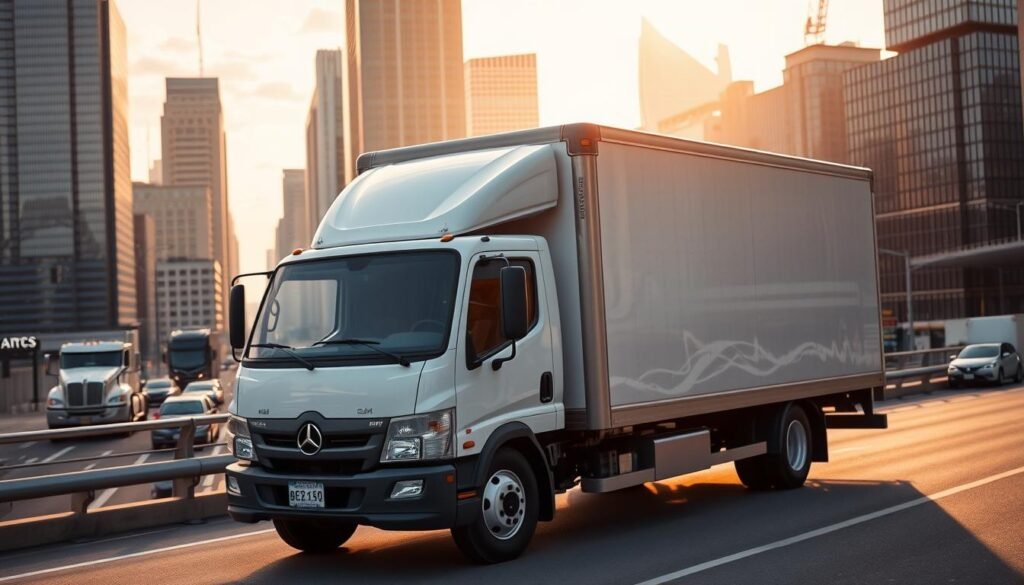
Commercial box truck insurance usually costs $250 to $1,200 a month. The exact price depends on your truck’s size, what you haul, and how far you drive. Federal law sets a minimum liability rule: $300,000 for smaller trucks, and $750,000 for trucks over 10,001 pounds hauling regular freight. Most brokers and shippers want $1,000,000 before they’ll give you loads, though. Here’s a detail that trips people up. A 26-foot box truck is almost always built to weigh right at 25,999 or 26,000 pounds. That’s not by accident. It’s built that way to stay just under the 26,001-pound mark that would require a CDL. That’s why most 26-foot box trucks can be driven and insured without one.
Commercial Box Truck Insurance: Key Facts at a Glance
| Question | Short answer |
|---|---|
| How much does commercial box truck insurance cost? | Usually $250 to $1,200 a month. It depends on truck size, cargo, and how far you drive |
| What’s the federal minimum liability rule? | $300,000 for trucks under 10,001 lbs. $750,000 for trucks over that weight hauling regular freight |
| Does a 26-foot box truck need a CDL? | Usually not. Most are built at 25,999 to 26,000 lbs, just under the 26,001-lb mark that requires a CDL |
| Do brokers really accept the $750,000 minimum? | Often not. Many brokers want $1,000,000 in liability coverage, even though it’s not the legal floor |
| What is the MCS-90 endorsement? | A federal rule that makes sure your insurer pays covered claims. It’s not its own policy |
| Do I need an LLC to get commercial insurance? | No. You can get this insurance as a sole owner. An LLC protects your personal assets in a different way |
| What changed recently in federal filing rules? | On October 1, 2025, FMCSA stopped giving out new MC numbers. New authority now ties to your USDOT number instead |
How Much Does Commercial Box Truck Insurance Cost?
Real 2026 data puts the typical range between $250 and $1,200 a month. A few things drive that range up or down.
Your truck’s size and value matter. A bigger, pricier truck costs more to fix or replace. Your driving area matters too. Local, short routes usually cost less to insure than long-haul routes across states. What you haul changes your cargo cost a lot. High-value or dangerous freight carries more risk than regular goods. Your driving record and business history count as well. A clean record can lower your rate by a real amount. Get quotes from at least three places for your exact truck and route. This range is wide enough that one average number won’t tell you much about your actual bill.
Is a 26-Foot Box Truck Considered a Commercial Vehicle?
Yes. This deserves a clear answer, since it comes up all the time in this exact search.
A 26-foot box truck used to haul goods or make deliveries for a business counts as a commercial vehicle. This is true under both federal and state rules. It’s true whether or not it needs a CDL to drive. The CDL question is a separate question from the commercial question, and that’s where a lot of the mix-up happens. Most 26-foot box trucks are built with a weight rating right at 25,999 or 26,000 pounds. This isn’t an accident. It’s a choice made on purpose. 26,001 pounds is the exact federal line that triggers a CDL rule under 49 CFR Part 383. Stay at or under 26,000 pounds, and a normal driver’s license is enough. Cross into 26,001 pounds or more, and a CDL becomes required. Always check the weight sticker on the actual truck. It’s usually on the driver’s side door frame. Not every 26-foot truck is built the exact same way.
Federal Minimum Liability Insurance Rules for Box Trucks
The Federal Motor Carrier Safety Administration, or FMCSA, sets minimum liability rules based on your truck’s weight and what you haul.
For trucks under 10,001 pounds carrying regular, non-hazardous cargo, the federal minimum is $300,000. For trucks over 10,001 pounds hauling regular freight, that minimum rises to $750,000. Hazardous materials carry much higher rules. This commonly runs $1,000,000 to $5,000,000, depending on the exact goods and class. Here’s the part that surprises a lot of new drivers. Even though $750,000 is the legal floor for regular freight, most freight brokers and shippers won’t give you loads unless you carry $1,000,000 in liability coverage. The legal minimum and the real minimum needed to get work are often two different numbers. Build your coverage around what brokers actually ask for, not just the federal floor.
Your insurer files proof of this coverage with FMCSA. This is commonly done through a form called BMC-91 or BMC-91X. Many policies also carry an MCS-90 endorsement. This is a federal rule that guarantees payment for covered claims, even in cases a normal policy might otherwise skip. The MCS-90 isn’t its own separate policy. It’s added on top of your existing coverage.
Do You Need a CDL for Box Truck Insurance?
No. Insuring a box truck doesn’t require the driver to hold a CDL, as long as the truck’s real weight rating sits at or under 26,000 pounds.
Non-CDL box truck insurance is a real, common type, and many insurers price it just for trucks in this weight range. Whether you qualify depends on the truck’s actual weight rating, not just its length or how it’s advertised. Confirm the exact weight rating before assuming any “26-foot box truck” automatically qualifies. If your truck’s weight rating goes over 26,000 pounds, or if you haul hazardous materials no matter the weight, different CDL and insurance rules kick in. Getting your truck’s weight class wrong on an insurance application, even by accident, can lead to a denied claim later. Get this detail right from day one.

Do I Need an LLC to Get Commercial Insurance?
No. You can buy commercial box truck insurance as an individual, without forming an LLC first.
An LLC is a separate legal setup. It can protect your personal money and property from business debts. That’s a different kind of protection than an insurance policy gives you. Many owner-operators carry commercial insurance under their own name, with no LLC at all, and plenty of insurers work fine with either setup. If you’re weighing whether to form an LLC, that’s its own business and legal choice. It’s worth a talk with an accountant or lawyer. It’s not something your insurance company will ever require of you.
Types of Coverage a Box Truck Policy Actually Includes
A full commercial box truck policy usually bundles a few different types of coverage together, not just one.
Primary liability covers damage or injury you cause to other people. You’ll usually pick between a combined single limit, one flexible number for both injury and property damage, or split limits, separate caps for each. Physical damage coverage pays to repair or replace your own truck after a crash, theft, or weather event. It splits into collision coverage and coverage for everything else, like theft or storm damage. Motor truck cargo insurance covers the freight itself, separate from the truck. You’ll need to set a coverage amount that matches what your cargo is usually worth. Non-trucking liability matters if a driver uses the truck for personal errands outside of work hours. Your main commercial policy may not cover that kind of use without this specific add-on.
Comparing Real Insurance Providers
A mix of national companies, brokers, and local agents work in this market. Each type fits a different situation.
National carriers, including Progressive Commercial, GEICO Commercial, The Hartford, RLI, and Great West Casualty, offer wide market access. They’re worth getting a direct quote from to compare. Broker networks, like Reliance Partners and USI Insurance Services, can pull quotes from many insurers at once. This helps if your risk is more complex or unusual. Local independent agents know state-specific filing rules well. They can help with DOT paperwork and know local repair shops. Check any insurer’s AM Best financial strength rating directly on AM Best’s own site before you commit to anything. Get quotes from at least three sources across these types, since the same coverage can cost very different amounts depending on who you ask.
How to Lower Your Box Truck Insurance Cost
A few real, concrete steps can lower your premium without cutting real coverage.
Installing telematics or dash cameras, and sharing that safety data with your insurer, commonly earns you a real discount, since it proves lower actual risk. Picking a higher deductible lowers your monthly bill. Weigh this against whether you could actually afford that deductible if you did have a claim, though. Bundling policies helps too. Combine auto liability with cargo and general liability under one insurer to cut down on paperwork. This sometimes earns a multi-policy discount as well. Keeping a clean driving record and staying insured with no gaps also helps your rate over time, since insurers price new coverage partly based on your claims and coverage history.
Filing a Claim After an Accident or Cargo Loss
Acting fast and keeping good records after an incident makes the claims process go smoother.
File your First Notice of Loss with your insurer as soon as you can after an accident or cargo loss. Gather police reports, photos, and driver statements for a liability claim. For a cargo claim specifically, keep the bill of lading, delivery receipt, packing list, and declared value paperwork ready. These prove what was actually lost and what it was worth. If you use telematics or dash cameras, that data can genuinely help your claim and speed up the investigation. Follow your insurer’s specific rules on repair shops if your policy requires an approved network, since going outside that network can complicate your payout.
The Honest Read: Is This Guide Right for You?
This page is worth your time if you want the real federal liability numbers, a clear answer on the CDL question for 26-foot trucks, and an honest cost range, instead of vague general statements. It’s less useful if you need an exact quote for your own specific truck, route, and driving history. Only a direct application to a few insurers can actually give you that number.
Conclusion
Commercial box truck insurance typically runs $250 to $1,200 a month. Federal minimum liability rules sit at $300,000 or $750,000, depending on your truck’s weight. Most brokers actually want $1,000,000 to book your loads, though. Most 26-foot box trucks are built on purpose at 25,999 to 26,000 pounds to stay non-CDL. Check this on your own truck’s door sticker rather than guessing from its length alone. You don’t need an LLC to buy coverage. Compare quotes from national carriers, brokers, and local agents, and check each insurer’s AM Best rating directly before you commit to anything.
FAQs
How much is commercial insurance for a 26ft box truck?
Usually $250 to $1,200 a month, depending on your truck’s value, what you haul, and how far you drive. Get quotes from a few insurers for your exact truck and route, since this range is wide.
How much does a $1,000,000 liability insurance policy cost?
Cost varies a lot by truck weight, cargo type, driving record, and insurer. There’s no single fixed price. Most brokers and shippers want this $1,000,000 level, even though the federal legal minimum for regular freight is $750,000.
What kind of insurance does a box truck need?
A full policy usually includes primary liability, physical damage coverage, and motor truck cargo insurance. Non-trucking liability is also worth adding if drivers use the truck for personal errands outside of work.
How much does $100,000 cargo insurance cost?
Cargo insurance cost depends on your cargo’s declared value, the type of goods, and how risky your route is for theft or damage. It’s not a fixed price tied only to the coverage amount. Get a specific quote based on your typical shipment value.
Do I need an LLC to get commercial insurance?
No. You can buy commercial box truck insurance as an individual. An LLC is a separate business and legal choice about protecting your personal assets, not something your insurer will require.
Is a 26ft box truck considered a commercial vehicle?
Yes, if it’s used to haul goods or make deliveries for a business. Whether it also needs a CDL is a separate question. That depends on its actual weight rating, which is commonly built at 25,999 to 26,000 pounds specifically to stay non-CDL.
Is insurance high on a box truck?
It’s higher than a personal car policy, since box trucks carry business liability and cargo risk that personal auto insurance doesn’t cover at all. The exact cost depends a lot on your truck’s size, cargo, route, and driving history.
Who has the cheapest commercial truck insurance?
No single insurer is cheapest for every driver. Pricing depends on your specific truck, route, cargo, and driving record. Get quotes from a mix of national carriers, brokers, and local agents to compare for your own situation.
How can I lower my commercial truck insurance cost?
Install telematics or dash cameras and share the data with your insurer. Choose a higher deductible if you can afford it. Bundle policies where you can. Keep a clean driving record with no coverage gaps.
Which insurance company is best for commercial vehicles?
This depends on your specific truck type, cargo, and route. There’s no single universal answer. Compare national carriers, broker networks, and local agents directly. Check each insurer’s AM Best financial strength rating before deciding.
Why is commercial truck insurance so high compared to personal auto insurance?
Commercial policies cover higher liability limits, cargo value, and business-use risk that personal auto insurance skips entirely. Trucks also drive more miles for work, which raises the chance of accidents and claims.
Does a box truck need a CDL to be insured?
No, insuring a box truck doesn’t require a CDL. What matters is the truck’s actual weight rating. Trucks at or under 26,000 pounds generally don’t need a CDL to drive or insure.
What is the MCS-90 endorsement, and do I need it?
It’s a federal rule guaranteeing your insurer will pay covered claims. Many interstate motor carriers need it. It’s not its own policy. It’s added onto your existing liability coverage, and your insurer handles the filing.
What changed with FMCSA operating authority in 2025?
On October 1, 2025, FMCSA stopped giving out new MC numbers. New operating authority now ties directly to your USDOT number instead. Old MC numbers stay valid, and the actual insurance rules themselves didn’t change.
Can I get box truck insurance for personal use only?
Standard commercial box truck insurance is built around business use. If you also use the truck for personal trips, ask about non-trucking liability or a personal use add-on. Your commercial policy may not automatically cover non-work trips.
About This Guide
This guide was researched and written by the InsuranceGuidances Editorial Team using FMCSA’s own published rules and named insurer sources. See the methodology note at the top of this article for source details.
Reviewed : October 2026.
Methodology: This guide comes from FMCSA’s own rules, real 2026 cost data, and named insurer pages (Progressive Commercial, GEICO, The Hartford). We checked the common claim that a 26-foot box truck always needs a CDL against real weight data. It turns out that’s not quite true.
Sources
AM Best, insurer financial strength rating lookup (ambest.com)
Progressive Commercial, “FMCSA Insurance Requirements” (progressivecommercial.com)
Truckstop, “Carrier Insurance Requirements by State (2026 Guide)” (truckstop.com)
Duncan Insurance, “FMCSA Insurance Requirements 2025: Ultimate Guide” (duncanins.com)
Trucking Insurance Services, “FMCSA Insurance Requirements (2026),” October 2025 MC number filing change (truckinginsuranceservices.com)
CLIMB, “Do You Need a CDL for a 26-Foot Box Truck?” GVWR and CDL threshold explanation (climbtheladder.com)
RK Truck Sales, “Is a 26 Foot Box Truck a Commercial Vehicle?” (rktrucksales.com)
EngineerSkill, “Biggest Truck Without a CDL [The 26,000 LB Limit Explained]” (engineerskill.blog)
Logrock, “Non-CDL Box Truck Insurance and Job Requirements” (logrock.com)