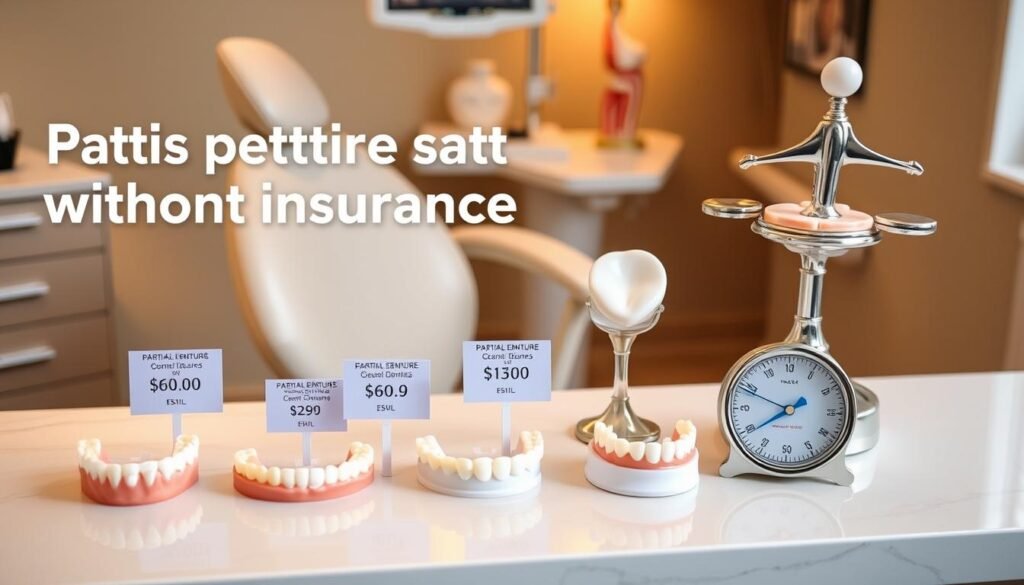
How much do partial dentures cost without insurance? Most people pay roughly $300 to $2,500 per arch, depending almost entirely on the material. An acrylic partial or flipper runs about $300 to $1,500, a flexible nylon partial (like Valplast) about $900 to $2,500, and a cast-metal framework about $950 to $3,500, climbing toward $4,200 with precision attachments. National averages land near $1,740 for acrylic, $1,760 for flexible, and $2,230 for metal. Remember that prices are quoted per arch, so replacing teeth in both your top and bottom jaw roughly doubles the total.
Partial Dentures Cost Without Insurance: Key Facts at a Glance
| Question | Quick answer |
|---|---|
| Typical cost without insurance | ~$300–$2,500 per arch (up to ~$4,200 for premium metal) |
| Cheapest type | Acrylic partial / flipper (1–3 teeth), ~$300–$1,500 |
| Most durable type | Cast-metal framework, ~$950–$3,500 |
| National averages | Acrylic ~$1,740 · Flexible ~$1,760 · Metal ~$2,230 |
| Priced per | One arch (upper or lower) — both jaws ≈ double |
| With insurance | Usually ~50% covered, up to your annual max, often after a waiting period |
| Hidden add-ons | Exam ($50–$350), extractions ($150–$700/tooth), future relines ($200–$600) |
| Cheapest place | Dental schools, community health centers, discount plans |
Partial Dentures Without Insurance: What You’ll Really Pay
You are missing a tooth or two, and now you want to know the price. You look online and the numbers confuse you. One page says $500. The next says $4,000. So what is true?
Here is the simple answer. How much do partial dentures cost without insurance? Most people pay about $300 to $2,500 per arch. An arch means your top jaw or your bottom jaw. The price jumps around so much because of one thing: the material. A cheap plastic “flipper” sits at the low end. A strong cast-metal partial that lasts for years sits at the high end. They are both called partial dentures, but they are not the same thing, and they do not cost the same.
Most cost pages mix all of this into one fuzzy range. This guide keeps the types apart. You will see the real price for each one, the national average from real survey data, and the extra costs that the first quote often hides.
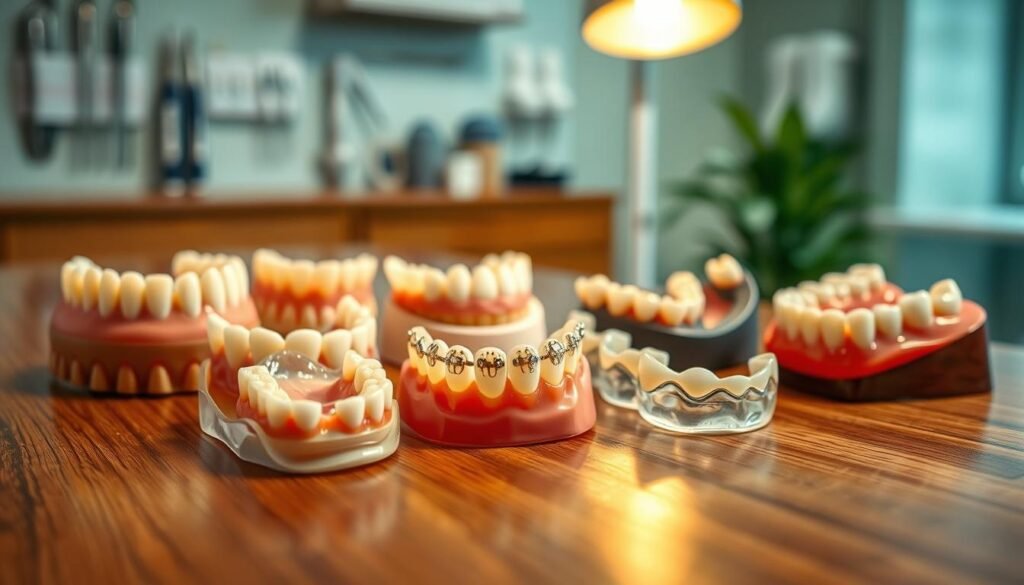
How Much Do Partial Dentures Cost Without Insurance by Type?
Without insurance, the biggest thing that sets the price is what your partial is made of. Here are the checked 2026 prices per arch, with the national averages from the 2024 ASQ360 study done for Synchrony’s CareCredit.
| Type of partial denture | Cost without insurance (per arch) | National average | Best for |
|---|---|---|---|
| Acrylic partial / flipper (1–3 teeth) | $300–$1,500 | ~$1,740 | Short-term or transitional use |
| Flexible nylon (Valplast, TCS) | $900–$2,500 | ~$1,760 | Comfort and a natural, clasp-free look |
| Cast-metal framework | $950–$3,500 (up to ~$4,200) | ~$2,230 | Long-term durability |
| Implant-supported partial | $3,000+ | Varies widely | The most stable, natural function |
An acrylic partial, often called a flipper when it replaces just one to three teeth, is the cheapest. It’s a pink acrylic base with wire clasps, light and easy to adjust, but bulkier and less durable. Most dentists treat it as a temporary or transitional piece. The national average for a flipper specifically is about $605.
A flexible partial uses a soft nylon base that hugs your gums and hides the metal clasps, so it looks the most natural. The trade-off: it can crack, usually can’t be repaired, and may need replacing rather than fixing if it breaks.
A cast-metal framework is the thin, rigid, long-lasting option. It costs the most up front and adds even more with precision attachments, but it’s the one built for years of daily chewing. Guardian and other carriers consistently rank metal as the most durable removable choice.
For a real-world sanity check: the American Dental Association reports prosthodontist fees starting around $1,600 for a partial, and Aflac pegs the no-insurance range at $450 to $3,100. Those line up with the table above.
How Much Does a Partial Denture Cost for 2, 3, 4, or 5 Teeth?
Cost climbs with the number of teeth you’re replacing, but not as steeply as you’d expect, because a big chunk of the price is the base and the lab work, not each individual tooth.
Replacing one to three teeth, especially up front, is usually a flipper or small acrylic partial in the $300 to $1,500 range. Once you’re filling four or five gaps, you’re into a larger acrylic, flexible, or metal partial, and the cost shifts toward the $1,000 to $2,500 band, higher for metal. The jump from a 2-tooth to a 4-tooth partial is real but modest. The jump from acrylic to metal, or from one arch to two, costs you far more than the extra teeth do.
How Much Do Upper Partial Dentures Cost?
Upper partial dentures cost about the same as lower ones for the same material, roughly $300 to $3,500 per arch depending on type. The material and the number of teeth drive the price, not which jaw you’re treating. One practical note: upper partials sometimes use a thinner palate design or a horseshoe shape for comfort, and a cast-metal upper can feel less bulky than acrylic because the metal can be made thinner. That comfort upgrade is part of what you’re paying for with the metal framework.
The Real Out-of-Pocket Math (What the Quote Leaves Out)
This is the part that surprises people, so let’s use real numbers. Say a dentist quotes you $1,800 for a cast-metal lower partial. That sounds like your full price. It usually is not.
A typical no-insurance quote covers the impressions, the lab-made partial, and the first few fitting adjustments. It often does not include:
- The exam and X-rays: $50 to $350
- Extractions, if a failing tooth has to come out first: $150 to $700 per tooth
- Future relines as your gums change shape: $200 to $600, often needed every 1 to 3 years
So that $1,800 partial can realistically become $2,300 to $2,800 all-in once you add an extraction and the exam. And if you need the same treatment on both arches, you roughly double it. None of this is a scam. It’s just billed in pieces, which is exactly why the first number you hear rarely matches the final one. When you call around, ask each office for an all-in written estimate, not the partial-only price.
How Much Do Partial Dentures Cost With Insurance (and With Delta Dental)?
With dental insurance, you’ll typically pay about half. Most PPO plans, including Delta Dental, classify partial dentures as a “major” service and cover around 50% of the cost. But three catches decide what you actually owe:
- The annual maximum. Most plans cap total yearly payouts at $1,000 to $2,000. If your metal partial runs $2,400 and your plan pays 50% up to a $1,500 max, you don’t get $1,200 back. You get $1,200 only if it fits under your remaining max for the year.
- The waiting period. Many plans make you wait 6 to 12 months before they’ll cover major work like a partial. Buy the plan today, need the partial next month, and you may be paying full price anyway.
- Frequency limits. Plans often replace a partial only once every 5 to 7 years.
So “covered” rarely means half off the sticker. On a $2,200 partial, it’s common to still owe well over half once the annual max and any deductible are factored in. Always ask for a pre-treatment estimate so your plan tells you the real number in writing.
How Much Does Aspen Dental Charge for Partial Dentures?
Aspen Dental publishes a partial denture range on its site, listing its Flexilytes flexible partial at roughly $1,319 to $1,819 based on 2026 internal data, with the exact price varying by location and case. Aspen offers acrylic, flexible, and metal-free options and works with most major insurers, though it notes it does not accept Medicaid. As with any chain, the headline number is a starting point. Ask for a full written quote that includes the exam, any extractions, and follow-up adjustments before you sign.
Where Is the Cheapest Place to Get a Partial Denture?
The cheapest legitimate places to get a partial denture, in rough order of savings, are dental schools, community health centers, and discount dental plans.
- Dental schools let supervised students make your partial for 40% to 60% less than a private practice. It takes longer, but the work is checked by faculty.
- Community health centers (FQHCs) offer sliding-scale fees based on income, and many provide dentures.
- Dental discount plans (not insurance) charge a low annual fee for set discounts on major work, with no waiting period or annual max.
- A flipper is the budget interim option if you need something now while you save for a permanent partial.
- Mail-order or online denture labs are the cheapest of all, but read the honest caveat: you take your own impressions at home, there’s no in-person fitting, and the fit can be hit or miss. They’re fine for a simple replacement and a bad idea for a complex case.
Which Is Cheaper, Implants or Partials?
Partials are dramatically cheaper than implants up front. A removable partial replacing several teeth runs a few hundred to about $2,500 per arch. A single dental implant averages around $2,143 and can run from $1,646 to over $4,000, so replacing three teeth with implants could cost $6,000 to $12,000 or more.
But here is the other side. Implants last far longer, often for decades. They feel and chew like real teeth, and they slow the jawbone loss that removable partials do not stop. So the real choice is not only about price. Do you want the cheaper option that you remove and replace every few years, or the costly option that stays in and protects your bone? A dental bridge (about $2,000 to $5,000 for three teeth) sits in the middle.
How Many Teeth Can Go on a Partial Denture?
A removable partial denture can replace anywhere from one tooth to most of the teeth in an arch, as long as you still have enough healthy natural teeth to anchor the clasps. Those remaining teeth are what hold the partial in place, so they matter more than the count of missing ones. Once you’ve lost all or nearly all the teeth in a jaw, there’s nothing left to clasp onto, and a full denture or an implant-supported option becomes the better fit.
A First-Hand Pattern Worth Knowing
After years of helping people sort out their dental bills, I see the same two mistakes again and again with partials.
The first is fixing on the lowest number. Someone reads “$300” for a flipper and expects to pay that. Then they are surprised by the per-arch doubling, the extraction fee, and a waiting period on their new insurance plan. The fix is easy: price the type you really want, on both jaws if you need it, plus the extra costs, before you settle on a number in your head.
The second is using a flipper as a long-term answer. A flipper is meant to be temporary. If you wear it for years, it can hurt your gums and the teeth it clips onto. If you can afford it, a flexible or metal partial is a better long-term value, even though it costs more today. Cheap and temporary has its place. Just know which one you are buying.
The Honest Read: Who Each Option Is For
A flipper or acrylic partial is right if you need an affordable fix now, you’re bridging a gap before something permanent, or you’re on the tightest budget. Just don’t expect it to last a decade.
A flexible partial is right if you care most about looks and comfort, especially for visible front teeth, and you’re okay replacing it rather than repairing it if it cracks.
A cast-metal partial is right if you want durability and the best long-term value, and you can handle a higher up-front cost.
An implant or implant-supported partial is right if budget allows and you want the most natural, longest-lasting result that also protects your jawbone.
And here is one honest point: if your only insurance has a low yearly cap and a long waiting period, sometimes a discount plan or a dental school saves you more than the insurance you would buy just for this. Check both numbers before you assume insurance is the cheaper path.
Conclusion
Partial dentures cost roughly $300 to $2,500 per arch without insurance, with the material doing most of the work on the price tag. Acrylic and flippers sit at the bottom, flexible nylon in the middle, and cast metal at the top. The numbers that trip people up aren’t the headline ranges. They’re the per-arch doubling, the extractions, and the insurance fine print that turns “50% covered” into something closer to “still owe most of it.”
Tooth loss is common as we get older, so you are in a large group making this choice. About 72 million U.S. adults have no dental insurance, and even among seniors, keeping every natural tooth is rare. Get an all-in written quote, compare two or three providers, and weigh the cheap-and-temporary option honestly against the costs-more-but-lasts-longer one. The right partial is the one that fits your mouth, your timeline, and your budget, all three together.
FAQs
How much do partial dentures cost without insurance?
Without insurance, partial dentures typically cost about $300 to $2,500 per arch, occasionally up to $4,200 for a premium metal framework. The price depends mostly on the material: acrylic and flippers are cheapest, flexible nylon is mid-range, and cast metal is the most expensive and most durable. National averages run near $1,740 for acrylic, $1,760 for flexible, and $2,230 for metal.
How much does a partial denture cost for 1 to 3 teeth (a flipper)?
A flipper or small acrylic partial replacing one to three teeth usually costs about $300 to $1,500, with a national average near $605 for a basic flipper. It’s a lightweight, low-cost option, but dentists generally consider it temporary because it’s less durable and can stress nearby teeth over time. It’s a good interim fix while you save for a permanent partial.
How much does a partial denture cost for 4 or 5 teeth?
Replacing four or five teeth usually moves you into a larger acrylic, flexible, or metal partial in the $1,000 to $2,500 range, higher for a cast-metal framework. The cost rises with more teeth, but the base and lab work make up much of the price, so the jump from a 2-tooth to a 5-tooth partial is real but smaller than people expect.
How much do upper partial dentures cost?
Upper partial dentures cost about the same as lower ones, roughly $300 to $3,500 per arch depending on the material. The jaw doesn’t change the price; the type and number of teeth do. A cast-metal upper can sometimes be made thinner and more comfortable than a bulky acrylic one, which is part of what the higher price buys.
How much do partial dentures cost with insurance, and with Delta Dental?
With insurance, you’ll usually pay around half, since most plans, including Delta Dental, cover partials as a “major” service at about 50%. But your real cost depends on your annual maximum (often $1,000 to $2,000), any 6-to-12-month waiting period, and frequency limits. On a $2,200 partial, it’s common to still owe well over half once those limits apply, so ask for a written pre-treatment estimate.
How much does Aspen Dental charge for partial dentures?
Aspen Dental lists its Flexilytes flexible partial at roughly $1,319 to $1,819 based on 2026 internal data, with the exact price varying by location and case. It offers acrylic, flexible, and metal-free options and works with most major insurers, but does not accept Medicaid. Always request a full written quote that includes the exam, any extractions, and adjustments.
Where is the cheapest place to get a partial denture?
The cheapest legitimate options are dental schools (40% to 60% less, with student work checked by faculty), community health centers with sliding-scale fees, and dental discount plans. A flipper is the cheapest interim device, and mail-order denture labs are cheaper still, though you take your own impressions with no in-person fitting, so they suit simple cases only.
Which is cheaper, implants or partials?
Partials are far cheaper up front. A removable partial replacing several teeth runs a few hundred to about $2,500 per arch, while a single implant averages around $2,143 and can exceed $4,000, so a few implants can total $6,000 to $12,000 or more. Implants cost much more but last longer, feel more natural, and slow the jawbone loss that partials don’t prevent.
How many teeth can go on a partial denture?
A removable partial can replace anywhere from one tooth to most of an arch, as long as you have enough healthy natural teeth left to anchor the clasps. The remaining teeth hold it in place, so their health matters more than the number of gaps. Once nearly all teeth in a jaw are gone, a full denture or implant option works better.
Are partial dentures worth the money?
For most people, yes. Partial dentures restore chewing and speech, improve appearance, and stop your remaining teeth from drifting into the gaps, which prevents bite problems later. They’re the most affordable, non-surgical way to replace several missing teeth. The main trade-offs are that they’re removable, need occasional relines, and don’t preserve jawbone the way implants do.
How much do snap-in dentures cost?
Snap-in (implant-supported) dentures cost much more than removable partials because they include surgery and implants, typically $5,000 to $20,000 per arch. They snap onto 2 to 4 titanium implants for far better stability, but require a healing period and ongoing maintenance, like replacing the O-ring attachments every 1 to 2 years. They’re a step between a removable partial and a permanent fixed bridge.
How long do 3D-printed dentures last, and can you sleep in them?
3D-printed dentures are a newer, often more affordable option, but long-term durability data is still limited, and printed resin is generally expected to last fewer years than milled or conventional dentures because it wears and stains more easily. Many are positioned as economical or interim pieces. As for sleeping, dentists usually recommend removing any denture overnight, printed or not, to let your gums rest and lower the risk of infection.
What is monkey mouth with dentures?
“Monkey mouth” is a slang term for dentures that push the lips outward and make the lower face look overfilled or protruding. It’s usually caused by a denture that’s too thick, teeth set too far forward, or an incorrect bite. A dentist can often fix it by thinning the front of the denture, resetting the teeth, or adjusting the bite, though a bulky base sometimes needs a remake.
What can I get instead of a partial denture?
Alternatives to a partial denture include a fixed dental bridge (crowns anchoring replacement teeth, ~$2,000 to $5,000), dental implants (the longest-lasting, most expensive option), or, for some, an implant-supported partial. The right choice depends on how many teeth you’re missing, the health of the surrounding teeth and bone, and your budget. A dentist can tell you which options your specific case supports.
How many 70-year-olds still have all their teeth?
Very few seniors keep every natural tooth. CDC data shows about 11% of adults aged 65 to 74 have lost all their teeth, so roughly 89% still have some, but most have lost several along the way. Seniors 65 and older average around 21 remaining teeth, and only about three in five have a full “functional” set of 20 or more. That’s exactly why partials are so common at this age.
About the Author
Md Shahinuzzaman is an insurance and out-of-pocket healthcare cost specialist with 16 years of banking and insurance experience. He writes plain-English guides that trace every figure to a named source, name the real trade-offs, and never inflate a number to make a point. On dental cost questions, his focus is simple: help you see the full bill, including the parts the first quote leaves out, before you commit.
Sources
DentalCalcs — Dentures Cost Guide (snap-in / implant-supported ranges): https://dentalcalcs.com/guides/dentures-cost-guide/
Looking into dental care, especially partial dentures costs, can be scary without insurance. Knowing the cost of partial dentures without insurance helps with budgeting. They are key for those missing teeth, helping with both looks and function.
CareCredit — 13 Types of Dentures and Average Costs (2024 ASQ360 study): https://www.carecredit.com/well-u/health-wellness/types-of-dentures/
CareCredit — How Much Do Dentures Cost: https://www.carecredit.com/well-u/health-wellness/denture-cost/
GoodRx — Dentures Cost by Type (ADA prosthodontist fees): https://www.goodrx.com/health-topic/oral/cost-of-dentures
Aflac — How Much Do Dentures Cost Without Insurance: https://www.aflac.com/resources/dental-insurance/how-much-do-dentures-cost-without-dental-insurance.aspx
Guardian — Partial Dentures Cost and Types: https://www.guardianlife.com/partial-dentures
Aspen Dental — Partial Dentures Cost: https://www.aspendental.com/dentures/partial-dentures/partial-dentures-cost/
CDC — About Tooth Loss (2024 Oral Health Surveillance Report): https://www.cdc.gov/oral-health/about/about-tooth-loss.html
CDC — 2024 Oral Health Surveillance Report, Selected Findings: https://www.cdc.gov/oral-health/php/2024-oral-health-surveillance-report/selected-findings.html
NIDCR — Tooth Loss in Seniors: https://www.nidcr.nih.gov/research/data-statistics/tooth-loss/seniors