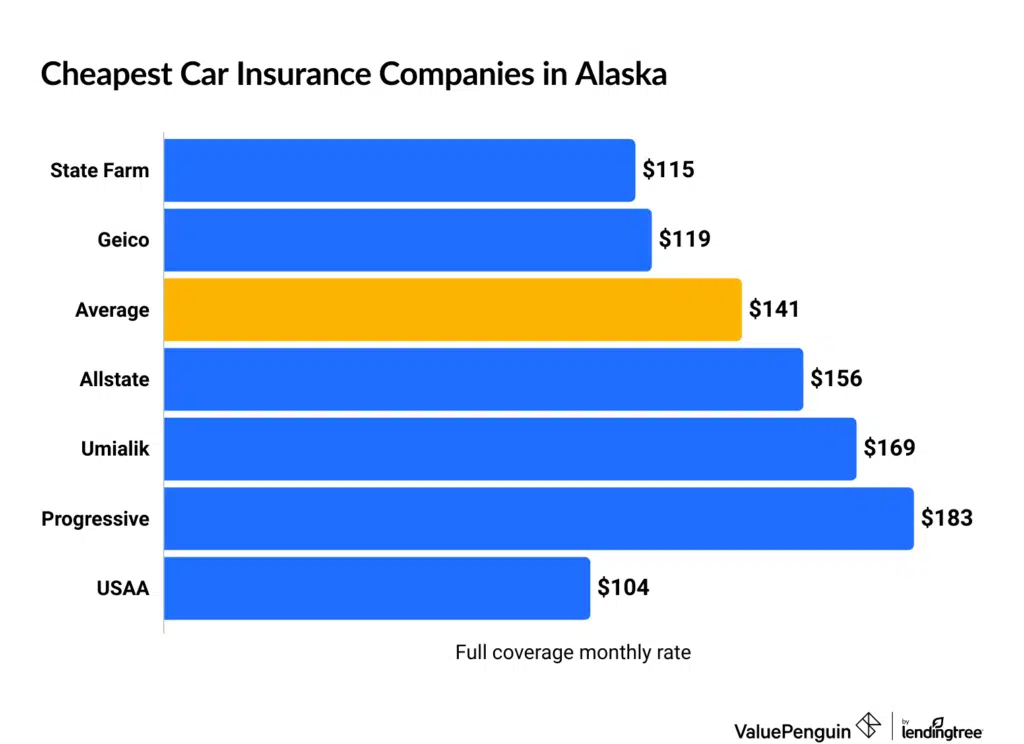
Alaska is the only state in America with a geographic insurance exemption. If your community isn’t connected to the state highway system, motor vehicle insurance isn’t required at all. Live in Anchorage, Fairbanks or the Mat-Su Valley and the normal rules apply, and those rules are strict: Alaska demands 50/100/25 liability, double the 25/50/25 baseline most states use. So the honest answer to “best car insurance in Alaska” starts with a question nobody else asks you. Which road do you live on? For everyone on the grid, USAA, Umialik and GEICO are where the money is, and Umialik is the one the national sites keep leaving out.
Best Car Insurance in Alaska: Key Facts at a Glance
| Detail | What we found |
|---|---|
| Does Alaska require car insurance? | Not everywhere. It’s the only state with a geographic exemption. |
| Who is exempt? | Communities not connected to the state highway system |
| Who is not exempt? | Anchorage, Fairbanks, the Mat-Su Valley and other connected areas |
| Minimum liability | 50/100/25, versus the 25/50/25 most states require |
| Governing statute | Alaska Statutes Title 28, Chapter 22 |
| No Pay, No Play? | Yes. Uninsured drivers can’t recover pain and suffering damages. |
| Is PIP required? | No. Alaska isn’t a no-fault state. |
| UM/UIM | Not mandatory, but insurers must offer it |
| J.D. Power coverage | Alaska isn’t included in its 2025 auto study |
| SR-22 after suspension | Three years |
| Alaska-only carrier worth knowing | Umialik, ranked third in Alaska by U.S. News |
Does Alaska Require Car Insurance? The Only State Where the Answer Might Be No
Two of the most common searches on this topic are “does Alaska require car insurance” and “do you need car insurance in Alaska.” Those are strange questions to ask about a US state. Every state requires insurance. Everyone knows that.
Except Alaska genuinely doesn’t, and it’s the only one.
Motor vehicle insurance isn’t required in areas of Alaska that aren’t connected to the state highway system. That’s a real, live geographic exemption written into how the state handles financial responsibility, and no other state has anything like it. If you live in a bush community you can’t drive to, the mandate doesn’t reach you.
Anchorage, Fairbanks and the Mat-Su Valley have standard requirements. So do the other communities on the road network. If you can drive to Tok, the rules apply to you.
ValuePenguin frames it slightly differently, noting that auto insurance is only required in Alaska in certain cities where vehicle registration is mandatory, which comes at the same reality from the registration side. Either way, the practical upshot holds: in Alaska, whether you legally need car insurance depends on geography in a way it does nowhere else in the country.
Now here’s the part that makes this interesting rather than just trivia. Alaska is simultaneously one of the strictest states in the union. Its minimum liability requirement is 50/100/25, which is double the 25/50/25 that most states settle for.
So Alaska is both the most forgiving and the most demanding state on this subject at the same time, and which one you get depends entirely on whether there’s a road to your house.
Before you do anything else, work out which side of that line you’re on. Everything below assumes you’re on the connected side, which most Alaskans are.

What Is the Minimum Car Insurance in Alaska?
50/100/25, and it’s one of the highest minimums in the country.
| Coverage | Alaska minimum | What it pays for |
|---|---|---|
| Bodily injury, per person | $50,000 | Injuries to one other person in a crash you cause |
| Bodily injury, per accident | $100,000 | Total injuries to everyone in a crash you cause |
| Property damage | $25,000 | Damage to someone else’s car or property |
Compare that to the 25/50/25 baseline most states use and Alaska is asking for twice the bodily injury protection. The Alaska Division of Insurance confirms these figures, and they sit in Title 28, Chapter 22 of the Alaska Statutes.
A few things that aren’t required but matter:
Uninsured and underinsured motorist coverage isn’t mandatory, though insurers must offer it to you. Take it seriously before you decline it.
Alaska isn’t a no-fault state, so PIP isn’t required.
Comprehensive and collision aren’t required either, but in a state with moose, ice and long distances between towns, comprehensive is doing more work here than almost anywhere else.
You don’t strictly need an insurance policy at all, incidentally. Alaska accepts a surety bond as proof of financial responsibility, and if you have more than 25 cars registered in your name you can apply to self-insure. Neither is practical for most people, but they exist.
And if you skip it: driving uninsured in Alaska brings license suspension, fines, possible impoundment, higher rates afterward, and potentially jail time for repeat violations. An insurance-related suspension then requires an SR-22 filing for three years.
Alaska’s No Pay, No Play Law: The Part That Actually Stings
This is the most important thing on this page that almost no competing article mentions, and it changes the maths on going uninsured completely.
Alaska has a “No Pay, No Play” law. If you’re driving uninsured and someone else causes a crash that injures you, you cannot recover pain and suffering damages from them. Not reduced. Barred.
You can still recover your medical bills and economic damages, like lost wages. But non-economic damages, the pain and suffering portion that’s often the largest part of an injury settlement, is off the table entirely. Even though the crash was completely the other driver’s fault.
Think about what that means. Someone runs a red light and puts you in hospital for a month. Because your policy lapsed in February, the law removes your right to compensation for the month you spent in pain. The other driver’s negligence doesn’t matter. Your lapse does.
That’s the real cost of going without coverage in Alaska, and it dwarfs the fine.
Best Car Insurance in Alaska: Who Each Carrier Actually Fits
We’re not going to crown one. Nobody can, because the “best” carrier depends on who you are, and any page that names a single winner is guessing on your behalf.
Here’s who each one actually suits, with the catch named.
USAA. Best if you qualify, and that’s the whole sentence. U.S. News ranks USAA second in Alaska with lower-than-average rates, and Way.com’s rate analysis puts it top for full coverage. The catch: you have to be military, a veteran, or an eligible family member. If you don’t qualify, none of this applies to you, which is why USAA topping “best of” lists is useless to most readers.
Umialik. Best if you want an insurer that only does Alaska. U.S. News ranks it third in the state, ahead of GEICO, and Way.com’s data puts Umialik at the cheapest liability rates in Alaska. Its Signature Auto Program includes a Penalty-Free Promise, meaning you won’t pay a higher rate because of future accidents or violations. The catch: Umialik only writes in Alaska, so if you’re moving Outside you’ll be starting over, and it’s smaller than the nationals with fewer digital bells and whistles.
GEICO. Best for cheap minimum coverage and good apps. Insurance.com’s analysis puts GEICO at the lowest minimum-coverage rates in Alaska, averaging around $415 a year. The catch: GEICO only underwrites auto. If you want to bundle home or renters, that coverage gets underwritten by an unaffiliated third party, so the “bundle” is less integrated than it sounds.
State Farm. Best if you want a local agent. Strong agent network and a well-regarded app, and Way.com’s data has State Farm competitive on both liability and full coverage. The catch: you’re paying for the agent, and if you never call them, you’re paying for nothing.
Progressive. Best if you’re shopping on price and like tools. The Name Your Price tool genuinely helps people who need to hit a number. The catch: Name Your Price shows you what your budget buys, which is not the same as showing you the best coverage. It’s a budgeting tool wearing a shopping tool’s clothes.
Allstate. Way.com’s Alaska data has Allstate at the expensive end of full coverage. Worth a quote, but don’t assume the brand means the price.
Umialik Insurance: The Alaska-Only Carrier National Sites Miss
Worth its own section, because if you searched “best car insurance in Alaska” and got a list of the same four national brands you’d see in Ohio, you were reading a template.
Umialik only offers coverage in Alaska. That’s unusual and it matters. An insurer writing nothing but Alaska risk understands moose season, break-up, ice fog and the fact that “the shop” might be 200 miles away. National carriers price Alaska as one line in a fifty-state model.
U.S. News ranks Umialik third in the state, ahead of GEICO. Way.com’s rate data puts Umialik at the cheapest liability coverage in Alaska at around $57 a month, and competitive on full coverage.
The Signature Auto Program’s Penalty-Free Promise is the standout feature: the commitment that you won’t pay a higher rate in future because of accidents or violations. Read the actual terms before you rely on that, because promises like this usually carry conditions, but no national carrier is offering anything similar here.
The honest trade-offs. It’s Alaska-only, so a move Outside means shopping again from scratch. It’s smaller, so the app and digital tooling won’t match GEICO’s. And it’s not a household name, which matters to some people and shouldn’t.
If you’re in Alaska for the long run and you want a carrier whose entire book is people like you, get a quote. It costs you ten minutes and it’s the quote the national comparison sites won’t run for you.
How Much Is Car Insurance in Alaska? Average Rates
Here’s where we’re going to be more careful than most pages, because the numbers circulating for Alaska contradict each other badly.
What we can report, with attribution:
| Source and measure | Figure |
|---|---|
| GEICO, minimum coverage (Insurance.com) | About $415 a year |
| Umialik, liability (Way.com) | About $57 a month |
| USAA, full coverage (Way.com) | About $123 a month |
| State Farm, full coverage (Way.com) | About $132 a month |
| Umialik, full coverage (Way.com) | About $136 a month |
| Progressive, full coverage (Way.com) | About $180 a month |
| Allstate, full coverage (Way.com) | About $289 a month |
| Cheapest city (Way.com) | Douglas, around $113 a month |
Why we’re not printing a single Alaska average. Different studies use different driver profiles, different coverage levels and different methodologies, and they produce wildly different results. U.S. News works with Quadrant Information Services and averages male and female drivers at 25, 40 and 60 driving 14,000 miles a year with medium coverage and good credit. Way.com analyses insurer filings across ZIP codes. Those aren’t measuring the same thing, so quoting them as one “average” would be dishonest.
What that means for you. Any Alaska average you read, including on this page, describes a driver who isn’t you. The spread between the cheapest and most expensive carrier in Way.com’s own full coverage data is roughly $123 to $289 a month, which is more than double. That spread is the entire argument for getting three quotes rather than trusting a list.
Is Car Insurance More Expensive in Alaska?
Less than people assume, and the reasons are interesting.
Alaska has brutal weather, wildlife collisions, enormous distances and expensive parts logistics. All of that should make it costly. But it also has very low population density, minimal congestion in most of the state, and far fewer of the multi-car pile-ups and litigation costs that drive urban premiums.
The figures above put competitive Alaska full coverage in the region of $123 to $180 a month at the better carriers, which isn’t cheap but isn’t a national outlier either.
The Anchorage exception. Anchorage Metro carries above-average vehicle theft exposure compared to Alaska’s smaller markets. If you’re in Anchorage, comprehensive coverage is doing more work for you than the state average suggests, and it’s worth pricing rather than dropping.
Best Car Insurance in Anchorage, Alaska
Anchorage is where most Alaskans actually live, and it’s where the standard rules bite hardest.
Three things change your answer here:
You’re definitely not exempt. Anchorage has standard requirements. The geographic exemption is irrelevant to you.
Theft exposure is higher than the rest of the state. That pushes toward keeping comprehensive rather than stripping to liability to save money, particularly on a vehicle worth more than a few thousand dollars.
You have more carrier choice than anywhere else in Alaska, including agent-based options like State Farm that are thin on the ground elsewhere. Use that. Get quotes from USAA if you qualify, Umialik, and GEICO, then a fourth from whoever your neighbour swears by.
Best Car Insurance in Alaska for Seniors
The honest answer is that “for seniors” isn’t really a product category, and treat any page that says otherwise with suspicion.
What actually changes with age:
Mileage drops, and low-mileage discounts are real money. Ask every carrier what their threshold is, because they differ.
Bundling gets more valuable if you own your home outright and have settled insurance needs.
Agent access matters more to some people, which is a genuine argument for State Farm or Umialik over an app-first carrier.
Umialik’s Penalty-Free Promise is worth a look if you’re worried that one incident late in life will reprice everything.
USAA remains available to veterans, and a large share of Alaska’s senior population served. If that’s you, get the quote.
What doesn’t change: you still need to compare, and your age alone doesn’t dictate a carrier.
Who Is the Most Trusted Car Insurance Company? And Why J.D. Power Can’t Tell You Here
We’re not naming one, and in Alaska there’s a specific reason we can’t.
J.D. Power’s 2025 U.S. Auto Insurance Study doesn’t include Alaska. The single most-cited customer satisfaction benchmark in American insurance simply doesn’t cover this state. So every “most trusted in Alaska” ranking you read is either using national data that excludes Alaska, or making it up.
Here’s what actually works instead:
AM Best for financial strength, which tells you whether the company can pay at all.
The NAIC Complaint Index, filtered to private passenger auto, on the Alaska Division of Insurance site. Company-wide indexes blend lines and mislead badly.
The Alaska Division of Insurance itself, which publishes complaint data and enforcement actions for carriers licensed here.
Use those three together and you’ll know more than any “most trusted” listicle can tell you.
Is AAA Cheaper Than GEICO?
Sometimes, and there’s no universal answer, which is the honest response to a question phrased this way.
AAA is a federation of regional clubs, so “AAA” prices differently depending on where you are, and AAA membership bundles roadside assistance that GEICO sells separately. GEICO consistently prices well on minimum coverage in Alaska, averaging around $415 a year per Insurance.com’s analysis.
The comparison people should actually run: GEICO plus separately purchased roadside assistance, against AAA including membership. Otherwise you’re comparing a policy to a policy-plus-club and calling it a price.
Get both quotes. It takes twenty minutes and the answer is specific to you.
Is Costco Auto Insurance Really Cheaper?
Sometimes, and the important thing to understand is what you’re actually buying.
Costco doesn’t underwrite insurance. It’s a member benefit programme routed to a partner insurer, so a Costco auto policy is that partner’s policy with a Costco badge and member pricing on it. Whether it’s cheaper depends on the same things every quote depends on: your car, your record, your ZIP.
We could not verify current availability or partner arrangements in Alaska at our review date, and we’re not going to guess for you. Check with Costco directly and price it against three other quotes, exactly as you would any carrier. Membership programmes are worth checking. They’re not automatically cheaper, and nobody should buy insurance on brand loyalty.
Is $300 a Month Too Much for Car Insurance?
In Alaska, probably yes, and here you can actually answer this with data rather than a shrug.
Way.com’s Alaska rate analysis puts competitive full coverage between roughly $123 and $180 a month at the better carriers, with Allstate at the top of its list around $289. So $300 a month sits above even the expensive end of that range.
When $300 is legitimately explainable: a young driver, a recent at-fault accident or DUI, an SR-22 filing, a high-value or performance vehicle, very low deductibles, high liability limits, or a lapse in coverage in your recent past.
When it isn’t: a clean record, an ordinary car, and no filings. If that’s you and you’re paying $300, you’re overpaying and you have not shopped recently.
Either way, the fix is the same. Get three quotes including Umialik and, if you qualify, USAA. The gap between the cheapest and dearest carrier in Alaska is more than double.
Is It Better to Have a $500 Deductible or $1,000?
It depends on one honest question: can you write a $1,000 cheque tomorrow without it hurting?
If yes, take the $1,000 deductible. You’ll pay less every month, and over several claim-free years the savings usually beat the extra $500 of exposure.
If no, take the $500. A deductible you can’t afford isn’t a saving, it’s a coverage gap you’re pretending not to have. People with $1,000 deductibles and $200 in savings don’t file claims. They drive damaged cars.
The Alaska wrinkle. Comprehensive claims here are more likely than in most states: wildlife, ice, weather, and in Anchorage, theft. If comprehensive claims are realistic for you rather than theoretical, a lower comprehensive deductible earns its keep more than it would in Arizona.
The move most people miss: you can set different deductibles for comprehensive and collision. A lower comprehensive deductible and a higher collision one is often the right shape in Alaska.
What Is the $3,000 Rule for Cars?
This isn’t a real insurance rule, and it’s worth clearing up because it gets repeated as though it were.
There’s no industry standard called the $3,000 rule. What people are usually reaching for is the decision about when to drop collision and comprehensive coverage on an older car, and there is a sensible way to think about that.
The rule that actually works: compare your annual comprehensive and collision premium against your car’s actual cash value. If the yearly premium plus your deductible approaches roughly 10% of what the car is worth, the coverage is getting hard to justify. On a $3,000 car with a $1,000 deductible, your insurer can never pay you more than $2,000, so ask what you’re paying for that ceiling.
The Alaska caveat. Don’t apply that mechanically here. A $3,000 truck that dies in a moose strike 90 miles from town isn’t just a $3,000 loss, it’s a $3,000 loss plus a recovery, plus no vehicle in a place where that’s a serious problem. The replacement math is different when the nearest dealer is a flight away.
Best Car Insurance in Alaska on Reddit: What Holds Up
Forum sentiment on this topic gets one thing consistently right, and it’s the thing the national sites get wrong.
What holds up: Alaskans recommend Umialik far more often than the national listicles do. That tracks with U.S. News ranking it third in the state and with Way.com’s rate data, so it isn’t just local loyalty. When residents and the rate data agree against the templates, the templates are usually wrong.
What doesn’t: anecdotal pricing, as always. Somebody’s $95 a month in Douglas tells you nothing about Anchorage, where theft exposure is higher and the whole market prices differently. Way.com’s own data has Douglas as the cheapest city in the state.
The other thing worth ignoring: claims horror stories about every carrier, which exist for every carrier everywhere. People who got paid don’t post.
The Honest Read: How to Choose in Alaska
First, find out if you are exempt. If your community isn’t connected to the state highway system, the mandate doesn’t apply to you. That’s a conversation nobody else on the internet is having with you, and it’s the first question.
If you’re on the road system, respect the 50/100/25. It’s double most states, and there’s a reason: medical costs and remoteness make Alaskan crashes expensive.
Don’t go uninsured, and No Pay No Play is why. The fine is survivable. Losing your right to pain and suffering damages after a crash somebody else caused is not.
If you qualify for USAA, start there. Second in the state per U.S. News and top of Way.com’s full coverage data.
If you don’t, get a Umialik quote before anything else. Third in the state, cheapest liability in Way.com’s data, ahead of GEICO, and the national comparison sites will never show it to you.
GEICO for cheap minimum coverage, at around $415 a year, with the honest caveat that bundling means a third-party underwriter.
Keep comprehensive. Moose, ice, weather, and Anchorage theft. This is not the state to strip it to save $12 a month.
And ignore any “most trusted” ranking for Alaska. J.D. Power doesn’t cover this state. Use AM Best and the NAIC complaint index on the Division of Insurance site instead.
Final Word on the Best Car Insurance in Alaska
Most articles on this subject are a national template with the word Alaska pasted over it. They list the same four carriers you’d see for any state, quote an average that describes nobody, and never mention that Alaska is the one place in America where the entire question might not apply to you.
The real picture is stranger and more useful. Alaska is simultaneously the only state that will let you skip insurance entirely and one of the strictest states for everyone else. It has a local insurer that outranks GEICO and that no comparison site will show you. It has a law that quietly strips uninsured crash victims of most of their compensation. And it isn’t covered by the satisfaction study everyone cites.
So: work out which road you live on. Get three quotes, and make one of them Umialik. Keep comprehensive. Don’t lapse.
The rest is just paperwork.
FAQs
Does Alaska require car insurance?
Not everywhere, and it’s the only state where that’s true. Motor vehicle insurance isn’t required in areas of Alaska not connected to the state highway system, so bush communities without highway connections are exempt. Anchorage, Fairbanks, the Mat-Su Valley and other connected areas have standard requirements.
What is the minimum car insurance in Alaska?
Alaska requires 50/100/25 liability coverage, meaning $50,000 bodily injury per person, $100,000 per accident, and $25,000 property damage. That’s double the 25/50/25 baseline most states use, making Alaska one of the strictest states in the country for minimum limits.
What is Alaska’s No Pay No Play law?
A law barring uninsured drivers from recovering pain and suffering damages after a collision, even when the other driver caused it. You can still recover medical bills and economic damages like lost wages, but non-economic damages are off the table entirely. It’s the real cost of letting coverage lapse in Alaska.
What is the best car insurance in Alaska?
There isn’t one answer, because it depends on who you are. USAA ranks second in the state per U.S. News if you qualify through military service, Umialik ranks third ahead of GEICO and only writes in Alaska, and GEICO offers the cheapest minimum coverage at around $415 a year per Insurance.com.
What is Umialik Insurance?
An insurer that only offers coverage in Alaska, ranked third in the state by U.S. News, ahead of GEICO. Way.com’s rate data puts it at the cheapest liability coverage in Alaska, and its Signature Auto Program includes a Penalty-Free Promise that you won’t pay higher rates for future accidents or violations.
How much is the average car insurance in Alaska?
Published averages disagree badly because studies use different driver profiles and methods, so any single figure misleads. Way.com’s analysis puts competitive full coverage between roughly $123 and $180 a month at the better carriers, with GEICO’s minimum coverage averaging around $415 a year per Insurance.com.
What is the cheapest insurance in Alaska?
Way.com’s rate analysis puts Umialik cheapest for liability at around $57 a month, with USAA leading its full coverage list at about $123 a month. Insurance.com puts GEICO lowest for minimum coverage at roughly $415 a year. Douglas is Way.com’s cheapest Alaska city at around $113 a month.
Is car insurance more expensive in Alaska?
Less than people assume. Harsh weather, wildlife and distance push costs up, but low population density and minimal congestion pull them down. Competitive full coverage runs roughly $123 to $180 a month at the better carriers, which isn’t a national outlier, though Anchorage carries above-average theft exposure.
Who is the most trusted car insurance company in Alaska?
No credible ranking exists for Alaska specifically, because J.D. Power’s 2025 U.S. Auto Insurance Study doesn’t include the state. Use AM Best for financial strength and the NAIC Complaint Index filtered to private passenger auto on the Alaska Division of Insurance site instead.
Is AAA cheaper than GEICO?
It depends on your profile, and there’s no universal answer. AAA is a federation of regional clubs that price differently by area, and AAA membership bundles roadside assistance that GEICO sells separately. Compare GEICO plus roadside against AAA including membership, or you aren’t comparing like with like.
Is Costco auto insurance really cheaper?
Sometimes. Costco doesn’t underwrite insurance, so a Costco policy is a partner insurer’s policy with member pricing attached. We could not verify current availability or partner arrangements in Alaska at our review date, so check with Costco directly and price it against three other quotes.
Is $300 a month too much for car insurance in Alaska?
Probably, unless something specific explains it. Way.com’s data puts competitive Alaska full coverage between roughly $123 and $180 a month. A young driver, recent at-fault accident, DUI, SR-22, high-value vehicle or coverage lapse can explain $300. A clean record and an ordinary car cannot.
Is it better to have a $500 or $1,000 deductible?
Ask whether you could write a $1,000 cheque tomorrow without it hurting. If yes, the higher deductible usually wins over several claim-free years. If no, take $500, because a deductible you can’t afford is a coverage gap. In Alaska, consider a lower comprehensive deductible and a higher collision one.
What is the $3,000 rule for cars?
It isn’t a real insurance rule and no industry standard exists by that name. What people mean is when to drop collision and comprehensive on an older car. Compare the annual premium plus deductible against the car’s actual cash value, but weigh Alaska’s remoteness before dropping coverage on a working vehicle.
Does Alaska require SR-22 insurance?
Yes, following an insurance-related suspension, and Alaska requires the filing for three years. Alaska also mandates an ignition interlock device for first-offense DUI convictions. An SR-22 isn’t insurance itself, it’s a form your insurer files with the state proving you carry the required minimum liability.
About the Author
Md Shahinuzzaman is an Insurance and Out-of-Pocket Healthcare Cost Specialist with 16 years of experience in banking and insurance. He writes plain-English guides that help people understand what they are being charged and why. Every figure on this page traces to a named source, and where a number cannot be verified, it is not published. This article is general information and not legal advice. Reviewed July 2026.
Related Reading
- Best car insurance companies in Alabama
- When do accidents fall off insurance in Texas: the three clocks
- American National car insurance review: what happened and is it good
- Car insurance without a license: the four routes that work
Sources
J.D. Power, U.S. Auto Insurance Study: https://www.jdpower.com/business/press-releases
MoneyGeek, Best Car Insurance Companies in Alaska 2026 (geographic exemption, No Pay No Play, SR-22, J.D. Power coverage): https://www.moneygeek.com/insurance/auto/best-car-insurance-in-alaska/
U.S. News, Best Car Insurance in Alaska for 2026 (carrier rankings, Umialik, Alaska Division of Insurance minimum): https://www.usnews.com/insurance/auto/best-car-insurance-alaska
ValuePenguin, Auto Insurance Requirements in Alaska (surety bond, self-insurance, registration cities): https://www.valuepenguin.com/auto-insurance/alaska/requirements
Insurance.com, Alaska car insurance laws and requirements: https://www.insurance.com/auto-insurance/alaska-car-insurance-laws/
Way.com via AOL, Car insurance rates in Alaska (per-carrier monthly rates, Douglas): https://aol.com/car-insurance-rates-alaska-163443183.html
Crowson Law Group, Car Insurance Requirements in Alaska: https://www.crowsonlaw.com/auto-accidents/car-insurance-requirements-in-alaska/
A Plus Insurance, Alaska Car Insurance 2026: https://learnandserve.org/alaska-insurance/alaska-auto-insurance-2/
Alaska Statutes Title 28, Chapter 22 (Motor Vehicle Safety Responsibility Act): https://www.akleg.gov/basis/statutes.asp
Alaska Division of Insurance: https://www.commerce.alaska.gov/web/ins/
Alaska Department of Administration, Division of Motor Vehicles: https://doa.alaska.gov/dmv/
Umialik Insurance Company: https://www.umialik.com/
NAIC, Consumer Insurance Search complaint index: https://content.naic.org/cis-consumer-information-source
AM Best, insurer financial strength ratings: https://web.ambest.com/home