If you searched mywebinsurance.com business insurance, here is the honest answer first. We could not independently verify mywebinsurance.com as a licensed insurance carrier. It appears to be an online insurance comparison or lead-generation website, not a well-known insurer with a public track record, a named underwriter, or a verifiable license that we could find. That does not prove it is unsafe, but it does mean you should treat it carefully: confirm any insurer’s license at your state’s department of insurance or NAIC.org, treat online quotes as estimates, and compare against established carriers before you share personal or financial details. The rest of this guide gives you the real, sourced business insurance facts you actually need.
Table of Contents
ToggleMyWebInsurance.com Business Insurance: Key Facts at a Glance
| Question | Honest answer |
|---|---|
| Is mywebinsurance.com a licensed insurer? | We could not verify it. It looks like a comparison/lead-gen site, not a carrier. |
| Who underwrites its policies? | No named underwriter or NAIC license found in our checks. |
| Should you trust its quoted prices? | Treat any online quote as an estimate, never a binding offer. |
| Best first step | Verify any insurer at NAIC.org or your state insurance department. |
| Best coverage for most small businesses | A Business Owner’s Policy (BOP), which bundles liability + property. |
| Average small business insurance cost | Around $65/month nationally; general liability averages about $45/month. |
| Cost of a $1M liability policy | Roughly $45/month ($542/year) on average; range $260–$3,000+/year. |
What Is MyWebInsurance.com, and Is It Legit?
The honest take on mywebinsurance.com business insurance is that we cannot confirm it is a licensed insurance company. When we looked, the only pages describing it were low-quality review sites that disagreed with each other, calling it a life insurance site, a business insurance provider, a home insurance aggregator, and an “insurance blog” all at once. We did not find a verifiable state license, an AM Best financial-strength rating, or the name of the company that actually underwrites its policies.
What it most likely is, based on how these sites usually work, is an online comparison or lead-generation platform. That kind of site does not issue policies itself. It collects your information and connects you with carriers or agents, often earning a commission. There is nothing wrong with that model when the site is reputable and transparent. The issue here is that we could not confirm who is behind it or which carriers stand behind the coverage. A related domain even drew a low-trust flag from an automated scam-checking service for being newly registered.
So this is not us calling mywebinsurance.com a scam. We have no proof of that. It is us saying: we cannot verify it is what the marketing claims, and for something as important as protecting your business, “we can’t verify it” is a reason to slow down. Below is exactly how to protect yourself, followed by the real business insurance answers most people are actually searching for.
How to Safely Check MyWebInsurance.com or Any Online Insurance Site
Before you enter your business details or pay anyone, run this quick check. It works for mywebinsurance.com and for any unfamiliar insurance website.
- Verify the license. Search the company name at NAIC.org or your state’s department of insurance website. A real insurer or licensed agency will show up. If it does not, stop.
- Find the underwriter. Ask which insurance company actually backs the policy, then check that carrier’s rating with AM Best. A platform that cannot name its carriers is a red flag.
- Read the fine print before you pay. Treat any instant quote as an estimate. Real premiums are set only after underwriting.
- Protect your data. Do not share your EIN, payroll, or banking details until you have confirmed the company is licensed.
- Cross-check with a known name. Get a second quote from an established marketplace or carrier (Insureon, Progressive Commercial, Next, Hiscox) so you have something to compare against.
If a site fails the first two steps, the convenience is not worth the risk. Now, here is the coverage and cost information you came for.
What Types of Business Insurance Should You Compare?
Most small businesses build protection from a handful of core coverages. These are the same types you would compare on any platform, so understanding them helps you shop anywhere safely.
| Coverage | What it protects against | Who typically needs it |
|---|---|---|
| General liability (GL) | Customer injuries, third-party property damage, advertising injury | Almost every business, especially customer-facing ones |
| Commercial property | Damage to your building, equipment, and inventory | Businesses that own or lease space or gear |
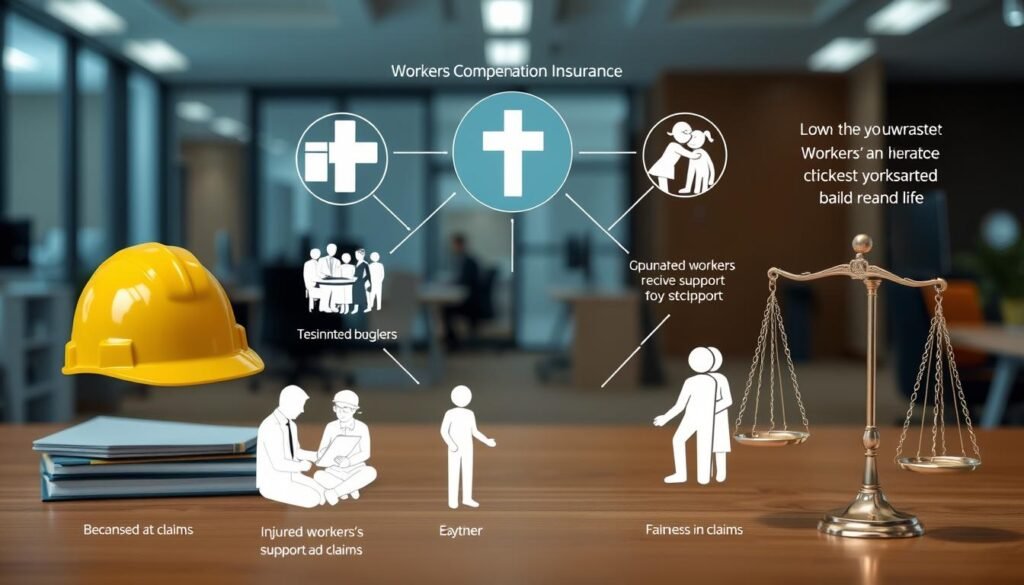
| Workers’ compensation | Employee medical bills and lost wages from work injuries | Required in most states once you hire employees |
| Professional liability (E&O) | Claims of mistakes, bad advice, or missed work | Consultants, agencies, healthcare, and service firms |
| Business owner’s policy (BOP) | Bundles GL + property (often + business interruption) | Most low- to medium-risk small businesses |
People often ask, “What are the 4 types of business insurance?” The common answer is general liability, commercial property, workers’ compensation, and professional liability. A BOP is not a fifth type so much as a money-saving bundle of the first two, usually 15% to 30% cheaper than buying them separately, which is why it is the go-to choice for most small firms.
What Is the Average Cost of Small Business Insurance?
The national average for small business insurance is roughly $65 a month, but the real number depends on your coverage, industry, size, and location. Here is what the major marketplaces report for each core policy.
| Coverage | Typical monthly cost | Source benchmark |
|---|---|---|
| General liability | About $45/month ($500–$1,200/year) | Insureon median of 40,000+ policies |
| Business owner’s policy (BOP) | About $50–$150/month (avg near $83) | Insureon; Progressive Commercial |
| Workers’ compensation | About $45–$70/month median | Homebase industry data |
| Professional liability (E&O) | About $60–$65/month ($700–$1,500/year) | Copeland; industry averages |
| Cyber liability | About $145/month average | Industry averages |
| Commercial auto | From about $500/year per vehicle | Industry averages |
A useful reality check: most LLCs spend roughly $500 to $2,000 a year on general liability alone, and the total climbs once you add workers’ comp, auto, or professional liability. These are medians, not quotes. Your price could land higher in a high-risk trade like construction or food service, or lower for a home-based consultant.
How Much Does a $1,000,000 Liability Insurance Policy Cost?
A $1 million general liability policy costs about $45 a month, or around $542 a year on average, according to Insureon’s data from policies sold to its small business customers. The full range runs from roughly $260 to over $3,000 a year, depending on your industry, location, revenue, and claims history.
That $1 million figure is the most popular choice for a reason. About 85% of Insureon’s general liability customers pick limits of $1 million per occurrence and $2 million aggregate, because many commercial leases and client contracts require at least $1 million in coverage. A higher $2 million per-occurrence limit usually costs only a little more, so it is worth comparing both.
What Does a Liability Limit Like $100,000 or $300,000 Mean?
A liability limit is the most your insurer will pay for a covered claim. So a $100,000 limit of liability means the insurer pays up to $100,000 on a covered claim, and you pay anything above that yourself. A $300,000 liability limit works the same way, just with a higher ceiling. Higher limits cost more but protect more of your assets.
There is one more piece that trips people up: general liability policies usually carry two numbers, like $1 million / $2 million. The first is the per-occurrence limit (the most paid for a single incident). The second is the aggregate limit (the most paid for all claims in the policy year). Here is a worked example from Progressive Commercial: if a carpenter has a $1 million / $1 million policy and three separate clients each sue for $500,000 in one year, each claim is under the $1 million per-occurrence limit, but the three together total $1.5 million, which blows past the $1 million annual aggregate. The third claim would not be fully covered. That gap is exactly why the $1M / $2M combination is so common.
So “a good amount of liability coverage” is usually $1 million per occurrence and $2 million aggregate for a typical small business, but a higher-risk trade, a big contract, or valuable assets can justify more. Match the limit to your actual exposure, not to the cheapest quote.
What Business Insurance Does an LLC Need?
An LLC needs the same core coverage as any other small business, because forming an LLC does not remove the need for insurance. This is the single most common and most costly misunderstanding we see.
An LLC shields your personal assets from certain business debts. It does not protect you from lawsuits, customer injuries, employee accidents, or property damage claims. Insurance covers what your business structure cannot. At a minimum, most LLCs should carry general liability. Add workers’ compensation the moment you hire employees (most states require it), professional liability if you give advice or provide a service, and commercial property or a BOP if you own equipment or space. LLC insurance commonly runs from about $300 a year for a simple single-person LLC up to $5,000 or more for larger operations.
What’s the Best and Cheapest Insurance for a Small Business Owner?
For most small business owners, the best single choice is a Business Owner’s Policy. It bundles general liability and commercial property (and often business interruption) into one cheaper package, covering the most common risks in one bill. If you are a service business with no physical storefront, general liability plus professional liability may matter more than property coverage.
The cheapest plan is usually a standalone general liability policy, which is why it averages around $45 a month and starts even lower for low-risk, home-based, or single-person businesses. But cheapest is not the same as best. A bare general liability policy will not cover a fire in your shop, an injured employee, or a professional mistake. The smarter goal is the lowest-cost mix that still closes your real gaps, which is exactly what a BOP is designed to do.
A Quick Note on “Free Business Insurance”
You will see “free business insurance” in search suggestions, so let’s be clear: there is no such thing as ongoing free business coverage. What is free is the quote and the comparison. Reputable marketplaces and agents let you compare quotes at no cost, and many offer a free risk consultation. But every real policy has a premium. If a site advertises genuinely “free” coverage, treat that as a warning sign and verify the license before going further.
How to Compare Business Insurance Providers Safely
Whether you use an online marketplace, an independent broker, or buy direct from a carrier, the smart comparison is the same. Look past the headline price.
- Compare limits, exclusions, and endorsements, not just premium. The cheapest policy that excludes your main risk is no bargain.
- Check the carrier’s financial strength with AM Best or S&P, so you know it can actually pay claims.
- Read claims reviews on independent sources like the NAIC complaint index, Trustpilot, or your state regulator, rather than testimonials on the seller’s own page.
- Confirm licensing in your state before you buy.
An online aggregator can save time by showing several quotes at once. An independent broker can negotiate complex or high-risk coverage and advocate for you at claim time. A direct carrier gives you one company’s product with in-house claims handling. None is automatically best. The right one depends on how complex your risks are and how much hands-on guidance you want.
The Honest Read
If you came here ready to buy business insurance through mywebinsurance.com, the most useful thing we can tell you is to pause and verify it first. We could not confirm it is a licensed carrier or even identify who underwrites its policies, and for a decision that protects your livelihood, that uncertainty matters more than a convenient website or an attractive quote.
The good news is that the actual business insurance you need is well understood and easy to price from trusted sources. A BOP for most, general liability at a minimum, workers’ comp once you hire, and the right limits for your real exposure. Get quotes from two or three established, verifiable providers, compare coverage rather than just price, and only then decide. That approach protects both your business and your wallet, no matter which website you start on.
Conclusion
The honest verdict on mywebinsurance.com business insurance is “verify before you trust.” We could not confirm it as a licensed insurer, so treat it as an unverified online platform: check the license at NAIC.org or your state department of insurance, find out who underwrites any policy, and compare against established carriers before sharing your details. Meanwhile, the coverage itself is straightforward. Know the core types, expect to pay around $65 a month on average for a small business, choose a BOP for the best all-round value, and match your liability limits to your real risk. Do that, and you will make a confident, well-protected choice.
FAQs
Is MyWebInsurance.com legit?
We could not independently verify mywebinsurance.com as a licensed insurance carrier. It appears to be an online comparison or lead-generation site, and we did not find a state license, a named underwriter, or an AM Best rating in our checks. That is not proof it is unsafe, but you should verify it at NAIC.org or your state insurance department, and compare it with established providers, before sharing any business or financial details.
What types of insurance does MyWebInsurance offer?
Sites like this typically present the common business and personal lines, such as general liability, commercial property, workers’ compensation, professional liability, and cyber coverage. We could not independently confirm which carriers actually back any of these through mywebinsurance.com. Whatever you compare there, ask which insurer underwrites the policy and verify that carrier separately.
What is the best insurance for a small business owner?
For most small businesses, a Business Owner’s Policy (BOP) is the best single choice, because it bundles general liability and commercial property at a lower cost than buying them apart. Service businesses without a storefront may prioritize general liability plus professional liability instead. The best mix depends on your industry, assets, and whether you have employees.
What is the average cost of small business insurance?
Small business insurance averages around $65 a month nationally, but it varies widely. General liability averages about $45 a month, a BOP runs roughly $50 to $150 a month, and workers’ compensation adds a median of about $45 to $70 a month. Your industry, size, location, and claims history drive the final price.
How much does a $1,000,000 liability insurance policy cost?
A $1 million general liability policy costs about $45 a month, or roughly $542 a year on average, based on Insureon’s customer data. The range runs from about $260 to over $3,000 a year depending on your industry and risk. Most small businesses choose $1 million per-occurrence and $2 million aggregate limits because leases and contracts often require it.
What business insurance does an LLC need?
An LLC needs the same core coverage as any small business, because forming an LLC does not remove the need for insurance. An LLC shields your personal assets from certain debts, but not from lawsuits, injuries, or property claims. Most LLCs should carry general liability at minimum, add workers’ comp once they hire, and add professional liability for service work.
What is the $100,000 limit of liability?
A $100,000 limit of liability means your insurer will pay up to $100,000 on a covered claim, and you are responsible for any amount above that. Higher limits cost more but protect more of your assets. For many small businesses, $100,000 is low; $1 million per-occurrence is a more common starting point.
What does $300,000 liability mean?
A $300,000 liability limit means the policy will pay up to $300,000 for a covered claim, with anything beyond that coming out of your pocket. It is higher than a $100,000 limit but still modest for a business that faces lawsuits or serious injury claims. Compare it against the $1 million limits most contracts and leases expect.
What is a good amount of liability coverage?
For a typical small business, $1 million per occurrence and $2 million aggregate is a common and reasonable starting point, and about 85% of buyers choose it. Higher-risk trades, large contracts, or valuable assets can justify $2 million or more. Match your limit to your real exposure, not to the cheapest quote.
What are the 4 types of business insurance?
The four most commonly cited types are general liability, commercial property, workers’ compensation, and professional liability (errors and omissions). A Business Owner’s Policy is not a separate type but a bundle of general liability and property, usually 15% to 30% cheaper than buying them separately.
What is the cheapest insurance plan for a business?
The cheapest single policy is usually standalone general liability, averaging about $45 a month and lower for low-risk, home-based, or single-person businesses. But the cheapest plan is not always the best, since bare general liability won’t cover property loss, employee injuries, or professional mistakes. A BOP is often the lowest-cost way to close several gaps at once.
Is there free business insurance?
No. There is no ongoing free business insurance. The quotes and comparisons are free, and many marketplaces and agents offer a free risk review, but every real policy charges a premium. If a website advertises truly “free” coverage, treat it as a warning sign and verify its license before going further.
How do I check MyWebInsurance.com reviews and claims record?
Do not rely on testimonials posted on the seller’s own page, since those can’t be verified. Instead, check the NAIC complaint index, your state department of insurance, and independent sources like Trustpilot or the Better Business Bureau. For any policy, also look up the actual underwriting carrier’s claims reputation and AM Best rating.
How much would a $300,000 life insurance policy cost?
Life insurance is a separate product from business insurance, so prices vary widely by age and health. A healthy adult in their 30s might pay roughly $20 to $40 a month for a $300,000 term life policy, while older applicants pay more. Always get personalized quotes from licensed life insurers and verify them before buying.
Methodology
This guide was researched and written by the InsuranceGuidances Editorial Team. We attempted to verify mywebinsurance.com through standard checks, including searches for a state license, an underwriting carrier, and an AM Best rating, and we reviewed how the site is described across the web. Cost and coverage figures come from named industry sources, including Insureon, Progressive Commercial, Homebase, the Insurance Information Institute, and NAIC, cited in the Sources section. We do not accept payment for reviews, and we are not affiliated with mywebinsurance.com. Where we could not verify a claim, we say so plainly rather than presenting it as fact.
About InsuranceGuidances
InsuranceGuidances publishes plain-English insurance and out-of-pocket cost guides for a U.S. audience. For company-vetting, B2B, and specialist topics outside our personal-lines focus, articles are produced under the Editorial Team byline with the methodology note above. Our standard is simple: every figure traces to a named source, and we never invent prices, quotes, or testimonials.
Reviewed June 2026 ·
Sources
Insurance Information Institute — Business insurance basics: https://www.iii.org/
NAIC — Consumer license and complaint lookup: https://content.naic.org/
AM Best — Insurer financial strength ratings: https://www.ambest.com/
Insureon — Small business insurance cost: https://www.insureon.com/small-business-insurance/cost
Insureon — How much does $1 million liability insurance cost?: https://www.insureon.com/small-business-insurance/general-liability/1-million-dollar-liability-cost
Insureon — Business owner’s policy (BOP) cost: https://www.insureon.com/small-business-insurance/business-owners-policy/cost
Progressive Commercial — Business insurance cost and limits: https://www.progressivecommercial.com/business-insurance/business-insurance-cost/
Homebase — Small business insurance cost guide 2026: https://www.joinhomebase.com/blog/small-business-insurance-cost
Copeland Insurance — Small business liability insurance cost: https://copelandins.com/small-business-liability-insurance-cost-tips/
Simply Business — Average small business insurance costs: https://www.simplybusiness.com/business-insurance/cost/