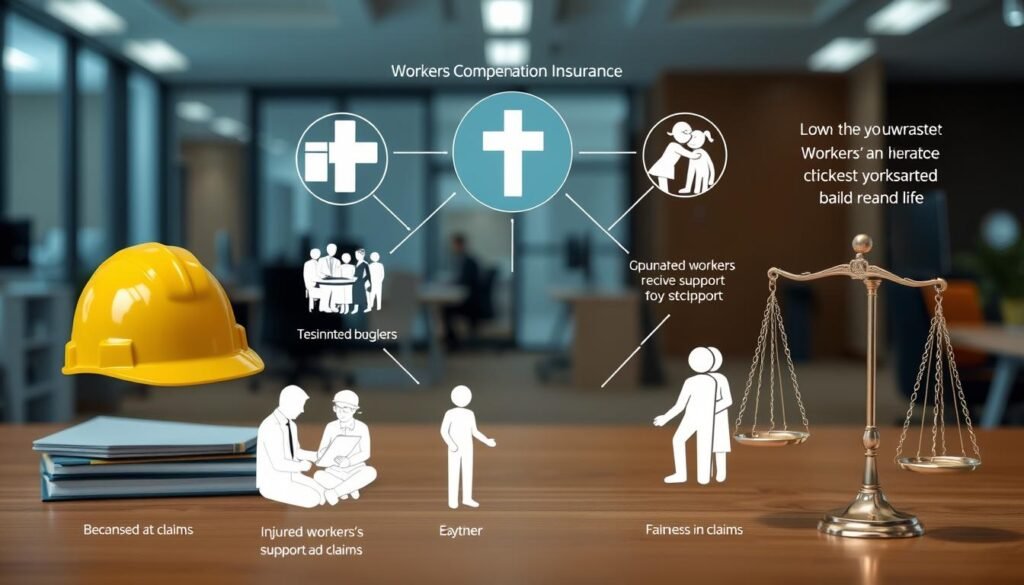
Workmen compensation insurance is a policy an employer buys to cover the cost of work-related injuries and illnesses to its employees, including medical care, lost wages, disability, and death benefits. “Workmen’s compensation” is the older and international name for what the United States now calls “workers’ compensation.” The term is still standard in the UAE, Qatar, India, Singapore, and Malaysia. In the US, it’s a state-mandated, no-fault system that also shields employers from most injury lawsuits. The employer pays for it, not the worker, and the coverage and cost depend heavily on your country or state.
Workmen Compensation Insurance: Key Facts at a Glance
| Item | Detail |
|---|---|
| What it is | Employer coverage for work-related injury and illness |
| Also called | Workers’ compensation (the modern US term) |
| Who pays | The employer, never the employee |
| Core benefits | Medical, lost wages, disability, death |
| US wage replacement | About two-thirds of the wage, tax-free |
| US requirement | Mandatory in every state except Texas |
| International term used in | UAE, Qatar, India, Singapore, Malaysia |
| Fault needed? | No, it’s a no-fault system |
Workmen compensation insurance answers a simple problem: when a worker is hurt on the job, who pays the medical bills and lost income? The answer, in most of the world, is the employer, through this insurance. The name and the exact benefits change from country to country, which is why this term is searched everywhere from Dubai to Detroit. This guide covers the meaning, what’s covered, the cost, and how it works across the US and key international markets.
What Is Workmen Compensation Insurance?
It’s an insurance policy that pays for the consequences of a work-related injury or illness. The employer buys it to meet its legal duty to injured staff. If an employee is hurt doing their job, the policy covers their medical treatment and part of their lost income. In serious cases, it also pays disability or death benefits for the family.
The key idea is that it’s no-fault. A worker usually doesn’t have to prove the employer was negligent to get benefits. In exchange, the employer is generally protected from being sued over the injury. That trade-off is the backbone of the system in the US and many other countries. The worker gets faster, more certain benefits, and the employer gets predictable, limited liability. The employer carries and pays for the policy, so it’s never a cost to the employee.
Workmen’s vs Workers’ Compensation: The Same Thing
This trips people up, so let’s settle it. Workmen’s compensation and workers’ compensation mean the same thing. “Workmen’s” is simply the older term, and the US shifted to the gender-neutral “workers’ compensation” over recent decades.
Much of the world kept the original name. The UAE, Qatar, and the wider Gulf use “workmen’s compensation” in their labour laws and insurance products. India’s landmark law is literally the Workmen’s Compensation Act of 1923. So if you searched “workmen compensation insurance,” you may be in a market that still uses the classic term. Or you may just be using the traditional phrase for US workers’ comp. Either way, the underlying product is the same.

What a Workmen’s Compensation Policy Covers
Coverage varies by country, but the core benefits are remarkably consistent. A standard policy pays for the medical treatment of the work injury, usually in full, with no deductible for the worker.
It also replaces part of lost wages while the worker recovers. In the US, that’s typically about two-thirds of the average wage, paid tax-free, up to state caps. Beyond wages, policies pay disability benefits. These fall into four types: temporary total, temporary partial, permanent total, and permanent partial disability. If a worker dies from a job injury, death benefits go to their dependents. Many systems add vocational rehabilitation to help a worker return to suitable work. Those four buckets, medical, wages, disability, and death, are the heart of every workmen’s comp policy worldwide.
What Workmen’s Comp Does Not Cover
Knowing the gaps matters as much as the benefits. Workmen’s comp is built for work-related harm, so injuries outside that box usually fall outside coverage.
Common exclusions include injuries off the job, injuries while intoxicated or on drugs, self-inflicted injuries, and injuries from horseplay or fighting. The daily commute is usually excluded too, under what US law calls the going-and-coming rule. Travel as part of the job, though, can be covered. One key limit for workers: the system pays economic losses like medical bills and wages, but not pain and suffering, since those non-economic damages aren’t part of no-fault comp. And independent contractors typically aren’t covered, only employees, which is a frequent source of disputes.
Who Needs It, and Can You Buy Your Own?
In most places, the employer must carry it. In the US, workers’ compensation is mandatory in every state except Texas, where it’s optional for private employers, and rules on how many employees trigger the requirement vary by state. The obligation sits with the business, not the worker.
Can an employee buy their own? No, and you don’t need to, since your employer’s policy covers you. The real question comes from the self-employed and independent contractors. They usually aren’t covered by anyone. They can often buy their own workers’ comp voluntarily, and many do. Clients and general contractors increasingly require proof of coverage before hiring them. For a small business owner, the three basic conditions for a valid claim are simple: the injured person is an employee, the employer carries or is subject to comp, and the injury is work-related.

How Much Does Workmen Compensation Insurance Cost?
Cost depends on payroll, job risk, location, and claims history, so a roofer pays far more than an office worker. In the US, small businesses commonly pay around $45 a month on the low end, or roughly $1 for every $100 of payroll, though high-risk trades pay multiples of that.
The price is driven by your job classification code, your state, and your experience modifier. That modifier rises or falls with your claims record. In the UAE and other Gulf markets, premiums are usually based on the number of workers and their salaries, and tend to be modest. Online and instant-quote options have made it easier for small businesses to compare, but the cheapest quote isn’t always the best fit, since carrier service and claims handling matter when someone actually gets hurt. For a deeper US cost breakdown, see our guide on workers’ compensation insurance and PEOs.
Workmen Compensation Insurance Around the World
Because the term is used globally, here’s how it works in the markets that search for it most. The concept is shared, but the rules differ.
In the UAE, workmen’s compensation is governed by the country’s Labour Law, and employers are expected to cover work injuries. Benefits include medical costs, full salary for the first six months of disability, and half for the next six. Permanent disability and death benefits are set by law. Employers often add an employer’s liability extension for larger claims. In India, the Workmen’s Compensation Act of 1923, now also called the Employees’ Compensation Act, makes employers in listed sectors liable for work injuries, occupational disease, and death. Compensation is calculated from wages and earning-capacity loss. In Singapore, the Work Injury Compensation Act is administered by the Ministry of Manpower. It requires employers to insure manual workers and lower-earning staff for work injuries. In Malaysia, the SOCSO scheme provides employment-injury protection for employees, including foreign workers. Across these markets, the shared thread is employer-funded, no-fault protection for job injuries.
The Four Elements of a Workers’ Comp Claim
To collect, a claim generally has to satisfy four elements, and missing any one can sink it. First, there must be an employer-employee relationship, since contractors usually don’t qualify. Second, the employer must be covered by or subject to the comp system.
Third, the injury or illness must arise out of and in the course of employment. That legal test ties the harm to the job. Fourth, the worker must give timely notice and file within the deadline, which varies by state and country. Those deadlines are strict, and late reporting is one of the most common reasons valid claims get denied. Reporting the injury promptly and in writing is the single best thing an injured worker can do to protect a claim.
What Not to Say to a Workmen’s Comp Adjuster
This question comes up often, and the honest answer isn’t about hiding things, it’s about being careful and truthful. Don’t guess, don’t speculate, and don’t downplay or exaggerate your injury.
Avoid saying “I’m fine” out of politeness, since it can be used to minimize your claim, and don’t admit the injury was your fault, because fault generally isn’t required anyway. Don’t speculate about causes or pre-existing conditions before a doctor weighs in, and don’t discuss unrelated activities that could be twisted to suggest you aren’t hurt. What you must never do is conceal or misstate a material fact, since that’s fraud and can void the claim and bring charges. Stick to the plain facts of what happened, when, and where, and let the medical record speak.
Can You Sue? Exclusive Remedy and When Suing Helps
Here’s the trade-off at the center of the system. In exchange for no-fault benefits, workers’ comp is usually the exclusive remedy, meaning an injured employee generally cannot sue their own employer over the injury. So “is suing workers’ comp worth it” often misunderstands how it works.
There are real exceptions worth knowing. You can typically sue a negligent third party, like a defective-equipment maker or another company on the site, separately from your comp claim. If your comp claim is denied or underpaid, you can appeal through the workers’ comp board or hire a lawyer to contest it. That’s different from suing. And in rare cases of employer misconduct, the exclusive-remedy shield can crack. For most injured workers, the practical path is a well-documented claim and, if denied, an appeal, not a lawsuit against the employer.
The Honest Read
The honest read on workmen compensation insurance is that it’s one of the more worker-friendly insurance systems, but it has hard edges. On the plus side, it pays medical bills and part of your wages without you having to prove fault, fast and with certainty. On the minus side, it caps what you get. That means about two-thirds of wages, no pain and suffering, and usually no right to sue your employer. For employers, it’s a required cost that protects the business from far larger lawsuits. That’s why it exists. If you’re a business owner, get it because you must and because one serious injury without it can be ruinous. If you’re a worker, report injuries immediately, be truthful, and appeal a wrongful denial rather than assuming the first “no” is final.
Conclusion
Workmen compensation insurance is employer-funded protection for work-related injury and illness, known as workers’ compensation in the modern US and by its traditional name across the UAE, India, Singapore, and Malaysia. It covers medical care, roughly two-thirds of lost wages, disability, and death benefits, on a no-fault basis, in exchange for limiting most lawsuits against the employer. Costs hinge on payroll and job risk, and the rules differ by country and US state. For an employer meeting a legal duty, or a worker protecting a claim, the essentials are the same. The employer pays, the injury must be work-related, and prompt, honest reporting is what makes the system work.
FAQs
What is workmen compensation insurance?
It’s a policy an employer buys to cover work-related injuries and illnesses to employees, paying for medical care, part of lost wages, disability, and death benefits. It’s a no-fault system, so a worker usually doesn’t have to prove employer negligence. The employer pays for it, not the employee.
Is workmen’s compensation the same as workers’ compensation?
Yes. “Workmen’s compensation” is the older term, and the US moved to the gender-neutral “workers’ compensation.” Many countries, including the UAE, India, Singapore, and Malaysia, still use “workmen’s compensation.” The underlying coverage is the same either way.
What is covered under a workmen’s compensation policy?
It covers the medical treatment of a work injury, usually in full, plus partial lost wages during recovery, disability benefits, and death benefits for dependents. Many policies also include vocational rehabilitation. It does not cover pain and suffering, since it pays economic losses rather than non-economic damages.
What are the three main requirements to obtain workers’ compensation?
Generally, the injured person must be an employee, the employer must carry or be subject to workers’ comp, and the injury or illness must be work-related. Independent contractors usually don’t qualify. Meeting reporting deadlines is also essential to actually receive benefits.
What are the four elements of a workers’ compensation claim?
A valid claim generally needs an employer-employee relationship, an employer covered by the comp system, an injury that arose out of and in the course of employment, and timely notice and filing. Missing any one, especially the deadline, can result in a denial. Prompt written reporting protects the claim.
What are the four types of injuries compensable in workers’ comp?
The four disability classifications are temporary total disability, temporary partial disability, permanent total disability, and permanent partial disability. Benefits differ for each based on how severe and lasting the impairment is. Medical care and, where applicable, death benefits apply alongside these.
What will workers’ comp not cover?
It generally won’t cover off-the-job injuries, injuries while intoxicated, self-inflicted injuries, or injuries from horseplay or fighting. The normal commute is usually excluded under the going-and-coming rule. It also doesn’t pay pain and suffering, and it typically excludes independent contractors.
Can I buy my own workers’ comp insurance?
Employees don’t buy it, since the employer’s policy covers them. But the self-employed and independent contractors, who usually aren’t covered by anyone, can often buy their own voluntarily. Many do, because clients and general contractors frequently require proof of coverage before hiring.
How much does workmen’s comp insurance cost per month?
In the US, small businesses commonly pay around $45 a month on the low end, or roughly $1 per $100 of payroll, with high-risk trades paying much more. Price depends on your job classification, payroll, state, and claims history. In the UAE, premiums are usually based on worker count and salaries.
What is the best workers’ compensation insurance?
There’s no single best, since the right choice depends on your state, industry, and size, and some states use a monopolistic state fund you must use. Compare licensed carriers on price, financial strength, and claims service rather than trusting a ranking. In monopolistic states like Ohio, Washington, Wyoming, and North Dakota, you buy from the state fund.
What not to say to a workmen’s comp adjuster?
Don’t guess, exaggerate, or downplay your injury, and avoid saying “I’m fine” out of habit. Don’t admit fault, since fault usually isn’t required, and don’t speculate about causes before a doctor does. Never conceal a material fact, as that’s fraud. Stick to the facts of what happened.
Is suing workers’ comp worth it?
Workers’ comp is usually the exclusive remedy, so you generally can’t sue your own employer over the injury. You can, however, sue a negligent third party separately, and you can appeal a denied or underpaid claim through the comp board. For most workers, appealing beats trying to sue the employer.
What are the disadvantages of workers’ compensation?
For workers, it caps benefits at about two-thirds of wages, pays nothing for pain and suffering, and usually bars suing the employer. Claims can also be denied or disputed. For employers, it’s a required cost that rises with claims. Still, it delivers faster, more certain benefits than a lawsuit would.
Is workmen’s compensation insurance required in the UAE?
Employers in the UAE are responsible for compensating work-related injuries under the Labour Law, and workmen’s compensation insurance is the standard way they meet that duty. Coverage includes medical costs, salary during recovery, and disability or death benefits set by law. Many employers add an employer’s liability extension.
What is the Workmen’s Compensation Act 1923 in India?
It’s India’s foundational law making employers in listed sectors liable to compensate employees for work injuries, occupational disease, or death arising from employment. Now also called the Employees’ Compensation Act, it bases compensation on wages and earning-capacity loss. Employers commonly buy workmen’s compensation insurance to cover this liability.
About This Guide
The InsuranceGuidances Editorial Team researches insurance topics for a global readership using primary sources. This guide drew on US state workers’ compensation rules and NCCI cost data, the UAE Labour Law, India’s Workmen’s Compensation Act 1923, Singapore’s Work Injury Compensation Act, and Malaysia’s SOCSO framework. Reviewed July 2026.
Sources
National Association of Insurance Commissioners (NAIC), state insurance departments (content.naic.org)
US Department of Labor, workers’ compensation overview (dol.gov)
NCCI, workers’ compensation class codes and experience rating (ncci.com)
National Federation of Independent Business, state workers’ comp requirements and Texas exception (nfib.com)
MoneyGeek, average workers’ compensation cost per employee (moneygeek.com)
UAE Government and Policybazaar UAE, workmen’s compensation under UAE Labour Law (policybazaar.ae)
Government of India and Tata AIG, Workmen’s Compensation Act 1923 provisions (labour.gov.in, tataaig.com)
Singapore Ministry of Manpower, Work Injury Compensation Act (mom.gov.sg)
SOCSO Malaysia (PERKESO), employment injury scheme (perkeso.gov.my)
Insurance Information Institute, workers’ compensation basics (iii.org)