
There is no single best pet insurance USA winner, and here’s proof: the big “best of” lists don’t even agree with each other. One crowns ASPCA, another Pets Best, another Figo. Consumer Reports rated 14 insurers and found nearly all of them only middling on customer satisfaction. So the real answer isn’t a company name, it’s a match. The best plan is the one that fits your pet’s age, breed, and your budget, with a resetting annual limit and no per-condition cap. This guide shows you how to find your match, in plain words.
Best Pet Insurance USA: Key Facts at a Glance
| Question | Short answer |
|---|---|
| Is there one best company? | No. The “best” lists openly contradict each other. |
| Average cost (2026) | About $62/month for dogs, $32/month for cats (NAPHIA). |
| What matters most | A resetting annual limit and no per-condition or lifetime cap. |
| Cheapest well-rated names | Lemonade and ASPCA often start around $10 to $15/month for cats. |
| Best for older pets | Insurers with no upper age limit, like Pets Best and ASPCA. |
| The golden rule | Enroll while young and healthy, before any pre-existing condition. |
Best pet insurance USA: why there’s no single winner
You typed “best pet insurance USA” hoping for a clear winner. I get it. But I’m going to do something the big sites won’t: tell you the truth up front. There isn’t one.
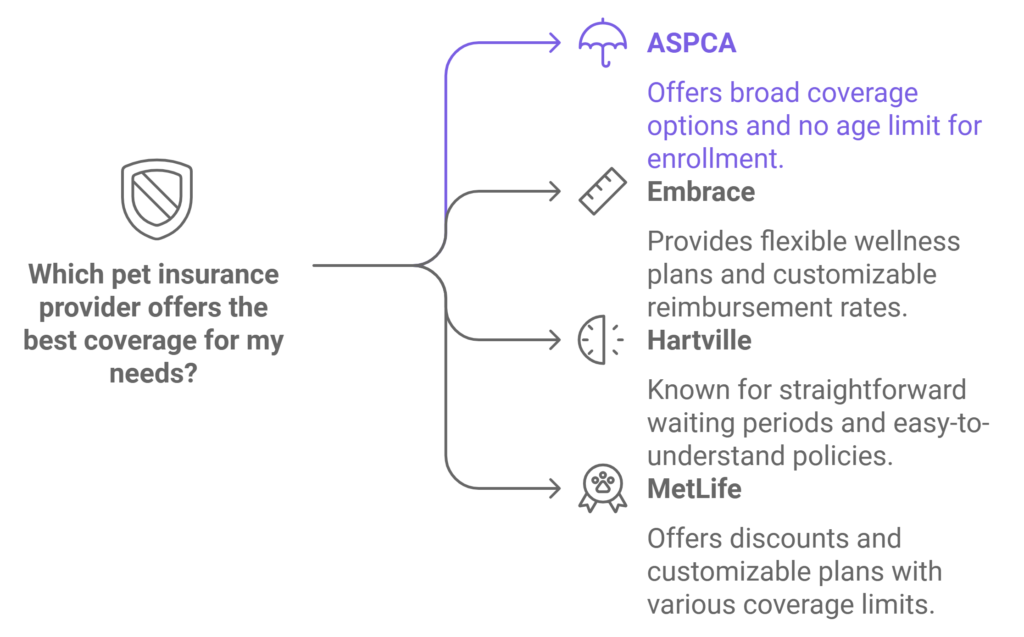
Look at the major “best of” lists side by side and they disagree. NerdWallet puts ASPCA, Spot, and MetLife on top. Forbes says Pets Best and Figo. Money magazine picks Figo, Pumpkin, and MetLife. Pawlicy says Trupanion and Embrace lead on service. If the experts can’t agree on a single winner, that’s your first clue: “best” depends entirely on your pet and your budget. This guide won’t fake a winner. Instead, it’ll help you find the right match, which is a far more useful thing.
Why “top-rated pet insurance” is the wrong thing to chase
Here’s what most rankings hide. Consumer Reports ran a survey of 3,583 policyholders across 14 insurers. The finding? Nearly every single company earned only a midrange satisfaction score, and one scored below that. In other words, no US pet insurer is wowing its customers. They’re all roughly fine.
So that changes things. If no company is clearly the best, chasing a “winner” is mostly a waste of time. The smarter move is to match a solid, well-rated insurer to your specific situation, and to build the policy correctly. Get the structure right, and several companies will serve you well. Get it wrong, and even a “top-rated” plan will disappoint you when you file a claim.
So let’s focus on the two things that actually decide whether your policy is good: how it’s built, and how it fits your pet.
How pet insurance reimbursement works (deductible and payout, made simple)
Most US pet insurance works like this: you pay the vet, then file a claim and get reimbursed. After you meet your yearly deductible, the plan pays back a set percentage of the bill, usually 70%, 80%, or 90%, up to your annual limit.
Here’s a real example. Say your dog needs ACL surgery costing $4,500, and you have a $250 deductible and 80% reimbursement. The plan looks at $4,500 minus $250, which is $4,250, and pays back 80% of that, about $3,400. You pay roughly $1,100. That’s the model almost every good insurer uses (Lemonade, ASPCA, Healthy Paws, Pets Best, Embrace, Spot, Figo, MetLife).
Watch out for two other models. A “benefit schedule” caps what the plan pays per condition, regardless of the real bill, so on that same surgery you could get far less back. Some Nationwide plans work this way. And Trupanion uses a per-condition deductible instead of an annual one, which can be great for a lifelong illness. Knowing which model a plan uses matters more than its spot on any ranking.

Annual limits and per-condition caps: the feature that matters most
If you remember one thing, remember this: for any serious or long-term illness, the plan’s payout limits matter most. Look for two things.
First, an annual limit that resets each year, so a fresh pool of money is available every policy year. Second, and even better, no per-condition or lifetime cap, so coverage never runs out on a single illness. A plan that caps one condition at, say, $10,000 total can leave you uninsured for that illness a few years into a chronic disease. This is the whole reason we built a separate guide to pet insurance for chronic conditions, where the cap structure decides everything. Many strong insurers now offer unlimited annual options, including Trupanion, Healthy Paws, ASPCA, Pets Best, Spot, Embrace, MetLife, Figo, and Pumpkin.
This is the trap the “cheapest plan” hunters fall into. A low monthly price with a low per-condition cap looks great until your pet gets a disease that needs care for life. In my experience, this is the single most common regret I see: people optimize for the monthly premium and ignore the cap, then hit the ceiling right when they need the coverage most.

How much does pet insurance cost per month in the USA?
Real numbers, from NAPHIA, the industry association that tracks US pet insurance data, for a comprehensive accident-and-illness plan:
| Pet | Average monthly cost (2026) |
|---|---|
| Dog | About $62 a month |
| Cat | About $32 a month |
But averages hide a wide range. For a young, healthy pet, the cheapest well-rated plans can start around $10 to $15 a month for cats and $40 for dogs. For a 10-year-old dog, quotes can jump past $130 a month. Your price depends on your pet’s age, breed, your location, and the deductible and reimbursement you pick. One honest note: dog insurance costs rose about 11% in the past year, per NAPHIA, while cat insurance barely moved. Rising vet costs are pushing premiums up, which is exactly why locking in a rate while your pet is young pays off.
Best pet insurance by situation: puppy, adult, senior, and chronic care
Since there’s no universal best, here’s how to match a well-rated insurer to your real situation. Always confirm with your own quote, since availability and price vary by state.
| Your situation | Commonly strong options | Why |
|---|---|---|
| Puppy or kitten | Lemonade, ASPCA | Lowest starting prices; lock in a low rate early |
| Adult pet (1 to 7) | Healthy Paws, Embrace | Strong value and solid coverage |
| Senior pet (8+) | Pets Best, ASPCA | No upper age limit; see our older-pet guide |
| Chronic illness risk | Trupanion, Healthy Paws | Unlimited limits, no per-condition cap |
| Budget under $25/month | ASPCA, Lemonade | Comprehensive coverage at low starting prices |
| Best service reputation | Trupanion, Embrace | Highest satisfaction ratings online |
| Fastest claims | Lemonade, Trupanion | Quick processing and reimbursement |
| Exotic pets (birds, reptiles) | Nationwide | The main major insurer that covers exotics |
See how no company wins every row? That’s the point. ASPCA and Spot actually share the same underwriter and offer near-identical coverage, so they’re often interchangeable on price and benefits.
A quick word on “top pet insurance” rankings and the year in the search box
One more honest note, since these searches are common. If you’re typing “top pet insurance USA,” “best pet insurance US News,” or an old “best pet insurance 2025” query, here’s the thing to know: those ranked lists are genuinely useful for research, but they’re built on averages and each publisher’s own scoring, so they name different winners and they go stale as prices change each year. Treat any list, from US News, NerdWallet, Forbes, or anyone else, as a starting shortlist of solid companies, not a final answer. Then run your own quotes for your pet.
The same goes for “best cat insurance USA” versus “best dog insurance USA.” They pull up mostly the same companies, because the insurer is the same; only the price and a few breed-specific risks change. So don’t get lost hunting for a species-specific “winner.” Pick two or three well-rated insurers that fit your situation from the table above, and compare them head to head at the same deductible and reimbursement rate. That five-minute comparison beats any headline ranking, in any year.
Best pet insurance for dogs vs. best cat insurance
More than 75% of insured pets are dogs, per NAPHIA, so most “best pet insurance” and “best dog insurance” lists are basically the same. For dogs, the key is checking that your breed’s common problems are covered, especially hereditary issues like hip dysplasia in German Shepherds, Labradors, and Golden Retrievers. Most insurers cover hip dysplasia if your dog wasn’t diagnosed before the policy, but some, like Healthy Paws, add waiting periods or age limits for it.
For cats, coverage is cheaper (that $32 average), and the big long-term risks are things like chronic kidney disease and diabetes. The same rule applies: enroll early, and pick a plan with no per-condition cap so a lifelong condition stays covered. Even a big one-off procedure, like a cat kidney transplant, is only covered if the illness started after your policy began.
ASPCA, Lemonade, Trupanion, and Pets Best: an honest snapshot
Since your search results name specific companies, here’s the honest snapshot:
- ASPCA (underwritten with Spot): among the most comprehensive base coverage, covers alternative therapies, behavioral issues, and prescription food. Low starting prices. Its app gets mixed reviews.
- Lemonade: often the cheapest, with a fast, app-based claims process. The trade-off is it’s available in fewer states (around 37 to 42, depending on the source) and exam fees need an add-on.
- Pets Best: no upper age limit, good for seniors, with flexible plans.
- Trupanion: no payout caps and can pay your vet directly, but it’s often the priciest.
- Healthy Paws: simple plans, no per-incident or lifetime caps, strong claims reputation.
None of these is “the best.” Each is the best for someone. Match it to your situation using the table above.
Is pet insurance worth it, or should you self-insure?
A fair question, and the honest answer is “it depends.” Only about 5.7 million of the roughly 147 million dogs and cats in the US are insured, so most owners skip it. If your pet is young and healthy and you have solid savings, self-insuring (setting money aside every month) can work.
But here’s the case for coverage: modern vet care now includes things like cancer treatment, surgery, and stem-cell therapy that can run into the thousands. One serious illness can cost more than years of premiums. Pet insurance turns an unpredictable, budget-wrecking bill into a steady monthly cost. It’s most worth it when bought early, before any condition becomes pre-existing and locked out. And a note on Reddit threads and reviews: they’re useful for spotting patterns, but every story reflects someone else’s pet, state, and plan, not your quote. Use them for questions to ask, then get your own numbers.
The Honest Read: how to actually choose
In my years around insurance and claims, the pattern that costs pet owners the most is chasing a label instead of a fit. Someone reads that “Company X is the best,” buys it, and later learns it had a low per-condition cap, or didn’t cover their senior pet, or wasn’t sold in their state. The label was real; the fit was wrong.
So here’s the plain verdict.
Pet insurance is worth buying if: you enroll while your pet is healthy, and you pick a well-rated insurer with a resetting annual limit and no per-condition cap that fits your pet’s age and your budget. Done that way, several companies will serve you well, and you’ll be protected from the big bills that actually threaten your finances.
Skip a “best list” winner and match instead. Get quotes from at least three insurers that fit your situation, compare the same deductible and reimbursement rate, check each one’s caps and waiting periods, and read the exclusions before you buy. That process beats any ranking, including this one.
Conclusion
The best pet insurance USA for you isn’t a name on someone’s list, it’s a match. The rankings contradict each other, and Consumer Reports found the whole category is only middling, so stop hunting for a winner. Instead, enroll while your pet is young, pick a plan with a resetting annual limit and no per-condition cap, match the insurer to your pet’s age and your budget, and compare three real quotes. Do that, and you’ll have genuinely good coverage, no matter whose “best of” list you started from.
Start here, then go deeper
Think of this page as your starting point. Once you know the golden rule (enroll early, pick a resetting annual limit, avoid per-condition caps), the next step is the topic that fits your pet: the chronic conditions guide if a lifelong illness is your worry, the pre-existing conditions guide if your pet is already sick, or the older-pet guide if you’re insuring a senior.
FAQs
What is the best pet insurance in the USA?
There’s no single best, and the major “best of” lists openly disagree, naming different winners like ASPCA, Pets Best, and Figo. Consumer Reports found nearly all insurers earn only midrange satisfaction. The best plan is the one that matches your pet’s age, breed, and your budget, with a resetting annual limit and no per-condition cap.
How much does pet insurance cost per month in the USA?
For a comprehensive accident-and-illness plan, NAPHIA reports averages of about $62 a month for dogs and $32 a month for cats in 2026. Young, healthy pets can start around $10 to $15 a month for cats, while a senior dog can exceed $130. Your price depends on age, breed, location, and your deductible and reimbursement choices.
What’s the best pet insurance for dogs?
Because over 75% of insured pets are dogs, the best dog insurers largely match the best overall list. Focus on plans that cover your breed’s common hereditary issues, like hip dysplasia, and that have no per-condition cap. Compare a few insurers that fit your dog’s age rather than trusting a single “winner.”
What’s the best pet insurance for cats?
Cat coverage is cheaper, averaging about $32 a month. The main long-term risks are chronic kidney disease and diabetes, so enroll while your cat is young and pick a plan with no per-condition cap so a lifelong condition stays covered. Lemonade and ASPCA often have the lowest starting cat prices.
Is ASPCA pet insurance good?
ASPCA offers some of the most comprehensive base coverage, including alternative therapies, behavioral issues, and prescription food, at low starting prices. It shares an underwriter with Spot, so their plans are similar. Its main knock is a mixed-reviews mobile app. It’s a strong choice, but not automatically “the best” for everyone.
Is Lemonade pet insurance good?
Lemonade is often among the cheapest, with a fast, app-based claims process and useful bundling discounts. The trade-offs are that it’s available in fewer states than some rivals and its exam-fee coverage needs an add-on. For budget-focused owners of young pets, it’s a very competitive option.
What is the best pet insurance for older pets?
Look for insurers with no upper age limit for enrollment, such as Pets Best and ASPCA. Expect premiums two to three times higher than puppy or kitten rates, since older pets cost more to insure. Enrolling before your pet develops conditions is still the key to avoiding pre-existing exclusions.
Which pet insurance has no payout caps?
Several strong insurers offer unlimited annual limits and no per-condition or lifetime caps, including Trupanion, Healthy Paws, ASPCA, Pets Best, Spot, Embrace, MetLife, Figo, and Pumpkin. For any serious or chronic illness, this is the most important feature to look for, more important than a plan’s spot on a ranking.
What does Consumer Reports say about pet insurance?
Consumer Reports surveyed 3,583 policyholders across 14 insurers and found that nearly all earned only a midrange overall satisfaction score, with one rated below that. The takeaway is that no US pet insurer clearly stands out on satisfaction, so matching a solid insurer to your needs matters more than chasing a “winner.”
Is pet insurance worth it?
It depends on your pet and finances. Only about 5.7 million of roughly 147 million US pets are insured, so many owners self-insure with savings. But one serious illness can cost thousands, more than years of premiums, so insurance is often worth it, especially when bought early before conditions become pre-existing.
What’s the cheapest pet insurance in the USA?
For young, healthy pets, the cheapest well-rated options often start around $10 to $15 a month for cats and $40 for dogs, with insurers like Lemonade and ASPCA. Choosing a higher deductible and a lower reimbursement rate lowers the price further. Always compare the same coverage settings across insurers.
What pet insurance is best for chronic conditions?
Choose a plan with a resetting annual limit and, ideally, no per-condition or lifetime cap, so coverage doesn’t run out on a lifelong illness. Trupanion and Healthy Paws are commonly cited for this. Crucially, the condition must not be pre-existing, so enroll before any symptoms appear.
Does pet insurance cover pre-existing conditions?
Almost never. A condition your pet showed signs of before the policy started is excluded at nearly every insurer. AKC Pet Insurance is the rare exception, covering some pre-existing conditions after 365 days of continuous coverage. Our full pre-existing conditions guide walks through the details. This is why enrolling while your pet is young and healthy matters so much.
How do I compare pet insurance companies fairly?
Get quotes from at least three insurers using the same deductible, reimbursement rate, and annual limit, then compare caps, waiting periods, and exclusions, not just the monthly price. Check objective measures like NAPHIA data and Consumer Reports satisfaction. The cheapest plan with no per-condition cap and good coverage usually wins for you.
Is a “best pet insurance” list on Reddit reliable?
Reddit threads are useful for spotting common complaints and questions to ask, but they can’t price your policy. Every story reflects that person’s pet, state, and plan, not yours. Use them for ideas, then get your own quotes and compare coverage settings, since your real price and fit are the only ones that count.
About the Author
Md Shahinuzzaman is an insurance and out-of-pocket healthcare cost specialist with 16 years of banking and insurance experience. He writes clear, honest guides for InsuranceGuidances.com to help pet owners find coverage that actually fits, without the hype. Every fact here is checked against named sources, including NAPHIA, Consumer Reports, and major insurer disclosures. Reviewed July 2026.
Sources
AKC Pet Insurance, pre-existing conditions coverage after 365 days. https://www.akcpetinsurance.com/plans/pre-existing-conditions
North American Pet Health Insurance Association (NAPHIA), state of the industry and average premiums. https://naphia.org/
Consumer Reports, is pet insurance worth it (14-insurer satisfaction ratings). https://www.consumerreports.org/money/pet-insurance/is-pet-insurance-worth-it-a8622180631/
NerdWallet, best pet insurance companies 2026. https://www.nerdwallet.com/insurance/pet/best-pet-insurance-companies
Forbes Advisor, best pet insurance companies 2026. https://www.forbes.com/advisor/pet-insurance/best-pet-insurance/
U.S. News, best pet insurance companies 2026. https://www.usnews.com/insurance/pet-insurance
Money, best pet insurance companies 2026. https://money.com/best-pet-insurance/
Pawlicy Advisor, best pet insurance companies 2026. https://www.pawlicy.com/blog/best-pet-insurance/
Healthy Paws, 2026 pet insurance comparison chart (payout limits). https://www.healthypawspetinsurance.com/pet-insurance-comparison.html
How Much Is Pet Insurance, 2026 side-by-side comparison (reimbursement models). https://howmuchispetinsurance.com/pet-insurance-comparison.html