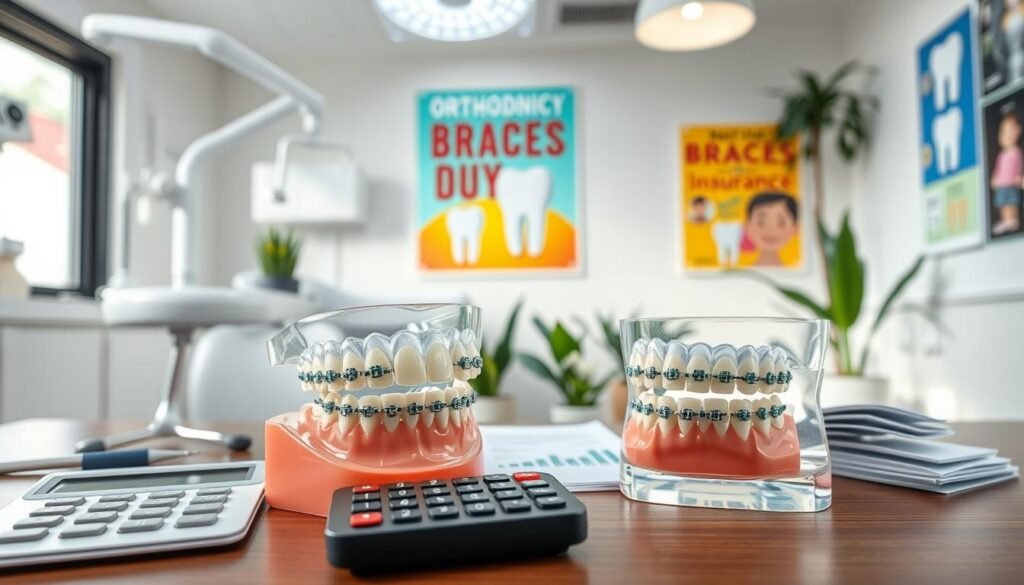
With insurance, braces typically cost $1,000 to $4,000 out of pocket, because dental plans pay 50% of treatment only up to a lifetime orthodontic maximum (usually $1,000 to $3,000), not 50% of the whole bill. Metal braces run about $3,000 to $7,000 before insurance, so on a $5,500 case with a $2,000 lifetime benefit, your plan pays $2,000 and you owe roughly $3,500, often around $100 to $200 a month on a payment plan. Understanding how much braces cost with insurance really comes down to that lifetime cap, which is the detail most people miss until they sign the contract.
How Much Do Braces Cost With Insurance, by Type
| Braces type | Without insurance | Your est. out-of-pocket (with ~$2,000 lifetime benefit) |
|---|---|---|
| Metal | $3,000 – $7,000 | $1,500 – $5,000 |
| Ceramic | $4,000 – $8,000 | $2,000 – $6,000 |
| Lingual | $8,000 – $13,000 | Often full price (usually not covered) |
| Clear aligners (Invisalign) | $3,500 – $8,000 | $1,750 – $6,000 (if covered) |
You get the orthodontist’s quote, you have dental insurance, and you assume it’ll knock off half. Then you learn about the lifetime cap, and the math changes a lot. Braces coverage doesn’t work like regular dental coverage, so here’s exactly what you’ll pay, why, and how to bring it down.https://insuranceguidances.com/root-canal-cost-without-insurance/
How Much Do Braces Cost With Insurance?
With insurance, most people pay between $1,000 and $4,000 out of pocket for braces, depending on the type and their plan’s lifetime cap. The key is that insurance covers a fixed maximum, not a percentage of whatever the braces cost.
Here’s a real example. Say metal braces cost $5,500 and your plan pays 50% up to a $2,000 lifetime orthodontic maximum. Fifty percent of $5,500 is $2,750, but that’s more than the $2,000 cap, so your plan pays $2,000 and you owe $3,500. On a higher-priced case, the gap is bigger: a $7,000 case still gets you only the $2,000 benefit, leaving $5,000. That capped benefit, not a clean 50% discount, is what “with insurance” really means for braces.
How Braces Insurance Actually Works: The Lifetime Orthodontic Maximum
Orthodontic coverage works differently from the rest of your dental plan, and the lifetime maximum is the part that trips people up. Most plans pay 50% of orthodontic treatment, but only up to a one-time dollar cap that never resets.
That cap is usually $1,000 to $3,000 per person, most commonly around $1,500 to $2,000, and it’s separate from your annual dental maximum. Once you’ve used it, you’ve used it for life, even across different sets of braces. So your plan pays the lesser of 50% of the cost or the lifetime cap. Most plans also require pre-authorization and documentation before treatment, and many have a 6 to 12 month waiting period before orthodontic benefits kick in. Always request a pre-treatment estimate so you know your exact share before you start.
Braces Cost by Type, With and Without Insurance
The type of braces is the biggest driver of cost, and it also affects whether insurance covers them at all. Metal is cheapest and best covered; lingual is priciest and usually not covered.
Without insurance, metal braces run about $3,000 to $7,000, ceramic $4,000 to $8,000, clear aligners like Invisalign $3,500 to $8,000, and lingual (behind-the-teeth) braces $8,000 to $13,000. Insurance generally treats metal and ceramic the same and increasingly covers clear aligners at the same rate, but lingual braces are often classified as cosmetic and get little or no coverage. Because your plan’s benefit is capped either way, choosing a pricier type mostly raises your out-of-pocket, not your insurance payout.
Does Insurance Cover Braces for Adults vs. Kids?
Insurance covers braces far better for children than for adults. Most plans limit orthodontic benefits to dependents under 19, and many exclude adult orthodontics entirely or apply a lower cap.
Children’s coverage typically includes that 50% benefit up to the lifetime max, and under the Affordable Care Act, medically necessary orthodontics is an essential health benefit for kids (though purely cosmetic treatment isn’t). Adults, who now make up about one-third of orthodontic patients, often face no coverage or a smaller benefit, plus braces that cost a bit more because adult treatment can take longer. If you’re an adult, check whether your plan covers adult ortho at all before counting on it, and look at HSA or FSA funds to pay with pre-tax dollars.
Does Delta Dental Cover Braces?
Yes, Delta Dental covers braces under many plans, but the details depend on your plan type. PPO plans typically pay 50% of treatment up to a lifetime maximum of about $1,000 to $2,500, often around $1,500.
DeltaCare USA (a DHMO) instead uses set copays for braces, commonly $1,500 to $2,500, but requires an in-network orthodontist and rarely covers Invisalign, ceramic, or lingual options. Like most insurers, Delta focuses coverage on dependents under 19, with adult benefits available only on some premium or employer plans, and it usually requires pre-authorization. Whatever your insurer, the structure is similar: 50% up to a lifetime cap, so ask for your specific lifetime maximum in writing.
Can I Pay for Braces Monthly?
Yes, and most orthodontists make it easy with in-house payment plans, frequently at 0% interest. Monthly braces payments typically run about $100 to $250, depending on the total cost, your down payment, and the treatment length.
For example, a $5,500 metal-braces case with a $500 down payment spread over 24 months comes to about $208 a month with no interest. Apply a $2,000 insurance benefit first and that drops to roughly $125 a month. So “Can I pay $100 a month for braces?” is often yes, especially with insurance or a longer plan. Ask the orthodontist about the down payment, the term, and whether there’s any interest.
How to Get Braces Cheaper (or Even Free)
You have several ways to lower the cost of braces, and a few paths to free or near-free care for those who qualify. The biggest savings come from where you get treatment and how you pay:
- Dental school clinics: orthodontic residents treat patients under faculty supervision at 20% to 50% below private practice (search ADEA.org for programs).
- Pay-in-full discount: many offices cut 5% to 10% off for paying the full balance upfront.
- Discount dental plans: a $100 to $200 yearly membership can give 15% to 25% off, with no waiting periods or age limits.
- Medicaid and CHIP: cover medically necessary braces for eligible children, varying by state (not cosmetic cases).
- Charity programs: nonprofits like Smiles Change Lives and Smile for a Lifetime offer free or low-cost braces to qualifying kids.
- HSA/FSA: pay with pre-tax dollars to effectively lower the cost.
Why Would Insurance Deny Braces?
Insurance denies braces most often when the treatment is considered cosmetic rather than medically necessary. Several other plan rules can also lead to a denial.
Common reasons include adult orthodontics being excluded from your plan, an unmet waiting period, a lifetime orthodontic maximum that’s already been used, missing pre-authorization or documentation, or seeing an out-of-network provider. If your claim is denied and you believe the braces are medically necessary, you can dispute the decision with supporting documentation from your orthodontist. A pre-treatment estimate is the best way to catch a coverage problem before you commit.
Is Braces Insurance Worth It?
It depends on whether you already have orthodontic coverage or you’d be buying it just for braces. If your existing dental plan includes an ortho benefit, it’s usually worth using, since a $1,500 to $2,000 lifetime benefit typically outweighs the incremental premium.
Buying standalone or supplemental orthodontic insurance specifically for braces is a tougher call. These policies often have 6 to 12 month waiting periods, low lifetime caps, and exclusions for pre-existing conditions, so if you already know you need braces, the plan may not cover them, or you may pay nearly as much in premiums as you get back. Do the math: compare the total premiums against the actual benefit, and weigh it against a discount plan plus a payment plan and HSA/FSA funds.
The Honest Read
The single biggest misunderstanding about braces and insurance is the belief that “covered” means half off. It doesn’t. It means a fixed lifetime benefit, usually $1,500 to $2,000, applied once, which on a typical $5,000-plus case leaves most of the bill to you.
The smartest moves are practical: get a written pre-treatment estimate so the cap doesn’t surprise you, ask the orthodontist for a pay-in-full or cash discount, and if you’re paying out of pocket, price a dental school clinic before private practice. Braces are worth it for the right case, but go in knowing your real number, not the half-off figure in your head.
Conclusion
Braces cost about $1,000 to $4,000 out of pocket with insurance, because plans pay 50% only up to a lifetime orthodontic maximum of roughly $1,000 to $3,000, not half the total. Metal braces are cheapest and best covered; lingual is priciest and usually isn’t. Coverage favors children over adults, payment plans run about $100 to $250 a month, and dental schools, discounts, Medicaid for kids, and HSA/FSA funds can all lower the cost. Get a pre-treatment estimate, learn your lifetime cap, and you’ll know exactly what your smile will really cost.
Frequently Asked Questions
How much do braces cost with insurance?
With insurance, braces typically cost $1,000 to $4,000 out of pocket. Plans pay 50% of treatment up to a lifetime orthodontic maximum of about $1,000 to $3,000, so on a $5,500 case with a $2,000 cap, the plan pays $2,000 and you owe $3,500.
How does orthodontic insurance actually work?
Orthodontic coverage pays 50% of treatment only up to a one-time lifetime maximum, usually $1,000 to $3,000, that never resets, even across multiple sets of braces. It’s separate from your annual dental maximum, and most plans require pre-authorization and a 6 to 12 month waiting period.
How much do braces cost without insurance?
Without insurance, metal braces run about $3,000 to $7,000, ceramic $4,000 to $8,000, clear aligners $3,500 to $8,000, and lingual braces $8,000 to $13,000. The price covers the entire treatment, usually 18 to 36 months, not a yearly fee.
Does insurance cover braces for adults?
Often not, or only partially. Most plans limit orthodontic benefits to dependents under 19, and many exclude adult orthodontics or apply a lower cap. Adults make up about one-third of patients now, so check your plan, and consider HSA or FSA funds to pay with pre-tax dollars.
Does Delta Dental cover braces?
Yes, under many plans. Delta Dental PPO plans typically pay 50% of treatment up to a lifetime maximum of about $1,000 to $2,500, often $1,500. DeltaCare USA (DHMO) uses set copays, usually $1,500 to $2,500, with an in-network orthodontist. Coverage mainly targets dependents under 19.
Can I pay $100 a month for braces?
Often yes. Most orthodontists offer 0% in-house payment plans, with monthly payments typically $100 to $250 based on the cost, down payment, and term. A $5,500 case over 24 months is about $208 a month, or roughly $125 with a $2,000 insurance benefit applied.
What is the cheapest way to get braces?
Metal braces are the cheapest type. For the lowest total cost, try a dental school clinic (20% to 50% off), ask for a pay-in-full discount (5% to 10%), or use a discount dental plan. Medicaid covers medically necessary braces for eligible children.
Can I still get free braces?
Sometimes. Medicaid and CHIP cover medically necessary braces for qualifying children, and nonprofits like Smiles Change Lives and Smile for a Lifetime provide free or low-cost braces to eligible kids. Free braces for adults are rare; dental schools and payment plans are the realistic low-cost routes.
Why would insurance deny braces?
The most common reason is that the braces are considered cosmetic rather than medically necessary. Others include adult orthodontics being excluded, an unmet waiting period, a used-up lifetime maximum, missing pre-authorization, or an out-of-network provider. A pre-treatment estimate helps you catch these first.
Is $10,000 too much for braces?
For standard metal or ceramic braces, $10,000 is on the high side, since typical treatment runs $3,000 to $7,000. Prices near $10,000 usually involve lingual braces or complex, long cases. If you’re quoted that for ordinary braces, get two or three more estimates before committing.
How much should 2 years of braces cost?
Braces are priced for the whole treatment, not per year, and most treatment lasts about 18 to 24 months. So “two years of braces” is simply the full cost: roughly $3,000 to $7,000 for metal, more for ceramic, lingual, or complex cases.
Is braces insurance worth it?
If your dental plan already includes orthodontic coverage, it’s usually worth using, since the lifetime benefit outweighs the added premium. Buying standalone ortho insurance just for braces is often not worth it, given waiting periods, low caps, and pre-existing exclusions. Compare premiums to the actual benefit.
About the Author
Md Shahinuzzaman writes about insurance and out-of-pocket healthcare costs at InsuranceGuidances.com, turning confusing dental bills into clear, source-backed guidance. For this guide, every figure traces to named 2025–2026 cost data and insurer coverage rules, and it corrects the common myth that braces insurance simply pays half, when it actually pays up to a fixed lifetime cap.
Sources
- SmileWorks NYC — how much do braces cost (2025 price guide). https://www.smileworksnyc.com/how-much-do-braces-cost/
- SmileWorks NYC — dental insurance for orthodontics coverage guide. https://www.smileworksnyc.com/dental-insurance-orthodontics/
- Budget Seniors — average cost of braces per month and insurance. https://www.budgetseniors.com/nearby/how-much-do-braces-cost/
- Nassau Bay Dental — does Delta Dental cover braces. https://nassaubaydental.com/blog/does-delta-dental-cover-braces/
- Carolina Complete Dentistry — Delta Dental PPO orthodontic lifetime maximum. https://nccompletedentistry.com/delta-dental-ppo-orthodontic-lifetime-maximum/
- Main Street Dental — understanding the costs of braces (2026). https://mainstreetdentalnewark.com/understanding-the-costs-of-braces-today/
- American Association of Orthodontists — orthodontic treatment and costs. https://aaoinfo.org/
- Charm Dental Care — cost of teeth braces (2025). https://www.charmdentalcare.com/cost-of-teeth-braces/
By Md Shahinuzzaman — Insurance & Out-of-Pocket Healthcare Cost Specialist Reviewed June 2026 ·