There is no single best auto insurance for drivers under 25, and any site that names one winner is guessing. The truth: the cheapest company for a 19-year-old in Ohio can be the most expensive for a 22-year-old in Florida. So the real answer is a short list of insurers that are often strong for young drivers, USAA (if you have military ties), Geico, State Farm, Travelers, and regional names like Erie or Auto-Owners, plus the one move that saves the most money by far: staying on a parent’s policy instead of buying your own. This guide shows you how to find your best rate, in plain words.
Best Auto Insurance for Drivers Under 25: Key Facts at a Glance
| Question | Short answer |
|---|---|
| Is there one “best” company? | No. The cheapest one depends on your age, state, and car. |
| Biggest money-saver | Stay on a parent’s policy. It can cost about 62% less than your own. |
| Cheapest big insurers (often) | USAA (military only), Geico, State Farm, Travelers |
| When do rates really drop? | Slowly every year, not all at once at 25. |
| Fastest discounts | Good student (~12%) and a safe-driving app (~11%) |
| Does age 25 fix everything? | It helps, but a clean record matters more. |
You just saw the quote, and it hurt
Let’s be honest about why you’re here. You got a car insurance quote, and the number felt like a joke. Maybe it was $500 or $600 a month. You’re doing everything right, working, studying, driving carefully, and the price still feels like a punishment for being young.
You’re not imagining it. Drivers under 25 pay the highest car insurance rates of any age group except the very old. But here’s the good news: those rates are not random, and they are not fixed. Once you understand what drives them, you can cut the bill in ways most young drivers never try. That’s what this guide is for. No hype, no fake “best company” list, just the honest path to a lower rate.
Why drivers under 25 pay so much
Insurance companies price you on risk, and the data on young drivers is hard to argue with. Drivers aged 16 to 19 have a fatal crash rate about three times higher than drivers 20 and older, according to the CDC and the IIHS. Crash rates by miles driven tell the same story: the AAA Foundation found about 1,432 crashes per 100 million miles for 16 to 17 year olds, dropping to 730 for 18 to 19 year olds, and 572 for ages 20 to 24.
So insurers see a young driver as a higher chance of a claim. That’s the whole reason for the high price. It’s not personal, and it’s not about you as an individual, at least not yet. As you build a clean record, the price comes down.
Two things push it higher still. Young men pay more than young women in most states, because male teens are in about two of every three fatal teen crashes. And a single speeding ticket can raise a young driver’s rate by around 39%. At this age, one mistake is expensive, so safe driving is also your cheapest discount.
How much does insurance cost for a driver under 25?
Here’s the part everyone wants: real average numbers. These are 2026 averages for full coverage on your own policy, pulled from named industry sources. Your quote will differ, sometimes a lot, based on your state, car, and record.
| Age | Typical full-coverage average (own policy) |
|---|---|
| 16 | About $640 to $865 a month |
| 18 | About $600 to $625 a month |
| 20 | About $410 to $455 a month |
| 21 | About $340 to $380 a month |
| 25 | About $250 to $300 a month |
Two honest notes. First, these are averages from analyses by insurance.com, ValuePenguin, carinsurance.com, and The Zebra, and they don’t all agree to the dollar, which is why you see ranges. Second, and this is the big one, these are prices for a young driver on their own policy. Staying on a parent’s policy usually costs far less, which brings us to the single most important tip in this guide.
The one move that saves the most: stay on a parent’s policy
If you remember nothing else, remember this. For most young drivers, buying your own policy is the expensive way to do it. Joining a parent’s policy is the cheap way.
The numbers are striking. One analysis found a 16-year-old on their own policy averaged about $9,825 a year, while adding that same driver to a parent’s policy averaged about $4,515 a year. For an 18-year-old, joining a parent’s policy runs about 62% cheaper than going solo.
Yes, the parent’s rate goes up when a young driver is added. That’s real. But the combined household cost is almost always lower than paying for two separate policies. So if you live with a parent, or you’re away at college but still count as living at home, sharing a policy is usually your best financial move by a wide margin.
When do you need your own policy? A few clear cases:
- You’ve moved out and no longer live at your parent’s address.
- The car is titled and registered only in your name (rules vary by state, so ask).
- You’re a minor buying alone (a driver under 18 usually needs an adult co-signer).
If none of those apply, stay on the shared policy as long as you can.

Who has the cheapest car insurance for drivers under 25?
We won’t crown a single winner, because the cheapest company truly changes person to person. But a few names come up again and again as strong for young drivers, and it’s worth knowing who fits whom.
| Insurer | Who it fits (and the catch) | Young-driver notes |
|---|---|---|
| USAA | Often cheapest, but military members, veterans, and their families only | Frequently the lowest full-coverage rates in studies |
| Geico | Widely available and often the cheapest option open to everyone | Good student and driver-training discounts |
| State Farm | Big network, strong for students and families | “Steer Clear” program for drivers under 25 |
| Travelers | Often competitive for young drivers | Good student and away-at-school discounts |
| Erie, Auto-Owners, NJM, Shelter | Regional insurers that are often very cheap | Only sold in some states; get a local quote |
Notice USAA’s catch: it’s usually the cheapest, but only if you have military ties, so it isn’t an option for most people. And the regional insurers can beat the big names on price, but only if they operate in your state. This is exactly why “near me” and your own state matter so much, and why no national “best” list can pick your winner for you.
The only way to know your cheapest option is to get quotes from at least three companies, and to include any regional insurer or USAA if you qualify. Real quotes beat any ranking, including ours.
How to lower your car insurance under 25 (the discount stack)
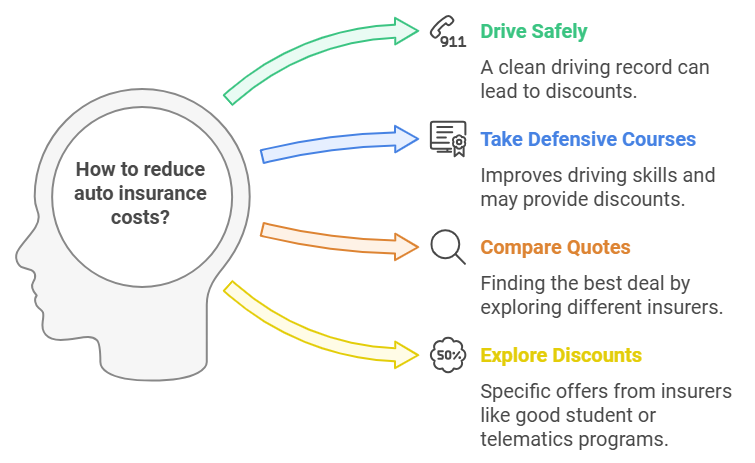
You can’t change your age. But you can stack discounts, and together they add up fast. Here are the ones that actually move the number, with typical savings.
- Good student discount: Around 12%, sometimes up to 15%. Usually needs a B average or a 3.0 GPA. Progressive, for example, offers it to full-time students under 23 with a B average.
- Safe-driving app (telematics): A usage-based program that watches your driving can earn about an 11% discount on average, and more if you drive well. It’s often the biggest lever a young driver controls.
- Distant student discount: If you’re away at school, often 100 or more miles from home, without a car there, you may get a discount.
- Defensive driving course: Can save up to about 10%, and it makes you a better, safer driver too.
- Bundle and multi-car: Combining auto with renters or home, or insuring more than one car together, often saves 5% to 15%.
- Pick a cheap-to-insure car: A safe, older, lower-value car costs far less to insure than a fast or expensive one. This is a huge, often ignored lever.
- Raise your deductible: A higher deductible lowers your monthly price, if you keep savings ready to cover it.
Stacking three or four of these can change your bill more than switching companies does.
Does car insurance really get cheaper at 25?
Sort of, but not the way people think. There’s no magic switch that flips at 25. Rates come down a little every year as you gain experience. Progressive, for example, reports average drops of about 10% at 19, 5% at 20, and 6% at 21. By 25, the price is much lower than it was at 18, but it got there step by step, not overnight.
And your record can override your age. If you get an at-fault crash or a ticket right before your birthday, your rate may not drop at all. So the real lesson is simple: a clean driving record lowers your price faster than your age does. The same curve applies to young adults under 26, so keep stacking discounts and comparing your cost per month every renewal until the price settles down.
Is Costco auto insurance really cheaper?
This one comes up a lot, so here’s the honest answer. Costco offers car insurance through a partner called CONNECT, which changed its name to American Family Insurance in December 2025. Costco members can get a member discount, and Executive members get extras like roadside help and lifetime renewability.
But “cheaper” depends. You must pay for a Costco membership first ($65 or $130 a year). The rates are competitive for some low-risk drivers, but often not the cheapest for young or higher-risk drivers, where Geico, State Farm, or Auto-Owners frequently beat it. It also isn’t sold in every state, and it draws more complaints than expected for its size, according to NerdWallet’s review. So treat Costco as one quote to compare, not an automatic bargain.
What not to tell your insurance company
This is a common search, and the honest version matters, because doing it wrong is fraud. You must always tell your insurer the truth. Hiding a driver in your home, lying about where the car is parked, or leaving a young driver off the policy to save money is called “fronting,” and it can get a claim denied and your policy canceled.
So what should you actually hold back? Only at the accident scene, and only opinions, not facts. Don’t say “it was my fault” or “I’m sorry, I didn’t see you,” and don’t guess about how fast you were going or whether anyone is hurt. Stick to the facts, share your insurance details, and let the adjusters decide who’s at fault. Being careful is not the same as lying. One is smart; the other is illegal.
The Honest Read: what actually gets you a lower rate
In my years working around insurance, the most expensive mistake I see young drivers and their parents make is the same one, over and over: they rush to put the new driver on their own separate policy. It feels grown-up, or they think it “protects” the parents’ rate. Then they pay nearly double for no reason. Adding the driver to the family policy would have cost far less.
The second pattern is chasing a “best company” list instead of getting quotes. These lists are built on averages that may have nothing to do with your ZIP code, your car, or the regional insurer down the road that would quote you half the price. A Reddit thread has the same problem: those are other people’s situations, not your quote.
So here’s the plain verdict. The “best” auto insurance for a driver under 25 is whichever real quote comes back cheapest for your exact profile, from a financially sound insurer, after you’ve stacked your discounts and stayed on a family policy if you can. Get three or more quotes, always include USAA if you have any military tie, and check a company’s complaint record on the NAIC website before you sign. That process beats any ranking, and it’s how you turn a scary quote into an affordable one.
Conclusion
Being under 25 makes car insurance pricey, but it doesn’t make you powerless. Stay on a parent’s policy while you can, drive a sensible car, stack the good-student and safe-driving discounts, keep your record clean, and compare at least three real quotes instead of trusting a “best” list. The cheapest company is different for everyone, so let your own quotes crown the winner. Do these things, and you’ll pay far less now, and even less every year as your record grows.
FAQs
How much is car insurance for a driver under 25?
On their own full-coverage policy, 2026 averages run roughly $600 to $865 a month at 16 to 18, dropping to about $250 to $300 a month by 25. These are averages from named industry analyses, and your real price depends heavily on your state, car, and driving record. Staying on a parent’s policy costs much less.
Who has the cheapest car insurance for drivers under 25?
It varies by person, but USAA is often cheapest if you have military ties, and Geico, State Farm, and Travelers are frequently competitive for everyone else. Regional insurers like Erie and Auto-Owners can be even cheaper in the states they serve. The only way to know your cheapest option is to compare at least three quotes.
What is the best car insurance for young drivers?
There is no single best. The right choice depends on your age, state, car, and record, so judge companies by real quotes plus objective measures like the NAIC complaint index, J.D. Power scores, and AM Best financial ratings. A company that’s cheapest for one young driver can be costly for another.
Is it cheaper to add a young driver to a parent’s policy?
Yes, almost always. For an 18-year-old, joining a parent’s policy costs about 62% less than a separate policy. The parent’s rate does go up, but the combined household cost is still much lower than paying for two policies. If you live at home, this is usually your biggest saving.
Can parents insure a car for their child?
Yes, if the child lives in the same household, they can be added to the parent’s policy, which is usually the cheapest route. Titling and registration rules vary by state and can affect whose policy the car belongs on, so ask your insurer. A driver under 18 generally needs an adult to co-sign any policy.
Do parents’ rates increase when they add a young driver?
Yes, adding a young driver raises the parent’s premium, often significantly, because the household now includes a higher-risk driver. Even so, this is still cheaper than the young driver buying a separate policy. When the young driver later moves out and gets their own coverage, the parent’s rate usually drops again.
What is the cheapest way to insure my 17-year-old son?
Add him to your existing policy rather than buying him a separate one, put him on the cheapest, safest car you own, and claim the good student discount if he has a B average. A safe-driving app can add more savings. Buying a 17-year-old his own standalone policy is the most expensive path.
Is car insurance cheaper if you’re 25?
It’s cheaper than it was at 18, but the drop is gradual, not a sudden cliff at 25. Rates fall a little each year as you gain experience, with only a modest extra dip around 25. A clean driving record lowers your price faster than simply turning 25 does.
How much would insurance cost for a 25-year-old new driver?
A brand-new driver at 25 pays more than a 25-year-old who has been driving for years, because insurers price experience, not just age. Expect a new-driver surcharge on top of the roughly $250 to $300 monthly average for full coverage. Good student, safe-driving, and comparison shopping still help.
How can I lower car insurance under 25?
Stack discounts: good student (about 12%), a safe-driving app (about 11%), distant-student and defensive-driving discounts, and bundling. Choose a safe, low-value car, consider a higher deductible, and keep a clean record. Then compare at least three quotes, since the cheapest insurer differs for everyone.
What discounts can young drivers get?
Common ones include the good student discount (roughly 12%, needing a B average), usage-based or telematics discounts (around 11%), distant-student discounts for those away at college without a car, and defensive-driving course discounts (up to about 10%). Bundling and multi-car discounts can add 5% to 15% more.
Is Costco auto insurance really cheaper for young drivers?
Sometimes, but not always. Costco’s insurance, now under the American Family name, offers a member discount and perks, but you must pay for a membership, and it’s often not the cheapest for young or higher-risk drivers, where Geico or State Farm may beat it. Compare it as one quote among several, not an automatic deal.
What should I not tell my insurance company?
Never lie to your insurer or hide a driver; that’s fraud and can void your policy. The only thing to hold back is opinion at the accident scene: don’t admit fault or guess about speed or injuries. Stick to the facts, share your details, and let the adjusters decide who is at fault.
What is the best insurance for new drivers under 21, and is full coverage worth it?
The same rules apply: stay on a family policy, stack discounts, and compare quotes. Full coverage is worth it if your car has real value or a loan, since it pays to repair or replace your own car. For an old, low-value car, liability-only may be the smarter, cheaper choice.
Does what people say on Reddit help me find cheap insurance?
It can give you ideas, but it can’t price your policy. Every Reddit story reflects that person’s state, car, age, and record, not yours. Use those threads for tips like which discounts to ask about, then get your own quotes, because your real price is the only one that counts.
About the Author
Md Shahinuzzaman is an insurance and out-of-pocket healthcare cost specialist with 16 years of banking and insurance experience. He writes clear, honest guides for InsuranceGuidances.com to help drivers and families understand their real options and pay less. Every figure here is checked against named sources, including the CDC, IIHS, AAA Foundation, and 2026 industry rate analyses. Reviewed July 2026.
Sources
NAIC, Consumer Information Source (complaint index). https://content.naic.org/consumer
MoneyGeek, average car insurance rates by age and gender (2026). https://www.moneygeek.com/insurance/auto/average-car-insurance-rates-by-age-and-gender/
Insurance.com, car insurance rates by age and teen calculator (2026). https://www.insurance.com/auto-insurance/car-insurance-rates-by-age
ValuePenguin, how age affects auto insurance and 18-year-old costs (2026). https://www.valuepenguin.com/how-age-affects-auto-insurance-costs
CarInsurance.com, average car insurance rates by age (2026). https://www.carinsurance.com/average-rates-by-age.aspx
The Zebra, teen driving cost report (2026). https://www.thezebra.com/resources/car-insurance/teen-driving-report/
Progressive, what age does car insurance get cheaper. https://www.progressive.com/answers/how-age-impacts-insurance/
Insurance Institute for Highway Safety (IIHS), teenage drivers. https://www.iihs.org/topics/teenagers
Centers for Disease Control and Prevention (CDC), teen drivers risk factors. https://www.cdc.gov/transportation-safety/teen-drivers/
AAA Foundation for Traffic Safety, rates of motor vehicle crashes by age. https://aaafoundation.org/rates-of-motor-vehicle-crashes-injuries-and-deaths-in-relation-to-driver-age/
NerdWallet, Costco car insurance review (2026). https://www.nerdwallet.com/insurance/auto/costco-auto-insurance-review