A cat neurologist consult is $200 to $500. That’s before any testing. Add an MRI and you’re up another $1,500 to $3,500. If it turns into surgery — usually for a brain tumor called a meningioma — the whole thing tends to land between $5,000 and $9,000. Most cases I see settle somewhere in the $2,500 to $8,000 range by the end. Insurance, if you bought it before the diagnosis, knocks the out-of-pocket down to roughly a quarter of that. Everything below is the detail behind those numbers.
If your vet just used the word “neurologist,” there’s a decent chance your stomach dropped a little. That’s a normal reaction. Cat neurology bills are genuinely big, and most people have no reference point for what’s normal — so the estimate lands like a brick.
Cats make this harder than dogs do, honestly. A dog will usually telegraph a problem: a limp, slowing down on walks, going off their food for a few days. Cats give you nothing. They are very, very good at acting fine right up until the moment they can’t. So owners often go from “my cat seems normal” to “my cat is having a seizure on the kitchen floor” with no warning in between — and then they’re in a specialist’s office staring at a five-figure number.
So let’s walk through what this actually costs in 2026. What the numbers are, why two clinics can quote you wildly different prices, and what you can do about the bill if you don’t have insurance to lean on. The figures here come from specialty hospital price sheets, insurance claims data, and what owners report paying — not from anyone’s marketing page.
How much is a neurologist for a cat in 2026?
The consult is $200 to $500. But a neurology consult almost never stays just a consult — the specialist looks at your cat, then recommends tests, and the tests are where the money is.
| Service | Typical 2026 U.S. Price | Notes |
|---|---|---|
| Specialist consultation | $200 – $500 | NYC, LA, SF at the top end |
| Bloodwork & basic labs | $80 – $250 | CBC plus chemistry panel |
| CSF tap (spinal fluid) | $300 – $700 | Sedation included |
| CT scan | $800 – $2,200 | Faster and cheaper than MRI |
| MRI (brain or spine) | $1,500 – $3,500 | Cats usually at the lower end |
| Craniotomy (brain tumor removal) | $4,500 – $8,000+ | Common for feline meningioma |
| Spinal surgery | $3,500 – $7,000 | Less common in cats than dogs |
| Hospitalization (per day) | $400 – $1,500 | Post-op or critical care |
| Long-term medication | $30 – $150/month | Phenobarbital, levetiracetam |
Sources: MoneyGeek, ACVIM specialist directory, specialty hospital published price sheets, pet insurance claims data.
So “a neurologist visit” can mean a $300 conversation, or it can mean the first step in a $9,000 treatment plan. Same appointment, completely different bill, and which one you get comes down to what’s actually wrong with your cat.
How much does a visit to a cat neurologist cost without insurance?
This is the question I hear most, and the honest answer is that the consult is the cheap part. Without insurance, that’s your $200 to $500. It’s the diagnostics that grow the bill.
Picture a normal workup. Consult, call it $350. Bloodwork, $185. An MRI, $2,400. You’re at roughly $2,900 and you haven’t treated anything yet — you’ve just figured out what you’re dealing with. If the MRI turns up something surgical, add $4,500 to $8,000 on top of that.
Where you live changes these numbers a lot. Same workup, very different price tag depending on the region:
| Region | Consult | MRI | Brain Surgery |
|---|---|---|---|
| California metros | $300–$500 | $2,500–$4,500 | $6,000–$10,000+ |
| NYC / NJ metros | $300–$500 | $2,500–$4,000 | $6,000–$9,500 |
| South Florida | $250–$450 | $2,000–$3,500 | $5,000–$8,500 |
| Texas (Houston, Dallas, Austin) | $225–$400 | $1,800–$3,200 | $4,500–$8,000 |
| Midwest (Chicago, Minneapolis, Columbus) | $200–$350 | $1,600–$2,800 | $4,000–$7,000 |
| Southeast (Atlanta, Charlotte, Nashville) | $200–$325 | $1,500–$2,600 | $4,000–$6,500 |
| Rural / small metro | $200–$300 | $1,400–$2,400 | $3,500–$6,000 |
If your cat’s case isn’t an emergency, driving to a cheaper region for the imaging or surgery can save you real money — sometimes thousands. One caveat, though. Rural clinics are often general practice, not specialty. If your cat’s case turns out to be genuinely complicated, you may get referred onward anyway, and the savings vanish into transport time and a second consult fee. So it depends on the case.

Why one estimate is double another
People ask me this all the time. You get quoted $7,500 at the city specialty center, drive an hour and a half out to a teaching hospital, and suddenly the same workup is $4,800. It feels like one of them is ripping you off. Usually neither is.
Most of the gap is just overhead. A specialty practice in Manhattan or West Hollywood is paying Manhattan and West Hollywood rent, and that has to come from somewhere — it comes from your bill. Take the exact same equipment and the exact same specialists, put them at a university teaching hospital, and the institutional overhead is lower. The price follows.
The MRI machine itself is the other big piece. Veterinary MRI mostly comes in two types. Low-field machines (often 0.3T) are cheaper to run, so the quote looks better — but the image quality is rough, and I’ve watched plenty of cases need a re-scan somewhere else because the first one wasn’t good enough to plan from. High-field machines (1.5T or 3T) cost more, but they give you an image a surgeon can actually use. If your cat is heading toward surgery, paying once for a good scan beats paying twice for a cheap one plus a redo.
Age plays in too. An older cat with kidney disease or a heart murmur needs careful pre-anesthesia bloodwork and slower, closely monitored sedation — that’s a few hundred dollars extra, and it’s not the clinic padding the bill, it’s genuinely safer. The one bit of good news for cat owners: cats are usually cheaper to image than big dogs. Smaller body, less anesthesia, shorter scan. Size works in your favor for once.
When should you take your cat to a neurologist?
Usually your regular vet makes that call and writes the referral. But it helps to know which signs point toward a neurology problem in the first place.
Move quickly if you see seizures, sudden circling, a head tilt that won’t go away, loss of balance, unexplained weakness in the back legs, vision changes, or behavior that changed fast. Some of these are flat-out emergencies. A seizure that runs past five minutes, or a cluster of seizures in a single day, means you go to an emergency hospital now — not next week, not after you’ve called around.
For the milder stuff — an occasional stumble, a faint head tilt, a cat that’s started hesitating before a jump it used to make without thinking — a referral within a week or two is usually fine. I’d still not sit on it, though. Cats hide things, so even a “small” sign sometimes means something that’s been quietly building for a while.
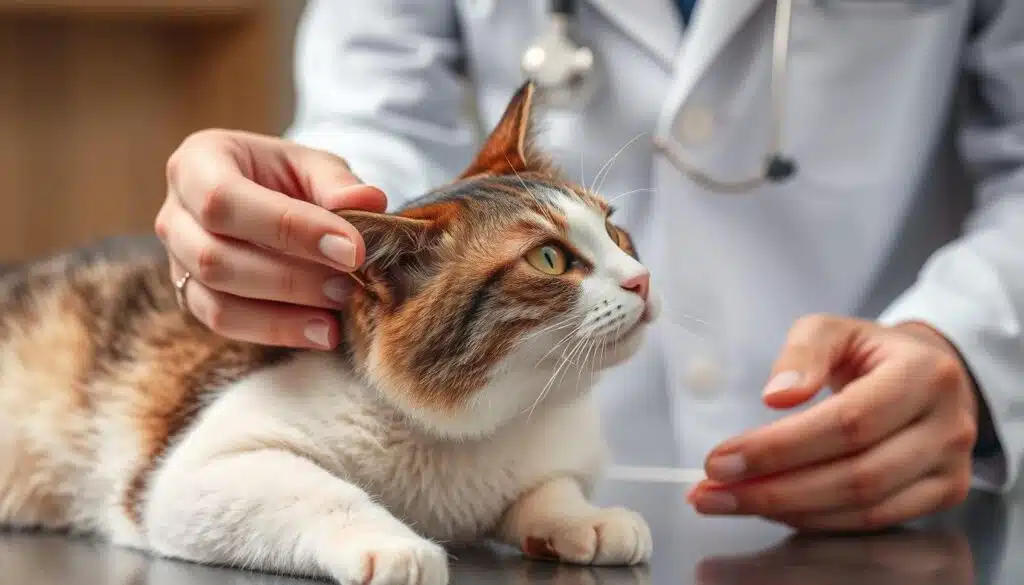
How do you know if a cat has a neurological disorder?
The obvious signs are hard to miss. Seizures. A head tilt. Circling. Eyes flicking side to side. Tremors, weakness, sudden blindness, disorientation.
It’s the subtle ones that get dismissed, and they matter just as much. A cat bumping into furniture. Pausing at the edge of the couch before a jump it used to do in its sleep. Missing the landing. Sleeping somewhere weird, or in a weird position. Getting briefly stuck facing into a corner. Vocalizing more, or differently. None of these alone proves anything. But a few of them together, or any of them showing up suddenly, is worth a vet visit.
The frustrating thing about cats is exactly this. By the time the sign is obvious, the problem has often been progressing for weeks behind the scenes. That’s not a reason to panic — it’s just a reason not to wait around once you do notice something is off.
The 5 most common neurological disorders in cats
Cat neurology cases tend to cluster around a handful of diagnoses. Each one has its own cost path and its own outlook.
Meningioma is the one I see most in claims. It’s the most common feline brain tumor, and it mostly shows up in cats over 10. Here’s the part that surprises people: it’s actually one of the more treatable things on this list. Surgical removal often goes really well, with median survival regularly past two years. Diagnosis through recovery usually runs $6,000 to $10,000.
Idiopathic epilepsy is less common in cats than in dogs, but it happens. The MRI is mostly there to rule out a tumor or inflammation. Once it’s confirmed, it becomes a long-haul medication thing — phenobarbital or levetiracetam, $30 to $120 a month, ongoing.
Vestibular disease is the one that frightens owners most and resolves most often. Sudden head tilt, falling over, eyes darting around. It looks awful. But most cats recover within a few weeks on supportive care alone. Sometimes an MRI makes sense to rule out something central; sometimes it doesn’t.
Inflammatory brain disease, including the neurological form of FIP, used to be a gut-punch of a diagnosis. The newer FIP antivirals have genuinely changed that — outcomes today are far better than they were even five years ago.
Cognitive dysfunction syndrome is, basically, feline dementia. It’s slower and more diffuse, and it shows up in senior cats. Diagnosis is mostly by ruling other things out. Treatment is supportive — $50 to $150 a month for enrichment, supplements, sometimes medication.
Spinal cord trouble from trauma or tumors rounds things out. It’s uncommon in cats, but when it happens, MRI plus possible surgery runs $4,000 to $8,500.
Can a cat recover from neurological problems?
More often than people expect, honestly. It depends on the cause.
Vestibular disease usually clears up on its own in two to four weeks. Epileptic cats, once they’re on the right medication, generally live normal lifespans. Meningioma surgery has genuinely good outcomes — median survival past two years, which catches a lot of owners off guard because they hear “brain tumor” and assume the worst. Inflammatory brain disease responds well to treatment in a lot of cases now.
The genuinely hard cases are aggressive brain tumors and severe spinal trauma. Even then, treatment can buy comfortable, good time.
One thing holds true across almost every diagnosis: how fast the cat gets in front of a neurologist matters more than just about anything else. Early, you’ve got options. Wait, and the options start closing.
Early warning signs of neurological deterioration
If your cat already has a diagnosis, you’ll want to spot it when things start sliding. Deterioration usually creeps rather than jumps.
Keep an eye out for balance getting shakier — more hesitation before jumps, more missed landings. A head tilt that’s becoming more obvious. Stumbling that’s happening more often than it was. Changes in pupil size or eye movement. More disorientation, more confusion. Getting stuck in corners more than before. Shifts in how your cat sounds, or how it sleeps. Less response to what’s going on around it.
The simplest rule I can give you: if any symptom your cat already has is getting worse — more seizures, a bigger tilt, more weakness — that’s progression, and it’s worth a call to your neurologist. Catching the slide early usually keeps more doors open.
Red flag symptoms that mean go now
Some signs aren’t “book a referral.” They’re “get in the car tonight.” These red flags can mean a brain tumor, a stroke, severe inflammation, or a spinal injury:
- A seizure that lasts more than 5 minutes
- More than one seizure in 24 hours
- Sudden, total loss of the use of the back legs
- Sudden blindness
- Unconsciousness, or barely responding to you
- Severe disorientation with distressed crying
- Any neurological sign getting dramatically worse over a few hours
If you see any of these, don’t wait for a scheduled appointment. Go to a 24-hour emergency veterinary hospital. They can stabilize your cat and usually get a neurologist involved faster than a referral ever would.
How can I see a cat neurologist quickly?
It depends on how urgent things are.
If it’s a real emergency, skip the whole referral process. Go straight to a 24-hour emergency hospital. They can stabilize your cat right away, and they’ll either have a neurologist on staff or be able to reach one fast.
If it’s urgent but not an emergency, ask your regular vet for an urgent referral — and ask them to phone the specialist directly. This part matters more than people realize. Neurologists bump vet-to-vet referrals up the list ahead of owners who call in themselves. A two-minute call from your vet can shave real time off the wait.
To find a board-certified neurologist near you, the ACVIM directory at acvim.org lists them by location. And don’t overlook teaching hospitals — they’ll sometimes squeeze in an urgent case faster than a private specialty clinic, and they’re usually cheaper while they’re at it.
Pet insurance for cat neurology — why timing decides everything
Every major U.S. pet insurer covers cat neurology. MRIs, CT scans, surgery, hospitalization — Pets Best, Lemonade, Fetch, Embrace, ASPCA, Healthy Paws all do it.
Here’s the catch, and it’s the one that traps people. None of them will cover a condition that already exists when you sign up. The moment your cat has a neurological diagnosis on its medical record, that diagnosis is “pre-existing,” and a brand-new policy won’t touch it. So if your cat is healthy right now, the real question was never whether to get insurance — it’s how fast you can do it.
| Insurer | Reimbursement | Covers cat neurology? | Watch for |
|---|---|---|---|
| Pets Best | 70/80/90% | Yes — meningioma, epilepsy, inflammatory disease | 14-day illness waiting period |
| Lemonade | 70/80/90% | Yes — full neurology on accident-illness plan | Document bilateral conditions carefully |
| Fetch | 70/80/90% | Yes — diagnostics included by default | 15-day illness waiting period |
| Embrace | 70/80/90% | Yes — including hereditary conditions | Diminishing deductible; 14-day wait |
| ASPCA | 70/80/90% | Yes — MRI, surgery on accident-illness plan | Check state availability |
| Healthy Paws | 70/80/90% | Yes — covers brain & spinal cord disease | No annual cap; no enrollment after age 14 |
Let me show you what coverage actually does with a real case. An 11-year-old cat in Phoenix, diagnosed with a meningioma:
- Specialist consult: $325
- Bloodwork and pre-anesthesia panel: $185
- MRI: $2,400
- Craniotomy: $5,200
- 3 days of hospitalization: $1,150
- Total: $9,260
No insurance, the owner pays the whole $9,260. With a typical Pets Best policy — 80% reimbursement, $500 deductible — the deductible comes off first, leaving $8,760. Insurance pays 80% of that, $7,008. The owner is out $2,252. Roughly a quarter of the bill. And honestly, that gap is often the entire difference between being able to say yes to the surgery and having to say no.
How to pay for it if you’re already past the insurance window
Most people reading this are past that window. The diagnosis already exists, the bill is already coming, and insurance isn’t an option for this particular condition anymore. So here’s what actually works, roughly in the order I’d try it.
Start with a teaching hospital. If you can get to UC Davis, Cornell, Texas A&M, Colorado State, NC State, Tufts, or Iowa State, you’ll usually save 25 to 40 percent compared to a private specialty clinic. The wait is longer, so this works best when things aren’t an emergency.
Push back if the diagnostic plan feels rushed. Not every cat needs an MRI on day one. Sometimes a staged approach — bloodwork, blood pressure, neuro exam, basic imaging first — narrows things down enough that the MRI wouldn’t change the next step anyway. Just ask the neurologist straight out: “If we hold off on the MRI for now, what do we actually lose?” A good one will give you a real answer.
Get CareCredit or ScratchPay sorted before the appointment. Approval takes a few minutes. CareCredit runs 6-, 12-, 18-, and 24-month no-interest plans for qualifying costs. Both turn a $7,000 wall into something you can actually climb.
Look into the grants. RedRover Relief, The Mosby Foundation, Frankie’s Friends, the Magic Bullet Fund. Cats in Crisis specifically funds neurological cases. The applications take a few weeks, so the sooner you start, the better.
Ask the billing office about cash-pay discounts. A lot of hospitals will quietly take 10 to 20 percent off for paying upfront. Senior, military, and hardship discounts often exist too — but they’re rarely volunteered. You have to ask.
Get a second opinion before a big surgery. Surgical estimates can swing $2,000 to $3,000 between two clinics half an hour apart. Getting a second estimate is completely normal. Nobody’s going to be offended.
Don’t write off crowdfunding. A specific story posted in a local Facebook cat group regularly pulls in $1,500 to $5,000 inside two weeks. The trick is being specific. “$4,500 for our 12-year-old cat’s brain surgery” gets funded. “Help with vet bills” doesn’t.
Conclusion: the cat neurologist cost breakdown
There’s no spinning this — cat neurology is expensive, and none of these numbers are fun to look at. But knowing the realistic breakdown means you can plan instead of just panic.
| Scenario | Typical total cost | With insurance (80%, $500 deductible) |
|---|---|---|
| Consult + bloodwork only | $300 – $750 | $160 – $550 out of pocket |
| Consult + CT scan (no surgery) | $1,100 – $2,700 | $620 – $940 out of pocket |
| Consult + MRI (no surgery) | $1,800 – $4,000 | $760 – $1,200 out of pocket |
| Full workup + brain surgery (meningioma) | $6,000 – $10,000 | $1,600 – $2,400 out of pocket |
| Epilepsy diagnosis + first-year medication | $2,500 – $5,000 | $900 – $1,400 out of pocket |
| Vestibular disease (often resolves) | $300 – $2,000 | $160 – $800 out of pocket |
Most cat neurology cases land between $2,500 and $8,000 by the time everything’s added up. And the single biggest thing that decides what you personally pay isn’t the diagnosis at all — it’s whether you had insurance in place before the symptoms started.
So if your cat is healthy today, this is the part to act on. Getting a policy now, before anything goes wrong, is the move that protects you most. Pets Best, Lemonade, Fetch, Embrace, ASPCA, and Healthy Paws all cover the diagnostics and surgeries in this article at 70 to 90 percent. The owners who walk out of this paying $2,000 instead of $9,000 are, almost without exception, the ones who bought the policy before they ever needed it.
And if you’re already in the thick of it with no coverage — you still have moves. Start with a teaching hospital. Get CareCredit lined up. Ask for staged diagnostics instead of everything at once. Get a second estimate on any big surgery. Look into the grants. Most owners find a way through this. There’s a good chance you will too.
FAQs
How much is a neurologist for a cat?
A cat neurologist consultation costs $200 to $500 in 2026, with the highest prices in New York, Los Angeles, and San Francisco. That’s just the specialist exam. Most cats need further testing — bloodwork ($80-$250), a CT scan ($800-$2,200), or an MRI ($1,500-$3,500). When surgery is involved, total costs typically run $5,000 to $9,000. Most cat neurology cases settle between $2,500 and $8,000 once everything is added up.
How much does a visit to a neurologist cost without insurance?
Without insurance, a cat neurologist visit starts at $200 to $500 for the consultation alone. It rarely stops there — if the neurologist recommends imaging, an MRI adds $1,500 to $3,500 and a CT scan adds $800 to $2,200. A full diagnostic workup without insurance commonly reaches $2,000 to $4,000 before any treatment begins. With insurance in place before the condition appeared, owners typically pay about a quarter of these amounts after deductible and reimbursement.
When should I take my cat to a neurologist?
Take your cat to a neurologist when your regular vet refers you, or when you notice seizures, sudden circling, a persistent head tilt, loss of balance, unexplained weakness in the legs, vision changes, or behavioral changes that came on quickly. Seizures lasting more than 5 minutes, or clusters of seizures, are emergencies — go immediately. For milder signs like a slight head tilt or occasional stumbling, a referral within a week or two is usually fine. Cats hide illness well, so any sudden neurological change deserves prompt attention.
How do you know if a cat has a neurological disorder?
Signs of a neurological disorder in cats include seizures, head tilt, circling, loss of balance or coordination, abnormal eye movements (nystagmus), tremors, weakness or paralysis, sudden blindness, disorientation, and behavioral changes. Some cats show subtle signs first — bumping into furniture, hesitating on jumps they used to make easily, or sleeping in odd positions. Because cats mask illness, neurological symptoms often appear suddenly even though the underlying problem developed gradually.
Can a cat recover from neurological problems?
Many cats recover, depending on the cause. Vestibular disease (head tilt and falling) usually resolves on its own within two to four weeks. Epilepsy is well-controlled long-term with medication, and most epileptic cats live normal lifespans. Meningioma, the most common feline brain tumor, has strong surgical outcomes — median survival regularly exceeds two years after removal. The harder cases are advanced brain tumors and severe spinal trauma. Across every cause, how fast the cat reaches a neurologist strongly affects the outcome.
What are the early warning signs of neurological deterioration in cats?
Early signs of neurological deterioration in cats include subtle balance changes (hesitating before jumps, missing landings), a mild head tilt, occasional stumbling, changes in pupil size or eye movement, more disorientation or confusion, getting stuck in corners, changes in vocalization, altered sleep, and reduced responsiveness. Any existing symptom getting worse — more seizures, a bigger tilt, increasing weakness — signals progression. Catching this early and getting a neurology referral usually keeps more treatment options open.
What are the red flag symptoms in cat neurology?
Red flag symptoms that mean emergency care for a cat: a seizure lasting more than 5 minutes, multiple seizures in 24 hours, sudden loss of the use of the back legs, sudden blindness, unconsciousness or extreme unresponsiveness, severe disorientation with distressed vocalization, and rapid worsening of any neurological sign over hours. These can point to a brain tumor, stroke, severe inflammation, or spinal injury. Any of them means going to a 24-hour emergency veterinary hospital right away rather than waiting for a scheduled referral.
What are the most common neurological disorders in cats?
The five most common feline neurological disorders are meningioma (the most common brain tumor, usually in cats over 10), idiopathic epilepsy (recurrent seizures), vestibular disease (head tilt and balance loss), inflammatory brain disease (including the neurological form of FIP), and cognitive dysfunction syndrome (feline dementia in senior cats). Spinal cord problems from trauma or tumors are less common. Each has its own cost path and prognosis, but all need a board-certified neurologist for an accurate diagnosis.
How can I see a cat neurologist quickly?
To see a cat neurologist quickly, ask your regular vet for an urgent referral and ask them to call the specialist directly — neurologists prioritize vet-to-vet referrals over self-referred owners. For genuine emergencies like cluster seizures or sudden paralysis, skip the referral and go straight to a 24-hour emergency hospital, which can reach a neurologist faster. The ACVIM directory at acvim.org lists board-certified neurologists by location, and veterinary teaching hospitals sometimes fit urgent cases in faster than private specialty clinics.
How much is an MRI for a cat without insurance?
A cat MRI without insurance costs $1,500 to $3,500. Cats usually land at the lower end because they’re small — less anesthesia and shorter scan times. High-field 3T machines at standalone imaging centers quote higher, often $3,000 to $4,500, but produce sharper images a surgeon can plan from. Always confirm whether the quote includes anesthesia and the radiologist’s read, since some clinics bill those separately.
Does pet insurance cover cat neurology and MRIs?
Yes — every major U.S. pet insurer (Pets Best, Lemonade, Fetch, Embrace, ASPCA, Healthy Paws) covers cat neurology including MRI, CT, and neurosurgery when it’s clinically necessary, at 70-90% reimbursement after deductible. The condition just can’t be pre-existing. Once epilepsy, a brain tumor, or any neurological diagnosis is on the medical record, no new policy will cover it. That’s why enrolling a healthy cat before symptoms start is the only way to guarantee coverage when these bills hit.
What is the silent killer of cats?
Chronic kidney disease (CKD) is widely called the silent killer of cats — it’s a leading cause of death and shows no obvious symptoms until around 75% of kidney function is already gone. Hypertrophic cardiomyopathy (HCM) is the heart-disease equivalent, often silent until it’s advanced. Both are why annual senior wellness exams matter for cats over 7: bloodwork and a blood pressure check catch these years before symptoms do, when treatment is far more effective and affordable.
Related on InsuranceGuidances.com
- [Dog Neurologist Cost Without Insurance: 2026 Prices](https://insuranceguidances.com/dog-neurologist-cost-without-insurance/)
- [Best Pet Insurance for Cats with Kidney Disease](https://insuranceguidances.com/best-pet-insurance-for-cats-with-kidney-disease/)
- [Pet Insurance Pre-Existing Conditions: 5 Insurers That Cover Them](https://insuranceguidances.com/pet-insurance-pre-existing-conditions/)
About the Author
Md Shahinuzzman writes about insurance coverage and out-of-pocket healthcare costs for InsuranceGuidances.com. Most of his work comes down to one question: what does a person actually pay at the end — the gap between the scary estimate and what insurance hands back? He digs through insurer claims data, specialty hospital price sheets, and what real owners report, because most of what’s online is either marketing copy or filler. The aim with every piece is the same — real numbers and a clear decision, so you’re not blindsided.
Sources
- MoneyGeek. “Pet Insurance and MRI Coverage.” moneygeek.com
- American College of Veterinary Internal Medicine (ACVIM). Board-certified neurologist directory.
- Cornell Feline Health Center. Feline neurological disorders overview.
- Morris Animal Foundation. Feline chronic kidney disease research.
- RedRover Relief. Veterinary financial assistance program. redrover.org
- NAPHIA. North American Pet Health Insurance Association claims data.
- American Veterinary Medical Association. Feline meningioma clinical references.
- Veterinary specialty hospital published price sheets, 2026.
Last Fact Checked: May 2026