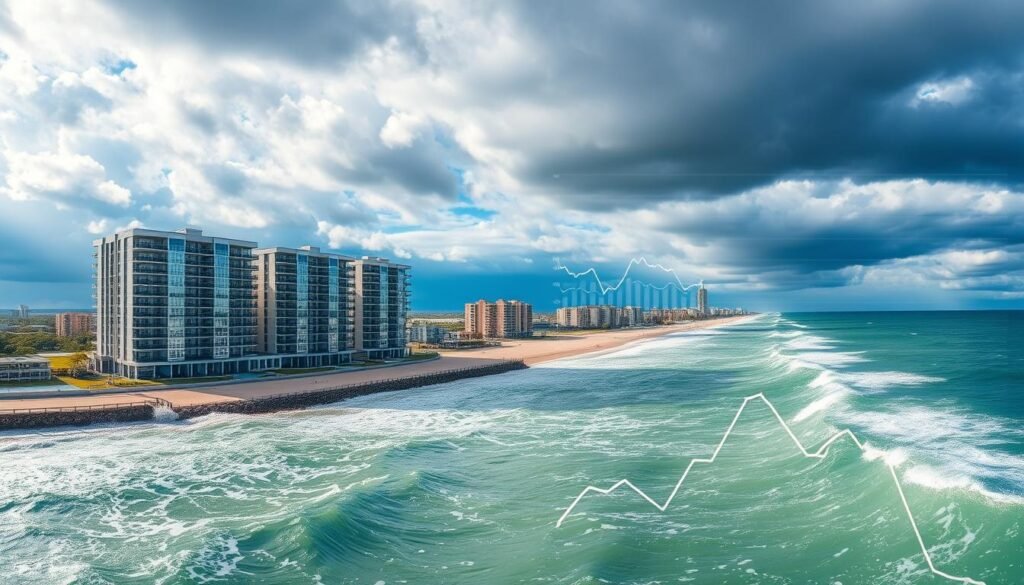
Condo insurance is rising in Ocean City, Maryland mainly because coastal condo association master policies have surged, with local property managers reporting average jumps around 40% and some renewals up as much as 150%. The increases are driven by soaring reinsurance costs, several years of catastrophe losses, and higher construction prices, not by Ocean City suddenly becoming uninsurable. Those higher master-policy costs reach owners through bigger condo fees and special assessments, while individual HO-6 policies have climbed too. Understanding why condo insurance is rising in Ocean City, Maryland helps you budget, shop smarter, and protect yourself from surprise assessments.
Condo Insurance Rising in Ocean City, Maryland: The Two Layers
| Master policy (the association) | HO-6 policy (you, the owner) | |
|---|---|---|
| Who buys it | The HOA/condo association board | Each individual unit owner |
| What it covers | Building, common areas, liability | Your interior, belongings, upgrades, liability |
| How you pay | Through your condo fees | Your own annual premium |
| What’s rising fastest | Master multi-peril premiums (40%+) | HO-6, more modestly |
| Typical Ocean City cost | Tens of thousands to $350k+/yr per building | ~$675–$1,300/year |
Your condo fee jumped again, or your HO-6 renewal landed higher than last year, and you’re wondering what’s going on. You’re not imagining it, and you’re not alone. Coastal condo insurance in Ocean City has climbed sharply, but the reasons are specific and so are the ways to manage it. Here’s the honest picture.

Why Is Condo Insurance Rising in Ocean City, Maryland?
Condo insurance is rising in Ocean City because the cost of insuring coastal buildings has jumped, and most of that increase hits the association’s master policy. Local property managers have reported average increases around 40%, with some renewals more than doubling.
A few forces are driving it. The cost of reinsurance, the insurance that backs insurance companies, has spiked after years of major catastrophe losses worldwide. Insurers have responded by raising rates and pulling back from coastal risk. Construction and rebuild costs have climbed, so the replacement values insurers must cover are higher. And new Maryland reserve-study requirements have added to association budgets at the same time. Stack those together and coastal condo premiums rise fast. Insurers are also increasingly requiring building inspections before renewal and flagging older, un-upgraded, oceanfront, or wood-frame buildings as the highest risk.
How Much Have Premiums Actually Gone Up?
The increases are real and large, though they vary a lot by building. The clearest local example comes from Ocean City property managers who handle these renewals directly.
One 28-unit Ocean City building managed by Mann Properties paid about $39,000 a year for coverage in 2014, roughly $60,000 by 2022, over $80,000 in 2023, and a projected $115,000 for 2024, according to figures the company shared with local news. That’s nearly a tripling in a decade. More broadly, condo association building premiums in Ocean City have risen in the 50% to 80% range over a couple of years, and managers reported average multi-peril increases near 40%, with some renewals up as much as 150%. For master policies, Maryland associations commonly spend 20% to 35% of their operating budget on insurance, with small buildings often paying $8,000 to $20,000 a year, mid-size buildings $25,000 to $80,000, and large high-rises $90,000 to $350,000 or more. Individual HO-6 policies in Ocean City typically run about $675 to $1,300 a year.
The Two Layers of Condo Insurance: Master Policy vs. Your HO-6
Condo insurance comes in two layers, and confusing them is where owners get caught out. The association’s master policy and your personal HO-6 cover different things.
The master policy, bought by the board and funded through your condo fees, covers the building structure, common areas, and the association’s liability, and under Maryland’s Condominium Act it must include property and general liability coverage. It generally covers units “as originally built” but excludes your improvements. Your HO-6 policy, sometimes called a “betterments and improvements” policy, covers what the master doesn’t: your personal belongings, flooring and cabinetry upgrades, interior finishes, your liability, and water damage starting inside your unit. Lenders require an HO-6 to finance a condo, and it’s also where you add loss assessment coverage, which matters more than ever right now.
How Rising Costs Reach You: Higher Fees and Special Assessments
When master-policy premiums rise, owners pay either through higher regular condo fees or through special assessments, one-time charges to cover a shortfall. In coastal Maryland, that’s increasingly common.
Property managers note that when 50% to 60% of an association’s revenue goes toward wind and flood coverage, and those markets keep getting pricier, associations start tapping reserve funds. Buildings with weak reserves have little choice but to assess owners directly, and there’s currently no Maryland program to help associations absorb these costs. This is exactly why loss assessment coverage on your HO-6 is worth checking: it can pay your share of certain association assessments, up to your policy’s limit, turning a surprise four-figure bill into a manageable one. If you own in a coastal building, ask your agent what loss assessment limit you carry.
Flood Zones and Flood Insurance in Ocean City
Flood insurance is a near-necessity in much of Ocean City, and it’s separate from your condo and master policies. Standard property insurance doesn’t cover flood damage, so it has to be added through the National Flood Insurance Program (NFIP) or a private flood insurer.
FEMA’s flood maps put much of the area in higher-risk zones like AE and VE, where a federally backed mortgage requires flood coverage; VE zones, which face wave action, carry the strictest building rules and highest premiums. But risk isn’t limited to those zones. Nationally, a meaningful share of flood claims, more than a quarter, come from outside high-risk areas, so even a lower-risk unit can flood. Ocean City’s participation in FEMA’s Community Rating System can earn policyholders a discount, so it’s worth asking whether your building qualifies.
Wind and Hurricane Deductibles on the Coast
Coastal policies usually carry percentage-based wind or hurricane deductibles instead of a flat dollar amount, and they can be a serious out-of-pocket hit. These deductibles often run from 1% to 5% of the insured value, sometimes higher.
For an association, even a 1% wind deductible on a multimillion-dollar building is a large sum, which is why many take out a separate “buy-down” policy to cover most of that deductible. As an owner, the practical takeaways are to know your building’s wind/hurricane deductible, understand how a buy-down affects what could be assessed to you, and make sure your own HO-6 and loss assessment limits account for it. A coastal deductible is the kind of detail that’s easy to overlook until a storm makes it very real.
Is Ocean City Really Too Risky to Insure?
Not according to the town and many local agents, and this nuance matters. While premiums have jumped, Ocean City officials push back on the idea that the resort is simply too risky to cover.
The town manager has noted that predictions of Ocean City being “wiped out” have circulated for decades, yet strict building codes adopted back in the 1970s, including ocean-front setbacks, minimum elevations, and tougher structural standards above FEMA minimums, have kept it resilient. Some local agents say their Ocean City books actually perform well, with fewer claims than outsiders assume. The honest read is that rising premiums here reflect global reinsurance and catastrophe trends more than a uniquely doomed location, and the increases, while painful, are smaller than in higher-risk states like Florida and the Carolinas.
How to Manage Rising Condo Insurance Costs
You have real options to soften the blow, both as an individual owner and as an association member. None of them are magic, but together they add up:
- Shop your HO-6 every renewal, and use an agent who knows coastal and condo coverage specifically, since mainland agents often miss the nuances.
- Carry adequate loss assessment coverage so an association special assessment doesn’t blindside you.
- Raise your deductible if you can afford the higher out-of-pocket, to lower the premium.
- Push your association to maintain strong reserves, get building inspections done, and fund mitigation upgrades that insurers reward.
- Review the master policy, reserve study, and recent assessments before buying a unit, so you know the building’s financial health.
- Know the insurer of last resort: Maryland’s Joint Insurance Association (JIA) exists for hard-to-place risks, though it’s a fallback, not a first choice.
For broader tactics that apply here too, see our guide on how to negotiate lower home insurance premiums.
The Honest Read
Condo insurance in Ocean City is rising for reasons mostly outside any one owner’s control, but the smart response is very much in your control. The owners who get hurt worst are the ones surprised by a special assessment they had no coverage for, or who bought into a building without checking its reserves and master policy first.
The single highest-value move I’d make is confirming your loss assessment coverage and reading your building’s financials before they become a problem. Rising premiums are frustrating, but a surprise five-figure assessment on top of them is the part you can actually insure against. Treat the master policy and reserve study as required reading, not fine print.
Conclusion
Condo insurance is rising in Ocean City, Maryland because coastal master-policy premiums have surged, driven by reinsurance costs, catastrophe losses, and construction inflation, with local managers reporting roughly 40% average increases and some up to 150%. Those costs reach owners through higher fees and special assessments, while HO-6 premiums and coastal wind and flood costs add to the squeeze. You can manage it by shopping coverage, carrying loss assessment protection, raising deductibles where sensible, and scrutinizing your building’s master policy and reserves. The increases are real, but Ocean City isn’t uninsurable, and informed owners can still protect their homes and budgets.
Frequently Asked Questions
Why has condo insurance gone up so much in Ocean City?
Mostly because the association’s coastal master policy has surged, with reinsurance costs spiking after years of catastrophe losses, insurers cutting coastal exposure, and construction costs rising. Local managers reported average increases near 40%, some up to 150%. New Maryland reserve-study rules added pressure too.
How much have Ocean City condo premiums increased?
A lot, and it varies by building. One 28-unit building’s coverage went from about $39,000 in 2014 to a projected $115,000 for 2024. Association building premiums broadly rose 50% to 80% over a couple of years. Individual HO-6 policies run about $675 to $1,300 a year.
What’s the difference between the master policy and my HO-6?
The master policy, funded by your condo fees, covers the building, common areas, and association liability. Your HO-6 covers your interior, belongings, upgrades, and personal liability, plus loss assessment coverage. The master usually excludes your improvements, which is exactly what your HO-6 is for.
What is a special assessment, and how do I protect against it?
A special assessment is a one-time charge an association levies on owners to cover a shortfall, such as a higher insurance bill or a big deductible. Loss assessment coverage on your HO-6 can pay your share up to its limit, so check that you carry an adequate amount.
Do I need flood insurance for my Ocean City condo?
Very likely. Standard policies don’t cover flood, and much of Ocean City sits in higher-risk FEMA zones (AE, VE) where a federally backed mortgage requires it. Even lower-risk units flood; over a quarter of flood claims come from outside high-risk zones, so coverage is wise regardless.
What is a hurricane or wind deductible?
It’s a deductible based on a percentage of the insured value, often 1% to 5%, rather than a flat dollar amount, that applies to wind or hurricane claims. On a large building that’s a big sum, so associations often buy a separate “buy-down” policy to cover most of it.
Why did my homeowners insurance go up by 50 percent?
Sharp increases usually reflect higher rebuild costs, regional catastrophe losses, and soaring reinsurance expenses that insurers pass on through approved rate increases. In coastal and disaster-prone areas the jumps are steeper. It’s largely market-wide, not necessarily about your individual claims history.
How much are home insurance premiums going up in 2026?
Home premiums have risen sharply across the country in recent years and continue climbing into 2026, with the steepest increases in coastal and disaster-prone regions. Exact figures vary widely by state, insurer, and risk, so check your own renewal and shop around rather than assuming a single national number.
How much is homeowners insurance on a $500,000 house?
It varies widely by location and risk, often roughly $2,000 to $5,000 or more a year, with coastal and catastrophe-prone areas at the high end. Note that a condo is different: the master policy covers the structure, so your HO-6 is far cheaper than insuring a whole house.
Why is homeowners insurance so expensive in Maryland?
Maryland overall is mid-range nationally, but coastal areas like Worcester County and Ocean City cost more because of wind, flood, and storm-surge exposure. Reinsurance costs and catastrophe trends affect the whole state, while the coast carries the added risk that drives premiums higher.
What is the 183 day rule in Maryland?
That’s a tax rule, not an insurance one. Spending 183 days or more in Maryland can make you a statutory resident for state income tax purposes. It has nothing to do with condo or homeowners insurance, though it sometimes appears in searches about Maryland property costs.
How can I lower my Ocean City condo insurance costs?
Shop your HO-6 each renewal with a coastal-savvy agent, raise your deductible if you can absorb it, and carry solid loss assessment coverage. Push your association toward strong reserves and mitigation upgrades insurers reward, and review the master policy and reserve study before buying any unit.
About the Author
Md Shahinuzzaman writes about insurance and out-of-pocket costs at InsuranceGuidances.com, turning confusing property and coverage bills into clear, source-backed guidance. For this guide, the Ocean City figures trace to named local reporting and property managers, and the coverage rules to the Maryland Condominium Act and Maryland insurance sources, with fabricated or contradictory numbers from earlier drafts removed.
Sources
- Ocean City Today / OC Today-Dispatch — insurance costs jump 40–150% for some OC condos. https://www.octodaydispatch.com/news/insurance-costs-jump-40-150-percent-for-some-oc-condos-property-managers-say/article_dae0cc7e-741c-11ee-ab08-eb7c7501b4d9.html
- Coastal News Today — Ocean City condo insurance increases. https://www.coastalnewstoday.com/post/md-insurance-costs-jump-40-150-percent-for-some-oc-condos-property-managers-say
- Ocean City Today — readers’ forum on condo insurance premiums (50–80%). https://www.oceancitytoday.com/opinion/readers_forum/concerns-over-condo-insurance-premiums/article_414c026a-7424-11ee-a0aa-a30cbf56a045.html
- FirstService Residential — Maryland condo insurance costs and coverages (2026). https://www.fsresidential.com/maryland/news-events/articles/maryland-condo-insurance/
- BeachLife Ocean City — Ocean City condo costs and HO-6 premiums (2026). https://www.beachlifeoceancity.com/blog/5-fees-buying-a-condo-ocean-city-md/
- Insurance Journal — Maryland coastal insurance market and the JIA. https://www.insurancejournal.com/news/east/2024/11/04/799379.htm
- FEMA — flood zones, NFIP, and flood risk. https://www.fema.gov/flood-insurance
- Maryland Insurance Administration — homeowner’s insurance guide. https://insurance.maryland.gov/consumer/Documents/publications/homeownersinsguide.pdf
By Md Shahinuzzaman — Insurance & Out-of-Pocket Healthcare Cost Specialist Reviewed June 2026 ·