
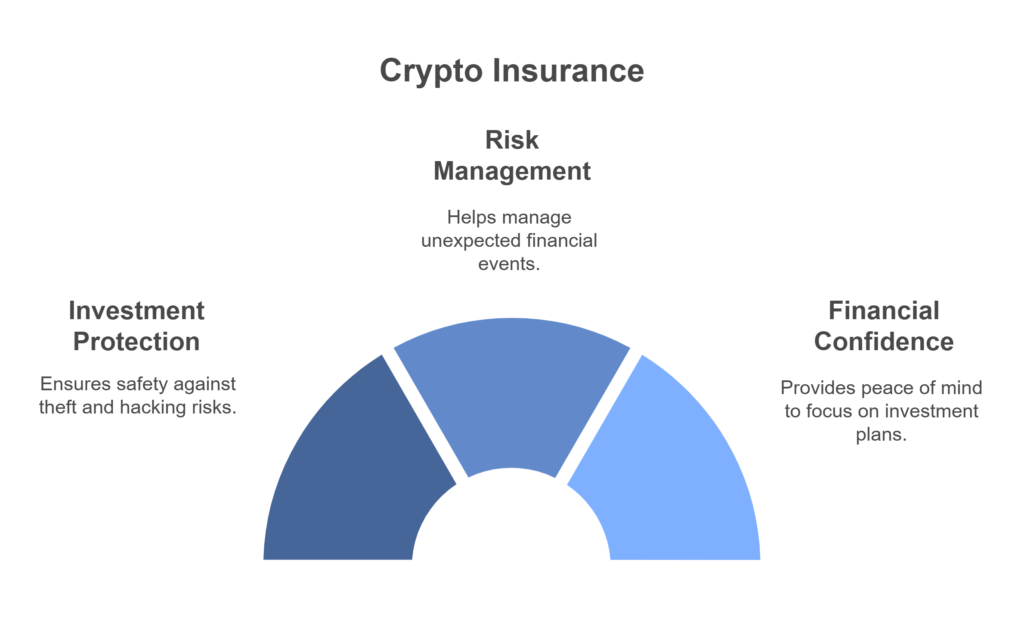
Cryptocurrency wallet insurance is specialist coverage that protects crypto holdings against theft, hacking, and loss of access — but it exists in only a handful of products, and most individual wallets are not insured. Fewer than 1% of crypto assets globally are insured. The main retail products are Breach Insurance’s Crypto Shield (theft cover for crypto held at qualified custodians like Coinbase, Gemini, Binance.US, and CoinList) and Coincover (Lloyd’s-backed cover for loss of access and theft). Self-custody wallets like MetaMask and most hardware wallets are largely uninsurable, no FDIC or SIPC equivalent exists for crypto, and scam losses are almost always excluded. Always read the specific policy before relying on it.
Cryptocurrency wallet insurance at a glance
| Detail | Cryptocurrency wallet insurance (2026) |
|---|---|
| Does it exist for individuals? | Yes, but with very limited options |
| Share of crypto that’s insured | Less than 1% globally |
| FDIC or SIPC equivalent? | No — none exists for crypto |
| Main retail product (US) | Breach Insurance’s Crypto Shield (up to $1M) |
| Alternative retail option | Coincover (Lloyd’s-backed, $10K–$100K tiers) |
| DeFi-specific coverage | Nexus Mutual (smart-contract failure cover) |
| Self-custody wallets (e.g. MetaMask) | Largely uninsurable as wallets |
| Hardware wallet investment cover | Generally not available as standalone insurance |
| Exchange “insurance” | Usually protects the exchange, not you |
| Scam losses (you sent funds) | Typically NOT covered |
| Institutional coverage | Much wider — Lloyd’s, Canopius, Breach Crypto Shield Pro, Relm |
Crypto insurance availability changes rapidly. Verify the specific product, custodian, and policy terms directly before relying on any coverage.
Are any crypto wallets insured?
The honest answer is “some, partially” — and the nuance matters.
Some crypto wallets are insured, but the coverage is narrow, and most individual users do not have personal wallet insurance. Three layers of “insurance” tend to get confused:
- The exchange’s own crime insurance — Coinbase, Gemini, and similar regulated US exchanges carry crime insurance that covers the exchange’s hot-wallet assets against theft from a breach of the exchange itself. This is the most common protection — but it covers the exchange’s assets and losses, not you personally as the wallet holder. If your individual account is hacked through credentials you exposed, this insurance typically does not pay you.
- Custodial protection funds — some exchanges run their own protection funds (Binance’s SAFU is the best-known) which act as an emergency reserve for users in the event of a major incident. This is a fund, not regulated insurance.
- Retail crypto wallet insurance you personally buy — this is what most searchers actually mean, and it is the smallest and newest layer. Genuinely regulated retail products exist (Breach’s Crypto Shield, Coincover), but they cover only specific custodians and specific loss types, and adoption remains very low.
So if you hold crypto on Coinbase, your account is touched by Coinbase’s crime insurance but not personally insured for you. To get a policy in your own name, you need to buy retail crypto wallet insurance separately — and only a handful of products exist.

Why traditional insurance doesn’t cover crypto
Your homeowners or renters policy will almost certainly not cover stolen or lost cryptocurrency. Three reasons explain why.
Crypto sits in a coverage gap. Most policies cap “money” coverage at small amounts (often a few hundred dollars), and even when crypto is treated as property, theft of intangible electronic assets sits outside what standard policies are written to address.
Cyber theft is excluded or sub-limited. Many homeowners policies either exclude losses from cyber attacks outright or apply low sub-limits that won’t meaningfully cover a wallet drain.
Traditional insurers lack the expertise. Underwriting crypto risk requires understanding hot versus cold wallets, private-key custody, smart-contract failure, and exchange counterparty risk. Most homeowners carriers simply don’t have that capability.
This is the gap that retail crypto insurance products were built for. They exist because conventional insurance genuinely doesn’t address crypto.
What does crypto wallet insurance actually cover?
Coverage varies by product, but retail policies generally cover a defined set of risks and explicitly exclude others.
Typically covered (in the products that exist):
- Theft of cryptocurrency from a qualified custodian following a security breach. Breach’s Crypto Shield is the most prominent example, covering theft from supported exchanges including Coinbase, Gemini, Binance.US, and CoinList, up to $1 million.
- Loss of access through forgotten or compromised credentials, in products like Coincover that focus on this risk.
- Social engineering attacks on the custodian that result in lost user assets.
- Employee theft or fraudulent transfer at insured custodians.
Typically NOT covered:
- Self-custody losses. If you hold crypto in a private wallet like MetaMask, Trust Wallet, Phantom, or your own hardware wallet, retail policies generally do not cover you. The current model requires assets to sit with a qualified custodian.
- Voluntary transfers to scammers. If you authorise a transaction to a scammer — romance scams, fake investment platforms, phishing-induced transfers — that is not theft in insurance terms, and these losses are almost never covered.
- Market losses. Insurance never covers your crypto going down in value.
- Losses from your own negligence, such as posting your seed phrase publicly.
- Smart contract failures, unless you specifically bought DeFi cover (see Nexus Mutual below).
- Custodian insolvency, in some cases. Read the terms carefully.
This list is the most important part of any policy: cryptocurrency wallet insurance is genuine, but it is much narrower than buyers often assume.
Cryptocurrency wallet insurance options that actually exist
The realistic list of retail crypto insurance products in 2026 is short. Most online guides cite large insurance brand names that don’t actually sell personal crypto policies. Here are the options retail users can genuinely buy.
Breach Insurance — Crypto Shield (US retail)
Breach Insurance’s Crypto Shield is widely cited as the first regulated insurance product specifically designed for retail crypto wallet holders. It covers theft of cryptocurrency while held in the custody of a qualified custodian — at launch, the supported list included Binance.US, Coinbase, Gemini, and CoinList — for limits up to $1 million. It is backed by reinsurance from Relm and was developed via the Boost Insurance white-label platform.
Crypto Shield is currently the most realistic retail option for a US individual who wants direct, in-their-own-name insurance on theft of crypto held at a supported exchange. Check current custodian eligibility and state availability before buying.
A separate product, Crypto Shield Pro, was launched by Breach in 2023 for institutional clients — it is A.M. Best A- rated via Relm and Trisura. Pro is institutional-only; do not confuse it with the retail Crypto Shield product.
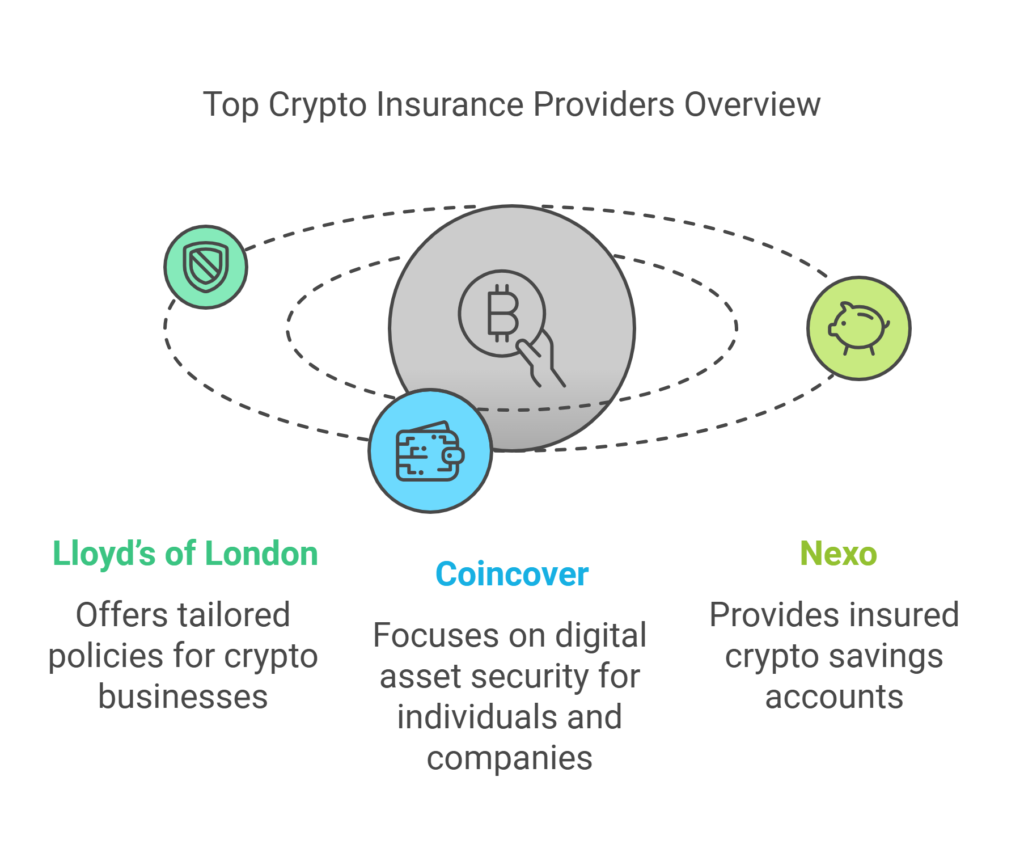
Coincover — wallet protection (UK and US)
Coincover is a UK-based provider offering crypto protection for individuals with assets at a range of wallets and exchanges. Coverage focuses on theft from a security breach and loss of access, with an insurance guarantee underwritten through Lloyd’s of London. Coincover has historically published concrete tiers — for example, a Standard plan around $159 per year for up to $10,000 of cover, and a Pro plan around $749 per year for up to $100,000 — with a “dynamic limit” feature that adjusts in line with cryptocurrency price movements.
Verify Coincover’s current supported wallets and exchanges before buying, as that list has evolved over time and several previously listed platforms no longer exist.
Nexus Mutual — DeFi-specific cover
Nexus Mutual is a decentralised insurance protocol that lets users buy cover for specific DeFi activities — for example, smart contract failure on a particular lending or staking protocol. Premiums are typically quoted as a percentage of the value insured, roughly 0.5% to 1% annually for popular protocols. This is technically not regulated insurance in the conventional sense — it is mutual cover within a DAO structure — and that distinction matters for legal recourse, so understand what you are buying before relying on it.
Lloyd’s of London — capacity, not a consumer product
You will see Lloyd’s referenced repeatedly in crypto insurance content, and it is important to be precise: Lloyd’s of London does not sell a personal “Lloyd’s crypto wallet insurance” policy direct to consumers. Lloyd’s syndicates provide the underwriting capacity behind many crypto insurance products — Coincover’s Lloyd’s backing is a real example — but a retail buyer interacts with the front-end product (Coincover, etc.), not with Lloyd’s directly.
Canopius and other specialty insurers — mostly institutional
Canopius, the specialty insurer, offers crypto insurance solutions but its focus is on businesses, custodians, exchanges, and institutional holders, not individual retail policies. The same is true of most other named “crypto insurers” in the market — Aon, Marsh, and similar broker-led capacity is largely for institutional clients.
Blockchain Deposit Insurance Corporation (BDIC)
BDIC is an attempt to build a deposit-insurance-style framework for crypto wallets, with stated approved wallets including Ledger Nano X, Trezor Model T, and others. As of recent public reporting, BDIC was working toward Lloyd’s coverholder status. It is worth knowing about as part of the landscape, but verify its current operational status and the specifics of any coverage before relying on it — this market segment is still emerging.
What about hardware wallets and cold storage?
Hardware wallets like Ledger and Trezor are widely promoted for security, and “hardware wallet insurance” is a common search. The position is straightforward but often misunderstood.
Hardware wallets are themselves a form of self-custody — you hold the private keys, not a custodian. The mainstream retail crypto insurance products covered above generally do not extend to assets in self-custody hardware wallets. They cover assets at qualified custodians instead.
Some hardware wallet manufacturers offer limited device-loss programmes or recovery services, but these replace the device or assist with recovery — they don’t reimburse the investment value of the crypto inside. If you store significant value in self-custody, your practical “insurance” is operational security: seed phrase management, multisig setups, geographically separated backups. There is no consumer policy that substitutes for those practices.
The more self-sovereign your setup, the less external insurance protects it. That is a real gap in the market, and it isn’t closing quickly.
Is crypto insurance worth it?
It depends on three things.
How much you hold and where. For a few hundred dollars on a regulated US exchange, the exchange’s own crime insurance gives some indirect protection (to the exchange), and a separate retail policy may not be economical. For tens or hundreds of thousands of dollars in custody, dedicated insurance becomes more rational.
Whether the policy actually covers your risk. If your biggest exposure is sending crypto to a scammer, no retail policy helps — those losses are excluded. If your biggest exposure is a custodian being breached, Breach Crypto Shield can. Match the policy to the actual risk.
The premium versus the limit. Coincover’s roughly $749 per year for $100,000 of cover is a concrete number to weigh against the value you hold and the alternative cost of self-custody protection.
For most retail users, the sensible setup is a combination: a regulated, well-insured custodian for everyday holdings, serious self-custody with strong operational security for long-term storage, and a dedicated insurance policy added only when the value at risk justifies the premium. Insurance is one layer of a security stack, not the whole stack.
A real scenario: two crypto holders, two outcomes
Picture Alex and Jordan, both US-based, both holding roughly $50,000 in crypto.
Alex keeps the entire $50,000 on a single exchange and assumes it is “insured” because the exchange has insurance. He has no personal policy, uses two-factor authentication via SMS, and shares his email password with several other accounts. When his email is compromised through a phishing attack, the attacker drains his exchange account through resets that look legitimate to the exchange. The exchange’s crime insurance covers the exchange, not Alex’s individual loss, and Alex has no recourse. His $50,000 is gone.
Jordan splits the $50,000 — $10,000 on a regulated exchange for active trading, $40,000 in a hardware wallet with a securely stored seed phrase. She uses a hardware-based authenticator (not SMS) for the exchange, a unique strong password, and she has bought Coincover Standard cover for the exchange portion. When her exchange account is targeted, the authenticator stops the attacker; the hardware wallet is never online to be drained. Jordan’s $50,000 is intact.
The lesson is not that insurance saved Jordan — her good operational security did. But the insurance gave her a real safety net for the portion in custody. Insurance is one layer of protection, not the whole stack. For crypto holders, the security choices you make every day matter more than any single policy.
How to secure your crypto — beyond insurance
Because insurance only covers a narrow slice of crypto risk, your daily security practices do most of the protective work.
Use unique, strong passwords stored in a reputable password manager — never reuse passwords across crypto accounts.
Use hardware-based two-factor authentication, such as a YubiKey or a TOTP authenticator app — not SMS. SMS-based 2FA can be defeated by SIM-swap attacks.
Keep large balances in cold storage. A reputable hardware wallet kept offline is the highest-security option for funds you do not need to trade daily.
Protect your seed phrase. Write it down, store it in a secure physical location, and never enter it into a website, email, or messaging app. Most large losses are not exchange hacks — they are seed phrases harvested by phishing.
Verify every address before sending. Always check the first and last several characters of a destination address, and consider sending a small test transaction first for large transfers.
Stay alert to phishing. Treat any unsolicited message about your crypto — even one that appears to come from a legitimate exchange — as suspicious. Use bookmarks to log into exchanges, not links.
Monitor your accounts. Set transaction alerts and review activity regularly. Quick detection often determines whether a loss can be limited.
Done well, these practices prevent the majority of crypto losses. Insurance is then a backstop for the residual risk you cannot fully control.
Conclusion
Cryptocurrency wallet insurance exists, but the market is much smaller and narrower than online guides imply. There is no FDIC or SIPC equivalent for crypto, and fewer than 1% of crypto assets globally are insured. For US individuals, the most realistic retail option is Breach Insurance’s Crypto Shield, which covers theft of crypto held at qualified custodians like Coinbase, Gemini, Binance.US, and CoinList. Coincover is a useful Lloyd’s-backed alternative with tiered consumer pricing. Nexus Mutual addresses DeFi smart-contract risk specifically. The large brand names you may see — Lloyd’s, Canopius, Aon, Marsh — sit mostly behind institutional coverage, not personal policies you can buy directly.
Two cautions matter most. Self-custody wallets are largely uninsurable in the current retail market, so if you hold in MetaMask, Trust Wallet, or your own hardware wallet, no policy meaningfully covers the investment value. And scam losses are almost universally excluded — if you send crypto to a scammer, insurance will not get it back, no matter how convincing the scam was.
So the practical guidance for any crypto holder: assume you are not insured by default; treat exchange “insurance” as protection for the exchange, not you; only consider buying a retail policy if the value at risk justifies the premium and the policy actually matches your risks; and remember that strong daily security — hardware 2FA, cold storage for large balances, vigilant phishing awareness — does far more protective work than any insurance product. Insurance is a useful layer, but in crypto it is the last layer, not the first.
FAQs
Are any crypto wallets insured?
Some are, but partially. Regulated US exchanges like Coinbase carry crime insurance that protects the exchange’s own assets, but this generally does not insure your individual account. Genuinely personal retail wallet insurance exists through products like Breach’s Crypto Shield and Coincover, but they cover only specific custodians and loss types.
Is cryptocurrency wallet insurance worth it?
It depends on how much you hold, where, and what your real risks are. For larger balances at qualified custodians, a regulated policy like Crypto Shield can be worthwhile. For smaller balances, or losses from scams (which are excluded), the value is more limited. Match the policy to your actual exposure.
Can you get your money back if you get scammed on crypto?
Usually no. If you authorised the transfer — common in romance scams, fake investment platforms, and phishing attacks — insurance generally treats that as a voluntary transaction, not theft, so it is excluded. Some law-enforcement recoveries occur in major cases, but the realistic baseline is that scam losses are not recoverable.
How much does crypto insurance cost?
Costs vary by product and limit. Coincover has published consumer tiers around $159 per year for about $10,000 of cover (Standard) and around $749 per year for about $100,000 (Pro). Nexus Mutual prices DeFi cover at roughly 0.5% to 1% of the value insured per year. Crypto Shield pricing depends on the custodian and limit. Confirm current pricing with each provider.
Does Coinbase insure my crypto?
Coinbase carries crime insurance that protects Coinbase’s hot-wallet assets against theft from a breach of Coinbase itself. This is not personal account insurance for you — if your individual account is compromised through credentials you exposed, the policy generally does not pay you. For personal cover, look at products like Breach Crypto Shield.
Is crypto insured by the FDIC?
No. The FDIC insures US bank deposits in regulated banks, and it does not cover cryptocurrency under any circumstance, including when crypto is held on an exchange. There is no government-backed deposit insurance for crypto in the US.
Is crypto covered by SIPC?
No. SIPC protects securities held at member brokerages in specific failure scenarios. It does not extend to cryptocurrency holdings, even those held at platforms that also offer securities trading.
What is the safest way to protect my crypto?
A layered approach: use a regulated, well-secured custodian for active trading balances, store the bulk in a hardware wallet kept offline with a securely backed-up seed phrase, use hardware-based 2FA, avoid SMS authentication, never share your seed phrase, and consider a retail insurance policy if the value at risk justifies the premium.
Does crypto insurance cover hacks?
Coverage of “hacks” depends on the specific loss. Theft from a covered custodian after the custodian is breached is generally covered under products like Breach Crypto Shield. Theft from your personal self-custody wallet — for example, a MetaMask drain via a malicious smart contract — is generally not covered by retail products.
Does crypto insurance cover lost passwords or seed phrases?
Coincover specifically focuses on loss-of-access scenarios for supported wallets and exchanges. Other retail products focus primarily on theft and may not cover access loss. Check the specific policy wording before assuming forgotten-credential coverage.
What does Lloyd’s of London cover for crypto?
Lloyd’s syndicates provide underwriting capacity behind a range of crypto insurance products, including Coincover. You generally cannot buy a “Lloyd’s crypto policy” direct as an individual — you buy the consumer product (Coincover, etc.), which is then backed in whole or part by Lloyd’s capacity.
Is there crypto insurance in the UK?
Yes. Coincover is a UK-based provider offering retail crypto protection with Lloyd’s of London-backed cover. UK regulation of crypto insurance is evolving, so confirm the current FCA position and the specific policy terms before buying.
Are hardware wallets like Ledger and Trezor insured?
Generally no — not for the investment value of the crypto inside. Hardware wallet manufacturers may offer device replacement or recovery services, but mainstream retail insurance products typically do not cover assets held in self-custody hardware wallets. Operational security is your protection.
What is the best crypto insurance company?
For US retail wallet holders, Breach Insurance’s Crypto Shield is the most prominent regulated option. Coincover is a strong choice in the UK and for loss-of-access focus. Nexus Mutual is the leading DeFi cover. The best provider depends on what you hold and where, so match the policy to your specific custodian and risk.
Can the IRS see your crypto wallet?
The IRS can request information from US-regulated exchanges and is increasingly able to trace blockchain transactions. Privacy is not insurance — this is a tax-compliance question, not a wallet-insurance one. Report crypto activity accurately and consult a tax professional.
Where do rich people store their crypto?
Larger holders typically use a combination of qualified institutional custodians (such as Coinbase Custody, Anchorage, Fidelity Digital Assets), multi-signature self-custody, and increasingly, dedicated institutional insurance like Breach Crypto Shield Pro or Lloyd’s-backed institutional coverage. The approach prioritises layered security and insurance, not a single product.
Should I put my XRP (or any crypto) in a cold wallet?
For amounts you do not need to trade daily, cold storage in a reputable hardware wallet is the highest-security option for any major crypto, including XRP. Hot wallets and exchanges are convenient but carry more risk. Balance is the key — small active balance hot, larger long-term balance cold.
Can institutions get better crypto insurance than individuals?
Yes — significantly. Institutional crypto insurance is a much more developed market, with broader limits, broader scope, and named-carrier underwriting from Lloyd’s, Canopius, Breach Crypto Shield Pro, Relm, and others. The retail market is genuinely thinner.
Does crypto insurance cover NFTs?
Some specialty policies do; most mainstream retail crypto wallet products focus on standard cryptocurrency rather than NFTs. NFT-specific insurance is an emerging niche. If you hold significant NFT value, look for a product that specifically lists NFT coverage in its terms.
Is decentralised insurance like Nexus Mutual the same as regulated insurance?
No. Nexus Mutual is a decentralised mutual cover protocol — it operates as a DAO, not a regulated insurer in the conventional sense. The cover it offers is real, but your legal recourse in a dispute differs from a traditional regulated insurance policy. Understand the structure before relying on it.
What should I do if my crypto is stolen?
Act quickly: contact your custodian (if applicable), document everything (transaction hashes, timestamps, communications), report to local law enforcement and to relevant agencies (FBI’s IC3 in the US), notify your insurance provider if you have a policy, and consider engaging a specialist blockchain investigations firm if the loss is significant. Recovery is rare but not impossible, and speed matters.
Sources
- Boost Insurance — “Crypto Wallet Insurance for Retail Wallet Holders” (Crypto Shield launch, qualified-custodian model, A-rated reinsurance via Relm): https://boostinsurance.com/product/crypto-wallet/
- Breach Insurance — “Crypto Shield Pro” institutional product launch (A.M. Best A- rating, institutional scope): https://www.breachinsured.com/
- Hunton Andrews Kurth — “Digital Asset Insurance Coverage Series, Part 5” (Coincover pricing tiers, Lloyd’s backing, supported wallets): https://www.hunton.com/hunton-insurance-recovery-blog/digital-asset-insurance-coverage-series-part-5-how-companies-and-consumers-with-cryptocurrency-risk-approach-insurance
- National Association of Insurance Commissioners (NAIC) — “Cryptocurrency” insurance topic page (industry overview, Coinbase crime insurance, Binance SAFU): https://content.naic.org/insurance-topics/cryptocurrency
- Canopius — “Digital Asset & Cryptocurrency Insurance Solutions” (institutional and custodian coverage): https://www.canopius.com/insurance/cryptocurrency-insurance/
- Coincover — official product information (consumer plans, Lloyd’s-backed guarantee, dynamic limit): https://www.coincover.com
- Nexus Mutual — official protocol documentation (DeFi cover, smart-contract failure, premium model): https://nexusmutual.io
- Blockchain Deposit Insurance Corporation — official information (approved wallets, Lloyd’s coverholder application): https://bdicinsurance.com/
By Shahinuzzaman — full-time writer with 16 years in the banking and insurance industry, covering consumer insurance and how emerging insurance products work for everyday users. He researches every topic from primary sources and accepts no payment from the companies he covers. Found an outdated detail or have a correction? Reach out — this page gets updated whenever a reader sends better information.
Last Check: May 2026.